

More news on this day
A joint statement by Saudi Arabia and several other Muslim-majority nations has condemned the rare closure of Jerusalem’s Al-Aqsa Mosque to Muslim worshippers during this year’s holy month of Ramadan, a move described in public reporting as an unprecedented escalation with far-reaching implications for religious travel to the city.
Get the latest news straight to your inbox!
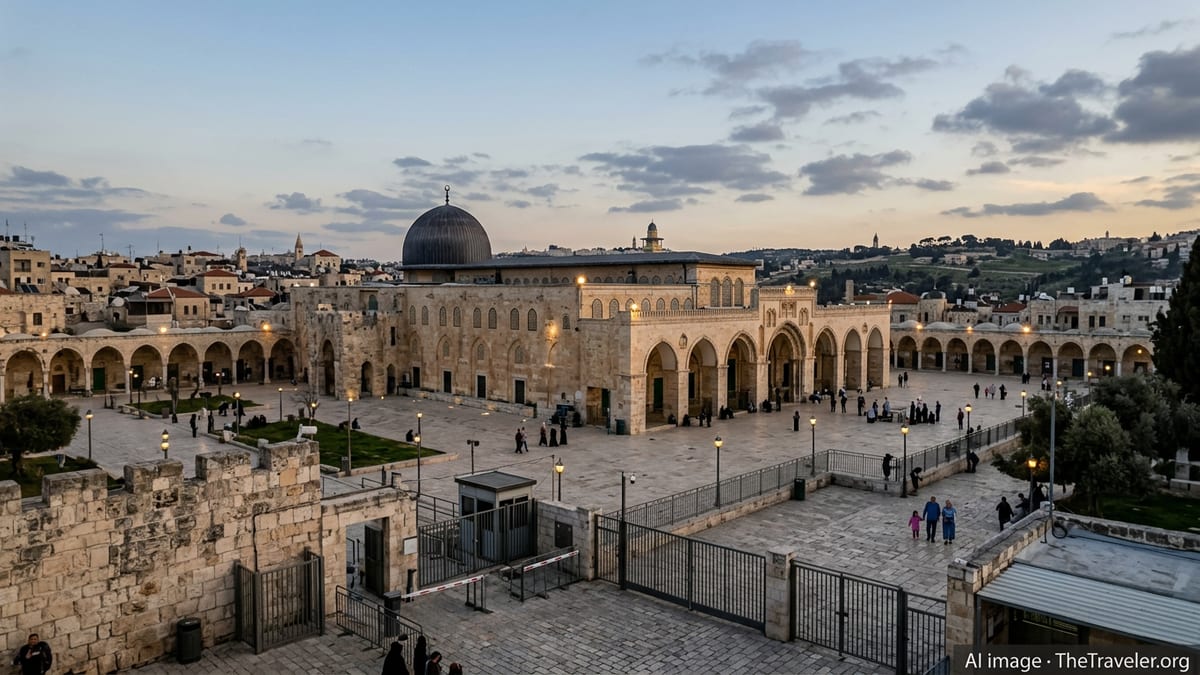
What Is Happening at Al-Aqsa This Ramadan
According to recent regional diplomatic statements and media coverage, Israeli authorities have imposed extensive closures and access restrictions at the gates of Al-Aqsa Mosque and the surrounding Al-Haram Al-Sharif compound in occupied East Jerusalem during key days of Ramadan 2026. Reports indicate that Palestinians have faced blocked entry for some daily and nightly prayers traditionally considered central to the Ramadan experience, including large evening gatherings.
Commentary from Palestinian religious and civic bodies cited in regional outlets characterizes the move as a serious infringement on freedom of worship and the long-standing status quo governing access to the site. Observers note that while clashes, checkpoints and age-based limits have periodically affected access in the past, the degree of closure during multiple Ramadan days this year is being treated as a harsher step than in many previous seasons.
The restrictions come at a moment when Jerusalem is normally preparing for peak Ramadan nights, with tens of thousands of worshippers from the city, the occupied Palestinian territories and abroad converging on the Old City for prayers, communal meals and religious study. Travel planners say that under usual conditions, this period is one of the most significant religious tourism windows of the year for the city.
Saudi Arabia and Partner States Issue Joint Condemnation
On 11 March 2026, a coordinated statement was released by the foreign ministers of Saudi Arabia, Türkiye, Qatar, Jordan, the United Arab Emirates, Indonesia, Pakistan and Egypt, publicly condemning what they described as the continued closure of Al-Aqsa’s gates and restrictions on Muslim worshippers during Ramadan. Publicly available government documents present the move as a united diplomatic response from key Arab and Muslim-majority states.
The joint text denounces the Israeli measures as a violation of international law and of the historical and legal status of Jerusalem’s Islamic holy sites. It calls for an immediate end to the closures, removal of access barriers around the Old City, and respect for Muslims’ right to worship at Al-Aqsa during Ramadan without obstruction, reflecting language consistent with earlier regional statements on Jerusalem.
Jordan’s long-recognized custodial role over Islamic and Christian holy sites in Jerusalem is also referenced in regional reporting on the statement, with participating states reiterating support for the Hashemite custodianship framework. The political message, analysts say, is that the closures are not viewed simply as a security measure, but as a challenge to an established regional and religious arrangement that many governments regard as central to stability around the shrine.
In parallel, separate media coverage from Iran, Malaysia and other Muslim-majority countries highlights additional condemnations and calls for broader international pressure to reverse the restrictions. While not all of these states are listed in the same formal joint document, their inclusion in the wider public outcry signals a broad-based convergence of concern across Middle Eastern and Asian Muslim communities.
Why Al-Aqsa’s Closure Matters for Religious Tourism
Al-Aqsa Mosque and the wider Al-Haram Al-Sharif compound are among the most important destinations in the Muslim world for religious tourism outside the pilgrimage sites of Makkah and Madinah. During Ramadan, particularly in its final ten nights, the compound typically fills with worshippers who travel from across the region and beyond to experience evening prayers, spiritual retreats and community gatherings in the Old City.
Travel sector observers note that these visits are more than devotional journeys; they support a network of small hotels, guesthouses, markets, guides and food vendors in and around the Muslim Quarter of Jerusalem’s Old City. When access to Al-Aqsa is curtailed, international visitors often reconsider or cancel trips, and local Palestinian residents may be unable to reach the site from other parts of the West Bank, further reducing the flow of people.
The 2026 closures arrive against a backdrop of already fragile tourism linked to the broader conflict environment. Industry data in recent years has shown that even short periods of heightened tension can sharply reduce arrivals to Jerusalem’s Muslim and Christian holy places. Travel agents serving pilgrims from Southeast Asia and the Gulf report that uncertainty about whether worshippers will actually be able to enter Al-Aqsa is becoming a key concern for group organizers and individual travelers.
For faith-based travelers from countries such as Indonesia, Malaysia and Turkey, combining visits to Jerusalem with trips to Saudi Arabia’s holy sites has become an increasingly popular itinerary. Restrictions at Al-Aqsa during Ramadan disrupt these plans, creating logistical and emotional challenges for visitors who see the journey as a once-in-a-lifetime spiritual milestone.
How Pilgrim-Sending Countries Are Responding
In the wake of the joint condemnation, governments that regularly send large numbers of religious tourists to Jerusalem are reassessing how to advise their citizens. Publicly available information from Southeast Asian and Middle Eastern media indicates that some travel agencies are adjusting marketing materials, placing stronger caveats around itineraries involving Al-Aqsa, and warning customers that access to the compound cannot be guaranteed during the current situation.
Officials in these countries have not, in most cases, formally banned travel to Jerusalem, but the tenor of public statements and press briefings emphasizes caution. Prospective pilgrims are being encouraged to monitor updates from consular services, airlines and tour operators regarding security developments, entry requirements and conditions on the ground. This environment of uncertainty is likely to lead some travelers to delay or redirect their religious trips to other destinations.
At the same time, civil society organizations and religious institutions in several countries are using public events and media platforms to highlight the situation at Al-Aqsa and encourage symbolic solidarity activities at home. For many worshippers who cannot travel, community iftars, fundraising for humanitarian efforts and educational programs about Jerusalem’s history have become alternative ways of marking their connection to the site.
Some analysts predict that the current crisis may accelerate a trend toward “multi-center” religious tourism within the Muslim world, where travelers combine visits to domestic or regional shrines and heritage mosques in lieu of, or in addition to, Jerusalem. For Saudi Arabia, which has been expanding its own religious and cultural tourism infrastructure, this could mean both a moral stake in defending access to Al-Aqsa and a practical role in absorbing redirected pilgrim flows.
What Travelers Should Know Right Now
For travelers currently planning, or who have already booked, trips that include Al-Aqsa during Ramadan or the weeks immediately after, the most important factor is the fluidity of the situation on the ground. Access rules to the Old City’s holy sites can change on short notice in response to evolving security and political dynamics.
Industry guidance suggests maintaining flexible itineraries, choosing refundable or changeable tickets where possible, and staying in close contact with local tour operators who can provide same-day updates on entry routes, checkpoint conditions and prayer times. Travelers are also advised to understand that periods of complete closure may alternate with partial openings, age restrictions or time-limited access windows.
Travelers who decide to postpone their visit to Jerusalem may still find opportunities to engage in meaningful religious journeys this year. Many agencies are offering alternative itineraries focused on Saudi Arabia’s holy cities, the historic mosques of Türkiye, and Islamic heritage routes across Jordan, Egypt and other regional destinations. These trips are being framed as ways to preserve the spirit of religious travel while conditions around Al-Aqsa remain uncertain.
For now, the joint diplomatic push by Saudi Arabia, Qatar, Jordan, the United Arab Emirates, Iran, Indonesia, Malaysia, Türkiye and other states keeps international attention focused on the status of Al-Aqsa during Ramadan. Whether these efforts will result in eased restrictions and a restored flow of worshippers and religious tourists to the compound in the coming days remains a central question for travelers and the wider Muslim world.