

The Middle East is undergoing a quiet tourism transformation, and two countries sit at the heart of this shift: Saudi Arabia and Jordan. Both offer desert drama, layered history, and warm hospitality, yet they deliver very different experiences once you land. From conservative cities and futuristic mega‑projects in Saudi Arabia to Jordan’s compact mix of Petra, Wadi Rum, and the Dead Sea, understanding how these neighbors compare will help you match the right destination to your travel style.
Cultural Atmosphere and Everyday Etiquette
Saudi Arabia and Jordan share an Arab and largely Muslim cultural foundation, but they feel quite different on the ground. Saudi Arabia is undergoing rapid social and economic reform under Vision 2030, yet public life still feels more conservative than in Jordan. Daily rhythms in Saudi cities such as Riyadh and Jeddah are shaped by prayer times, gender‑segregated spaces still exist in some settings, and dress tends to be more modest, especially outside major urban centers. In Jordan, Amman and tourist hubs like Petra, Aqaba, and the Dead Sea feel somewhat more relaxed, with mixed‑gender cafes and a visible international presence, though modest clothing is still appreciated.
In terms of etiquette, both societies place a premium on hospitality, respect for elders, and discretion in public affection. Visitors in Saudi Arabia are now less likely to encounter strict enforcement of older social norms, but conservative expectations remain, especially in smaller cities and rural areas. Jordanian hosts, particularly in Bedouin communities around Wadi Rum or in smaller towns, may invite you for tea or coffee, and declining too quickly can appear abrupt. In both countries, alcohol is restricted, but the rules differ. Saudi Arabia currently prohibits alcohol for visitors, while Jordan permits it in hotels, some restaurants, and licensed venues, which shapes nightlife and dining options.
Religion is a visible part of daily life in both destinations. Saudi Arabia is home to Islam’s two holiest cities, Mecca and Medina, which non‑Muslims cannot enter, yet their importance resonates in every corner of the kingdom. Many Muslim travelers time visits to perform Umrah in Mecca, a pilgrimage now possible on a standard tourist e‑visa outside the peak Hajj period, reflecting Saudi efforts to expand religious tourism. Jordan, by contrast, offers important biblical and early Christian sites, such as Mount Nebo and Bethany Beyond the Jordan, alongside early Islamic heritage, making it a natural fit for interfaith pilgrimage itineraries.
Landscapes: Desert Drama, Seas, and Mountains
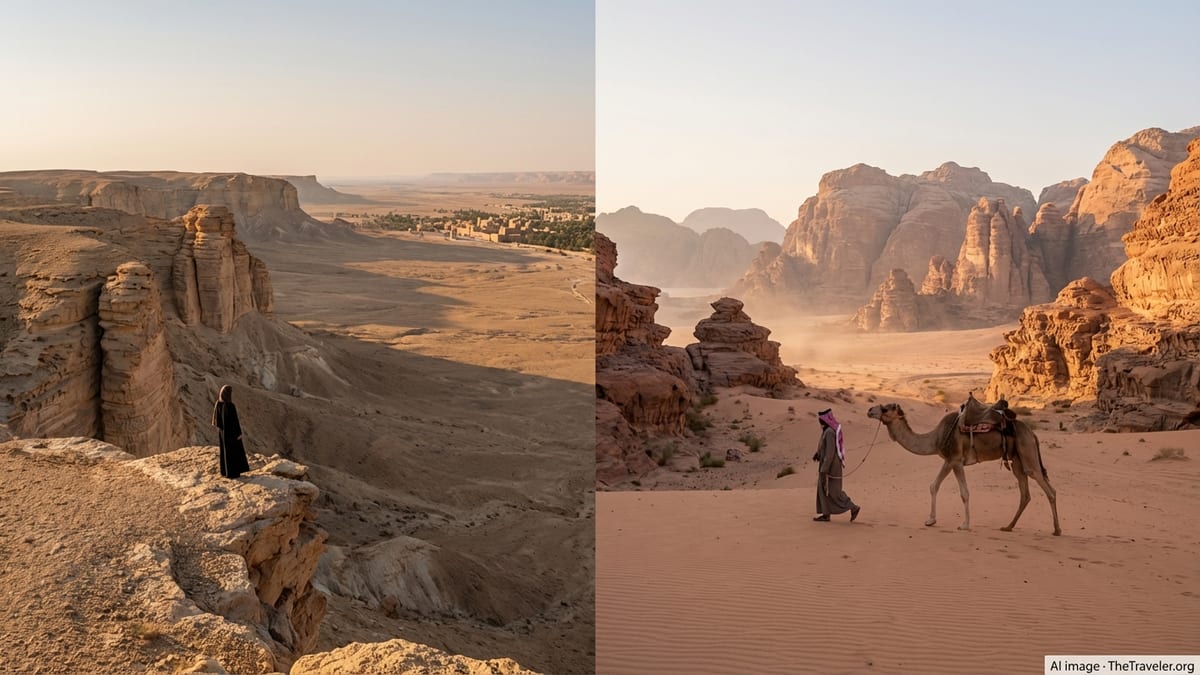
Both countries are dominated by desert, but their landscapes unfold in distinct ways. Saudi Arabia covers most of the Arabian Peninsula and offers vast interior deserts, volcanic fields, and long Red Sea and Arabian Gulf coastlines. Around Riyadh, travelers find sculpted escarpments and cliff edges such as the so‑called Edge of the World, while to the northwest lies AlUla, a monumental sandstone canyon and oasis region with Nabataean tombs, palm groves, and craggy rock formations. Along the Red Sea, Jeddah provides urban seafront life, while emerging projects and private‑island resorts promise coral‑rich snorkeling and diving in relatively pristine waters.
Jordan’s landscapes are more compact but remarkably varied over short distances. Within a few days you can wander rose‑red canyons at Petra, sleep under the stars in Wadi Rum’s iconic red desert, float on the Dead Sea, and hike forested highlands in the north. Wadi Rum, a protected area and UNESCO World Heritage site of sandstone mountains and dune valleys, often appears on “Mars on Earth” film sets and draws travelers for jeep tours, rock climbing, and stargazing. Petra’s narrow Siq, carved tomb facades, and high viewpoints create a more intimate sense of scale compared with Saudi Arabia’s more open desert plateaus.
Both countries are also investing in mountain tourism, but Saudi Arabia is doing so at a far larger scale. In the cool southwest, the Asir highlands and projects such as Soudah Peaks aim to turn mist‑covered juniper forests and the kingdom’s highest peak into summer retreats. In the northwest, new mountain destinations like Trojena within the wider Neom region have been announced as year‑round outdoor hubs with hiking and cooler temperatures. Jordan offers gentler but rewarding highland escapes, from the green hills of Ajloun to multi‑day treks along the Jordan Trail, with spring bringing wildflowers and cooler hiking conditions.
Heritage, History, and UNESCO Highlights
For many visitors, the central question is where to experience the region’s deep history most vividly. Jordan has a head start in international awareness thanks to Petra’s status as both a UNESCO World Heritage site and one of the New Seven Wonders of the World. Petra alone can occupy travelers for two or three days, with trails up to the Monastery and the High Place of Sacrifice, and evolving experiences such as night visits and eco‑trails that spread visitors beyond the main canyon. Wadi Rum, Jerash’s Roman ruins, Crusader castles like Karak, and early Christian sites complete a classic Jordan circuit that feels dense with recognizable historical eras.
Saudi Arabia, by contrast, is emerging from decades of limited tourism to reveal its own under‑appreciated archaeological wealth. AlUla’s Hegra site, with its monumental rock‑cut tombs from the Nabataean kingdom, invites comparison with Petra yet feels quieter and more spread out amid desert and oasis landscapes. Diriyah on the outskirts of Riyadh showcases the mud‑brick architecture and heritage of the first Saudi state and is being developed as a major cultural district. Historic Jeddah, or Al‑Balad, recently enhanced with projects such as the Red Sea Museum in a restored customs building, gives a sense of the city’s role as a gateway for pilgrims and traders along the Red Sea.
UNESCO recognition is growing on both sides of the border. Saudi Arabia now counts multiple World Heritage listings, including rock art sites, oases, and cultural landscapes, each woven into the national push to reveal a more nuanced past beyond oil wealth. Jordan, conversely, has leveraged Petra and Wadi Rum as global calling cards, but also highlights less famous World Heritage sites and tentative listings to encourage travelers to go beyond the greatest hits. For a first‑time visitor who wants one or two blockbuster sites and a compact itinerary, Jordan usually feels more straightforward. For repeat Middle East travelers, Saudi Arabia’s less‑visited heritage areas can feel like a frontier of discovery.
Travel Style: Independent, Guided, or Luxury‑First
Jordan has long catered to independent travelers, backpackers, and small groups, and that experience shows. The main tourist circuit linking Amman, Petra, Wadi Rum, and the Dead Sea is well served by established hotels, local guesthouses, and Bedouin camps. Rental cars are widely used, and public or shared transportation fills many gaps, although schedules can be informal outside major hubs. English is widely spoken in tourism settings, and it is relatively easy to string together a mix of mid‑range stays, local eateries, and occasional splurges without using a tour operator.
Saudi Arabia is moving fast toward greater accessibility, but it still favors somewhat more structured travel, especially outside major cities. In Riyadh, Jeddah, and Dammam or Khobar, international‑brand hotels and serviced apartments dominate, and the service culture is oriented toward business and high‑end leisure travelers. In AlUla and along the Red Sea, many accommodations are either luxury resorts or carefully curated camps or boutique properties tied to broader destination projects. Self‑drive is possible and increasingly popular among experienced travelers, but longer distances, sparse public transport in some regions, and limited backpacker infrastructure mean that organized tours and private drivers remain common, particularly for first‑time visitors.
On the luxury end, Saudi Arabia is investing heavily in high‑design resorts, desert retreats, and island properties that aim squarely at the upscale market. Red Sea islands, designer desert camps in AlUla, and future coastal and mountain resorts promise polished experiences with a focus on wellness, privacy, and curated excursions. Jordan has its own growing glamping and eco‑lodge scene, particularly around Wadi Rum and Dana Biosphere Reserve, but it still offers more options for budget and mid‑range visitors than Saudi Arabia in most regions. For travelers who enjoy mixing rustic experiences with a few nights of comfort, Jordan remains easier to tailor without a large budget.
Costs, Visas, and Practical Considerations
Costs in both countries can vary widely, but certain patterns emerge. In Jordan, accommodation and food range from affordable guesthouses and street snacks to upscale properties and fine dining, with plenty of mid‑range options. Entry fees to flagship sites such as Petra are significant, yet national passes that bundle Petra, other heritage locations, and visa fees can offer good value for travelers planning multi‑day stays. Daily budgets outside of accommodation can remain manageable if you favor local restaurants and shared transport, while private tours and luxury camps add substantially to overall costs.
Saudi Arabia often feels more expensive, particularly when focusing on new or remote destinations tied to major development projects. City hotels, especially in Riyadh and Jeddah, can be comparable to large metropolitan centers elsewhere, and excursions to desert or coastal projects often rely on private transfers or guided experiences. On the other hand, everyday costs such as casual dining and domestic flights can be reasonable, especially when booked ahead. Religious travel for Umrah can be managed on a range of budgets, but premium packages and peak dates increase prices considerably.
Visas are a crucial part of the comparison and continue to evolve. Jordan offers visa on arrival or relatively straightforward entry for many nationalities, and tourism authorities promote bundled passes that include visa fees for visitors staying multiple nights. Saudi Arabia has expanded its electronic visa system for tourism and individual Umrah, opening doors previously limited to business, family, or pilgrimage travel. Eligibility, fees, and processing times can change, so travelers should always consult official government sources before booking. Regional developments can also affect airspace, flight schedules, and advisories, especially for Jordan, which sits close to several conflict zones, so checking current guidance just before departure is essential.
Safety, Social Change, and Responsible Tourism
Perceptions of safety in the region are often shaped by headlines, but on the ground experiences can be more nuanced. Historically, both Saudi Arabia and Jordan have been considered relatively stable compared with some neighbors, with low rates of petty crime in tourist areas and strong state security presence. However, evolving regional tensions can influence travel advisories, particularly for Jordan, which borders multiple conflict‑affected countries. Governments may periodically update guidance, restrict airspace, or caution against non‑essential travel to certain areas, so it is wise to monitor official advisories from your home country and maintain flexible plans.
Within each country, social change is reshaping how travelers interact with locals. In Saudi Arabia, loosening cultural restrictions, new entertainment seasons, and high‑profile events signal a desire to showcase a more open image. Concerts, festivals, and sports events rub shoulders with traditional souqs and conservative customs. In Jordan, younger generations in Amman and Aqaba embrace cafe culture, art, and outdoor sports, while many rural communities retain traditional rhythms linked to agriculture and pastoral life. Visitors who approach both societies with curiosity, respect, and sensitivity to religious and cultural norms are often rewarded with meaningful exchanges.
Responsible tourism questions are increasingly central in both destinations. In Jordan, concerns focus on overtourism at Petra during peak years, the environmental impact of desert camps, and water scarcity. Initiatives promoting community‑based tourism, trail networks, and lower‑impact experiences aim to spread visitor spending and reduce pressure on single sites. In Saudi Arabia, mega‑projects along fragile coasts and in mountain ecosystems raise questions about sustainability, local benefit, and cultural continuity. Many projects advertise eco‑credentials and conservation goals, yet their long‑term impact is still unfolding, so travelers who value sustainability may want to seek out operators and accommodations with clear environmental and community commitments.
Who Each Destination Suits Best
Choosing between Saudi Arabia and Jordan often comes down to your travel personality and priorities. Jordan suits first‑time visitors to the region who want an accessible, highlight‑rich itinerary. If your dream is to walk through the Siq to the Treasury at Petra, camp under the stars in Wadi Rum, and float on the Dead Sea all within a week or ten days, Jordan delivers that narrative cleanly. Independent travelers, photographers, and hikers will find plenty of infrastructure already in place, and families can craft manageable routes that balance cultural sightseeing with downtime at resorts or in the desert.
Saudi Arabia, on the other hand, appeals strongly to travelers drawn to the feeling of being ahead of the curve. Much of the country still sees relatively few international leisure visitors compared with Jordan, and exploring beyond the main gateways can feel like entering a destination in transition. Archaeology lovers may enjoy seeing pre‑Islamic sites that were not widely accessible for decades, while urban travelers can observe a society modernizing at speed. Luxury‑focused travelers, particularly those interested in new desert or island resorts and curated cultural districts, will also find Saudi Arabia positioning itself as a high‑end destination.
Religious motivation can be another decisive factor. Muslim travelers who wish to combine Umrah in Mecca with broader sightseeing in Saudi Arabia will naturally favor the kingdom, using Jeddah or other cities as bases. Pilgrims or faith‑minded travelers from Christian backgrounds may gravitate to Jordan to visit biblical sites, while still enjoying nearby Petra and Wadi Rum as iconic landscapes. In practice, some travelers with more time and budget choose to combine both countries in a single trip, especially given their geographic proximity, but it is usually better to give each destination its own dedicated focus than to rush through.
The Takeaway
Saudi Arabia and Jordan share a desert horizon and deep cultural roots, yet they invite very different styles of travel. Jordan feels like a finely tuned classic, with Petra and Wadi Rum at its core, supported by a mature tourism network that makes independent exploration straightforward. It is compact, varied, and well suited to travelers who want big experiences in a relatively short stay, across a range of budgets.
Saudi Arabia, by contrast, feels like a story still being written. Vision 2030, new heritage restorations, and ambitious coastal and mountain projects are reshaping the country’s tourism map. For now, it remains more oriented toward structured, often higher‑end travel, with vast distances and powerful contrasts between traditional conservatism and rapid modernization. Visitors who appreciate frontier destinations, are comfortable navigating evolving logistics, and value the chance to see a society in transition will find Saudi Arabia compelling.
Ultimately, there is no single winner between the two. If you are planning your first foray into this part of the Middle East and want something intuitive, immersive, and logistically simple, Jordan likely comes first. If you are returning to the region, seeking less‑visited heritage and cutting‑edge developments, or combining religious pilgrimage with broader exploration, Saudi Arabia may rise to the top of your list. In both cases, approaching your journey with cultural sensitivity, up‑to‑date information, and a willingness to adapt will help you experience the best of these evolving destinations.
FAQ
Q1. Which country is better for a first‑time visitor to the Middle East, Saudi Arabia or Jordan?
For most first‑time visitors focused on classic sights and easy logistics, Jordan is generally more straightforward, with a compact circuit linking Petra, Wadi Rum, Amman, and the Dead Sea.
Q2. Is Saudi Arabia or Jordan more conservative for travelers?
Saudi Arabia is typically more conservative, especially outside major cities, while Jordan is modest but somewhat more relaxed in tourist areas such as Amman, Petra, and Aqaba.
Q3. Which destination is more budget‑friendly?
Jordan usually offers more budget and mid‑range choices in accommodation and dining, while Saudi Arabia currently skews higher‑end in many of its new tourism projects.
Q4. Can I visit both Saudi Arabia and Jordan in one trip?
Yes, it is possible to combine both, but each has enough to fill a full itinerary, so many travelers prefer to focus on one country per trip unless they have several weeks.
Q5. Where will I find the most dramatic desert landscapes?
Both countries have spectacular deserts. Wadi Rum in Jordan is famous for its red sand and cliffs, while Saudi Arabia offers vast plateaus, dune seas, and emerging desert destinations around AlUla.
Q6. How different are the cultural experiences in Saudi Arabia and Jordan?
Both share Arab and Islamic heritage, but Saudi Arabia highlights rapid social change and large‑scale projects, while Jordan emphasizes intimate, community‑based encounters and long‑established sites.
Q7. Is it easier to travel independently in Saudi Arabia or Jordan?
Jordan is generally easier for independent travel, with more public transport options and a long‑standing tourism ecosystem. Saudi Arabia is improving but still often favors private drivers or organized tours.
Q8. Which country is better for religious travel?
Muslim pilgrims often choose Saudi Arabia to perform Umrah and then add sightseeing, while visitors interested in biblical history tend to prioritize Jordan’s Christian and early religious sites.
Q9. Are there safety concerns when visiting either country?
Conditions can change, particularly due to regional tensions, so travelers should always consult up‑to‑date government advisories and follow local guidance before and during their trip.
Q10. If I love luxury resorts, should I choose Saudi Arabia or Jordan?
Both offer upscale stays, but Saudi Arabia is investing heavily in new high‑design resorts along its coasts, deserts, and mountains, making it especially appealing to luxury‑oriented travelers.