

More news on this day
Travel across Saudi Arabia has been heavily disrupted after a new wave of cancellations and delays involving at least 38 flights operated by Gulf Air, Emirates, KLM, British Airways and Air France, affecting major hubs in Riyadh, Jeddah, Dammam and Medina as regional airspace instability continues to reshape airline schedules.
Get the latest news straight to your inbox!
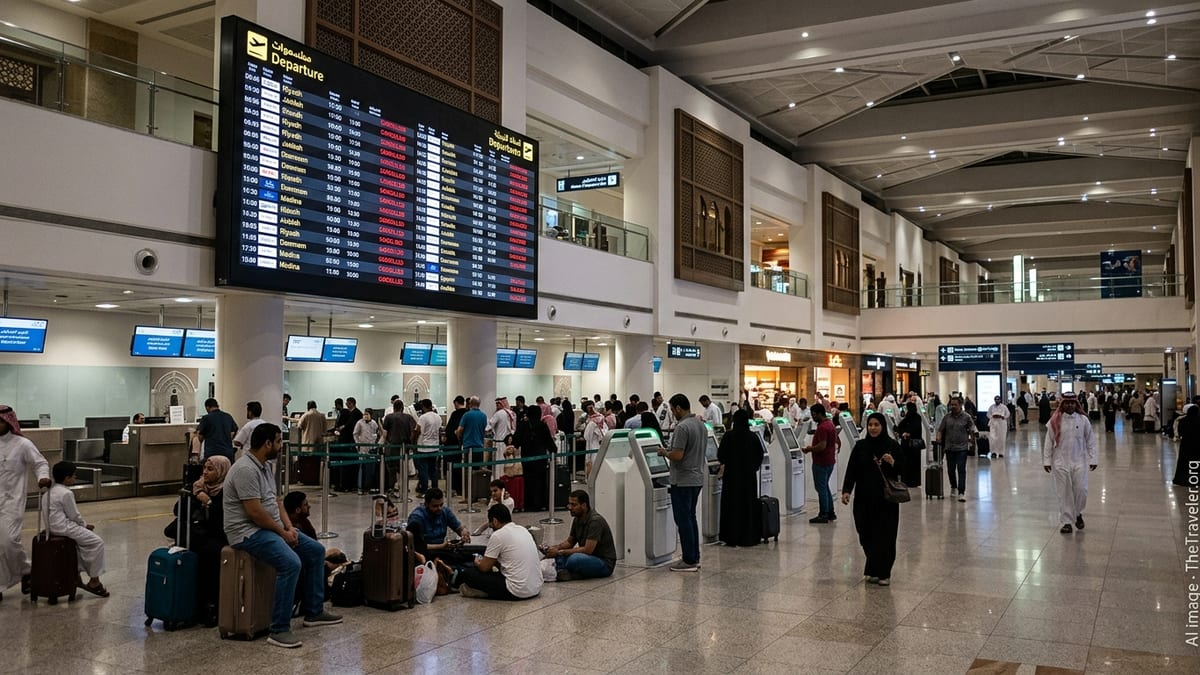
Wave of Cancellations Ripples Across Key Saudi Gateways
Reports from aviation tracking platforms and regional media coverage indicate that the latest round of operational cuts has centered on routes linking Saudi Arabia’s main airports with Europe and the wider Gulf. At least 38 flights involving Gulf Air, Emirates, KLM, British Airways and Air France have been removed from schedules or subject to extended disruption over recent days, compounding an already fragile travel environment.
Riyadh’s King Khalid International Airport, Jeddah’s King Abdulaziz International Airport, Dammam’s King Fahd International Airport and Prince Mohammed bin Abdulaziz International Airport in Medina have all seen international departures and arrivals trimmed or retimed. Travellers bound for London, Paris, Amsterdam, Dubai, Manama and other regional hubs have reported last‑minute cancellations, repeated rebookings and prolonged time on the ground.
The shake‑up follows weeks of rolling schedule changes across the Gulf as airlines continually reassess safety, routing options and crew availability in response to conflict‑related airspace closures. Publicly available data shows that carriers are selectively prioritising certain trunk routes while pausing or thinning frequencies on others, leaving passengers in Saudi Arabia facing unpredictable itineraries even when airports themselves remain open.
Gulf Air and Emirates Adjust Operations Through Saudi Airports
Gulf Air, the Bahrain‑based flag carrier, has played a prominent role in the evolving pattern of Saudi flight disruption. According to published travel advisories and airline communications summarised by aviation forums, the airline has rerouted portions of its network through Dammam to maintain connectivity with Bahrain and beyond, while also cancelling a series of rotations when schedules could not be safely or reliably maintained.
Passengers transiting between Jeddah or Riyadh and European destinations via Bahrain have reported missed connections and overnight delays after Gulf Air segments were dropped or heavily retimed. In some cases, travellers have been advised to reposition by road between Saudi cities or to use alternative departure points when local flight options became oversubscribed or unavailable.
Emirates has similarly trimmed its Saudi operations, with multiple services touching Riyadh, Jeddah, Dammam and Medina removed from daily schedules as the carrier concentrates on a mix of evacuation‑style and limited commercial flying from its Dubai hub. Travel community postings and flight status records show that some Emirates rotations to Saudi Arabia have operated as planned while others have been cancelled at short notice, leading to significant day‑of‑travel uncertainty for passengers.
European Carriers Scale Back Saudi and Gulf Links
European airlines have also pulled back from the region, further constraining options for travellers in Saudi Arabia. Publicly available information compiled from airline notices and security briefings indicates that KLM, British Airways and Air France have cancelled or suspended a range of flights touching the Gulf, including services routed through or over Saudi airspace.
KLM has halted operations on certain Amsterdam links to the Gulf, including services that would ordinarily serve Saudi destinations or pass near Saudi territory, as it continues to avoid large swathes of regional airspace. British Airways and Air France have reduced flights to several Gulf hubs and key Middle Eastern cities, which in turn has cut available seats and connections into Riyadh and Jeddah, and contributed to the tally of at least 38 affected flights involving these European brands.
The combined effect of Gulf and European schedule changes is particularly visible on core business and pilgrimage corridors between Saudi Arabia and Western Europe. Travellers who might previously have relied on through itineraries with a single change in Dubai, Manama, Doha or a European hub are now encountering multi‑stop routings, extended layovers or the absence of any workable same‑day option.
Riyadh, Jeddah, Dammam and Medina Face Uneven Disruptions
The impact of the cancellations is not uniform across Saudi Arabia. Riyadh, as a political and commercial centre, continues to see comparatively higher traffic levels, but has still experienced noticeable gaps in its usual slate of international departures as foreign carriers thin their schedules. Some long‑haul flights are operating at reduced frequency, leaving fewer alternatives when a particular service is withdrawn.
Jeddah, a key gateway for both business travellers and religious visitors to nearby Mecca, has endured repeated last‑minute changes, particularly on connecting itineraries involving Gulf Air and Emirates. Reports from travellers describe flights being cancelled after initial rescheduling attempts, as crews and aircraft struggle to rotate through constrained regional corridors.
Dammam’s King Fahd International Airport, a strategic outlet for the Eastern Province and a vital link to Bahrain, has emerged as both a pressure point and a partial relief valve. While some flights to and from Dammam have been cancelled, other carriers have used the airport to stage limited services, occasionally diverting passengers who might otherwise have travelled through closed or congested hubs elsewhere in the Gulf.
In Medina, where international traffic is heavily oriented around religious tourism, even a smaller number of cancellations has had an outsized effect. Emirates and other Gulf carriers have reduced frequencies into the city, forcing some passengers to reroute via Jeddah or Riyadh, or to defer travel altogether when suitable alternatives are not available within their visa or tour package windows.
Passengers Navigate Rebookings, Refunds and Longer Journeys
For travellers, the operational picture has translated into a patchwork of delays, cancellations and complicated rebooking efforts. Publicly shared experiences on travel forums describe passengers receiving multiple schedule changes for the same journey, standing in long lines at airport counters, and struggling to contact airline call centres during peak disruption periods.
Airlines affected by the current wave of cancellations, including Gulf Air, Emirates, KLM, British Airways and Air France, have generally published rebooking and waiver policies that allow passengers to shift travel dates or alter routings without standard change penalties. However, limited seat availability on remaining flights means that some travellers out of Riyadh, Jeddah, Dammam and Medina are waiting several days for an open seat or seeking refunds instead.
With regional airspace conditions described in official advisories as fluid and subject to rapid change, aviation analysts expect further short‑notice schedule adjustments in the days ahead. Travellers planning to transit Saudi Arabia are being advised by airlines and industry bulletins to monitor flight status closely, keep contact details updated in booking profiles and allow substantial flexibility in onward connections while Gulf carriers and European partners continue to recalibrate their operations.