

More news on this day
Thousands of travelers across Saudi Arabia are facing unexpected cancellations and hours-long delays after a wave of operational disruptions forced airlines including Gulf Air, Saudia, KLM, Air Cairo and EgyptAir to suspend at least 34 flights and delay more than 100 services affecting major hubs in Riyadh, Jeddah, Dammam and Medina.
Get the latest news straight to your inbox!
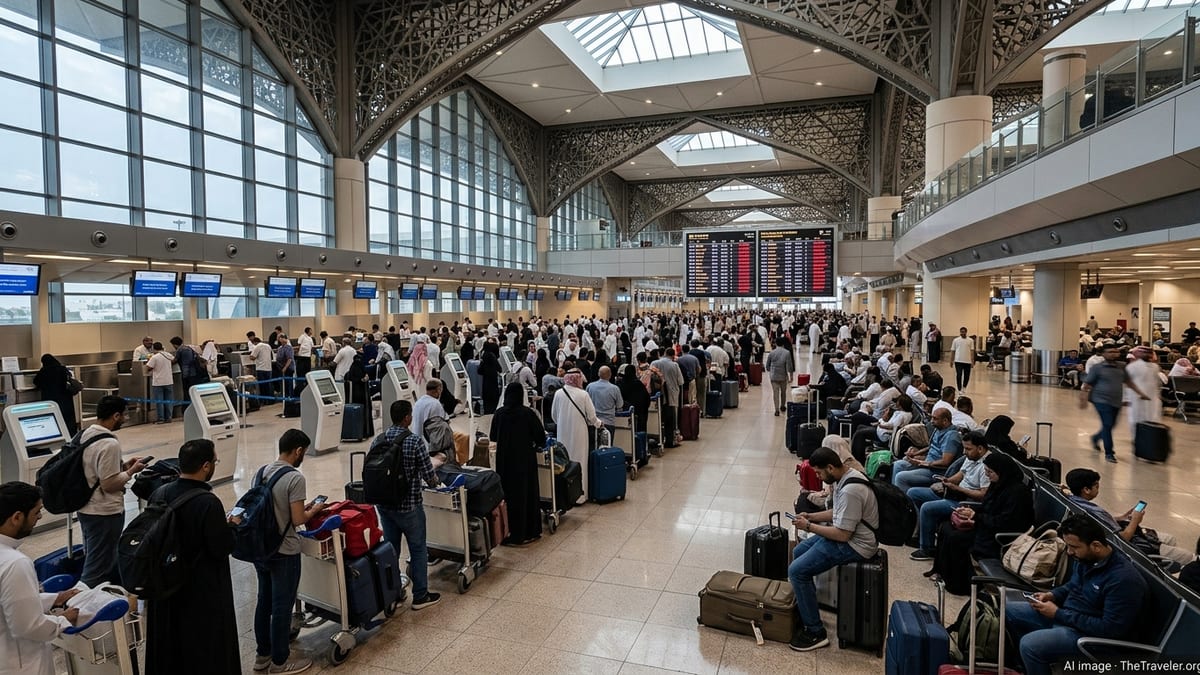
Saudi Hubs Struggle as Regional Airspace Stays Volatile
Publicly available aviation data and travel advisories show that Saudi Arabia’s principal international gateways in Riyadh, Jeddah and Dammam have shifted into a pattern of limited operations, with airlines trimming frequencies, consolidating services and, in some cases, cancelling entire rotations. Medina, a key religious travel hub, is also experiencing schedule disruptions as carriers adjust flight paths and crew deployment.
Industry updates covering the wider Gulf report that airspace restrictions and route adjustments across the region are continuing to ripple through airline schedules. While Saudi airports remain technically open, intermittent closures and reroutings in nearby states are reducing available routings and forcing airlines to re-time or ground flights that would ordinarily transit congested corridors above the Gulf.
Advisories aimed at corporate travel managers describe Saudi air operations as open but constrained, with a continued risk of short-notice changes. Travelers are being urged to treat published timetables as provisional and to build in additional buffer time for connections, particularly on itineraries that mix Saudi domestic legs with long-haul international sectors.
Gulf Air, Saudia and International Carriers Trim Schedules
Regional carrier Gulf Air has broadened its disruption policy through late March, reflecting a sustained period of uncertainty for passengers booked across the Gulf. Publicly shared customer notices highlight flexible change and cancellation options, signaling that the airline expects ongoing schedule volatility rather than a rapid return to normal operations.
Saudi Arabia’s flag carrier Saudia is operating a reduced pattern of flights on several routes, according to operational summaries and port advisories that note suspensions to a number of regional destinations earlier in the month. Although domestic services linking Riyadh, Jeddah and Dammam continue, travelers report repeated re-timings and rolling cancellations that have turned what are typically short hops into all-day journeys.
European and North African airlines are also adjusting their Saudi networks. KLM has been routing around sensitive airspace and has previously suspended selected services in the wider Gulf, while EgyptAir and Air Cairo have seen their point-to-point operations knocked off balance by airspace restrictions in neighboring countries. These adjustments are feeding into the current tally of 34 suspended flights that touch Saudi airports, alongside more than 100 delayed arrivals and departures logged over the latest reporting period.
Riyadh, Jeddah, Dammam and Medina See Passenger Backlogs
On the ground, travelers moving through Riyadh’s King Khalid International Airport report congested check-in halls and long queues at transfer desks as airlines attempt to rebook passengers from cancelled flights onto a shrinking pool of available services. With some Gulf routes suspended or reduced, options for same-day onward travel have narrowed sharply.
In Jeddah, operational summaries describe the airport as functioning but vulnerable to knock-on delays linked to airspace closures elsewhere in the region. Passengers on domestic legs into and out of King Abdulaziz International Airport are encountering rolling delays as incoming aircraft arrive late and airline crews reach duty-time limits, forcing last-minute substitutions or overnight layovers.
Dammam, a vital business and industrial gateway for the Eastern Province, has seen particular strain on its short-haul network. Travelers attempting to connect between Dammam and other Saudi cities report multiple schedule changes within a single day, prompting some to shift to rail or road where possible. Medina, heavily reliant on seasonal and religious traffic, is experiencing a similar pattern of irregular arrivals and departures as carriers juggle altered routings with high demand.
Security Backdrop and Regional Crisis Drive Aviation Instability
The flight disruptions in Saudi Arabia are unfolding against the backdrop of a broader security crisis in the Gulf region and ongoing conflict involving Iran and its neighbors. Open-source reporting on the 2026 Iran war and related missile activity across parts of the Middle East notes that aviation and tourism are among the sectors most exposed to sudden changes in risk assessments.
Analyses of the Strait of Hormuz and adjacent airspace describe a sharp reduction in commercial traffic following attacks on shipping and heightened military activity. Even when Saudi domestic skies remain open, airlines are having to redesign long-haul routings to avoid vulnerable corridors, increasing flight times, complicating crew scheduling and putting pressure on aircraft availability.
Specialist risk advisories for the region indicate that Saudi airports are classified as open but operating under elevated caution, with the possibility of rapid operational changes if regional tensions escalate. This environment has made airlines wary of restoring pre-crisis frequencies, contributing to the uneven patchwork of cancellations and delays now affecting passengers across the kingdom.
What Travelers in and out of Saudi Arabia Should Expect
For those currently planning journeys to or from Saudi Arabia, publicly available guidance from airlines and travel management companies emphasizes flexibility. Passengers are encouraged to monitor flight status closely on the day of travel and to be prepared for re-routing through alternative hubs if original connections break down.
Airlines serving Saudi cities are increasingly offering rebooking fee waivers, extended validity for unused tickets and, in some cases, expanded refund options for departures through late March. These measures aim to ease congestion at airport service desks while giving travelers more control over disrupted itineraries.
Travel specialists advise that itineraries involving tight connections, particularly those linking domestic Saudi segments with long-haul flights to Europe, North America or Asia, carry higher risk in the current environment. Booking longer layovers, consolidating checked baggage and allowing additional time for security screening and immigration checks are emerging as practical strategies for reducing stress amid the ongoing wave of cancellations, delays and grounded aircraft across Saudi Arabia.