

More news on this day
Travelers across Saudi Arabia are facing mounting disruption as a wave of flight suspensions and delays by multiple international and regional airlines affects major hubs in Riyadh, Jeddah, Dammam and Medina, with dozens of cancellations and more than a hundred delays reported across carriers including Gulf Air, Saudia, KLM, Air Cairo and EgyptAir.
Get the latest news straight to your inbox!
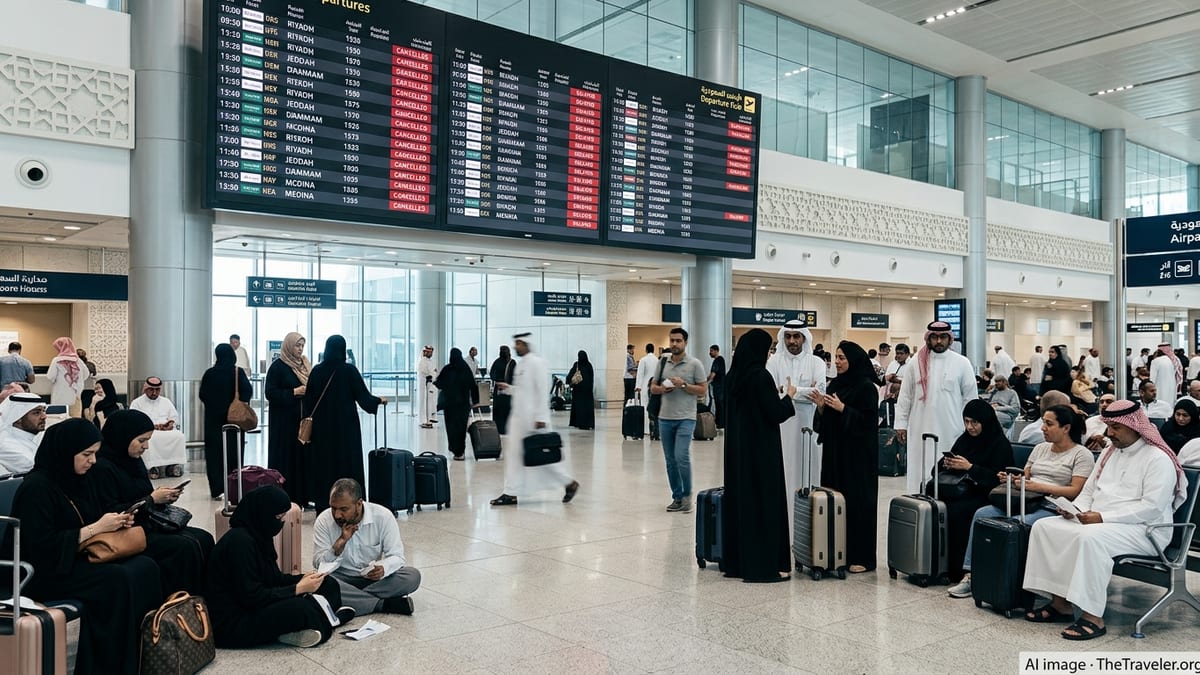
Widespread Cancellations Across Key Gulf and European Carriers
Publicly available flight-tracking data and airline travel alerts indicate that services operated by Gulf Air, Saudia, KLM, Air Cairo, EgyptAir and several other regional carriers have been heavily disrupted on routes serving Saudi Arabia’s main gateways. The pattern shows at least 34 flights suspended in a short window, alongside well over 100 delays, affecting both inbound and outbound journeys.
Schedules involving Bahrain, Egypt and European hubs such as Amsterdam appear particularly affected, with Gulf Air services linking Jeddah and Riyadh to Bahrain seeing repeated cancellations and rebookings. Passenger reports describe last‑minute notices, with some travelers advised that their itineraries via Bahrain or Cairo would not operate as planned and that alternative routings or dates would be required.
KLM’s network adjustments add to the disruption, with reduced or suspended operations on select routes connecting Amsterdam to Gulf destinations that feed onward traffic into Saudi Arabia. These changes, combined with cutbacks or retimings by other European and Middle Eastern airlines, have narrowed options for passengers attempting to reach Riyadh, Jeddah, Dammam and Medina on through tickets.
EgyptAir and Air Cairo services linking Cairo to Saudi cities have also seen interruptions, according to online schedule snapshots and passenger accounts. Travelers connecting through Cairo report missed onward sectors or extended layovers when departures to Jeddah, Medina and Dammam are delayed or rescheduled at short notice.
Major Saudi Hubs Under Pressure as Delays Mount
King Khalid International Airport in Riyadh, King Abdulaziz International Airport in Jeddah, King Fahd International Airport in Dammam and Prince Mohammad bin Abdulaziz International Airport in Medina have all experienced visible knock‑on effects as airlines trim or reshuffle their schedules. Display boards at these airports, as shown in publicly shared images and accounts, list clusters of delayed and canceled flights over several consecutive days.
In Riyadh, where Saudia and other domestic carriers operate dense shuttle schedules to Jeddah, Dammam and Medina, disruptions on international sectors are spilling into the domestic network. Reports from recent travelers describe short‑haul flights between major cities running significantly late, with some departures canceled outright and passengers moved to later services.
Jeddah, a critical gateway for religious travel and a key transit point for connections into South Asia and North Africa, has seen particularly acute crowding as passengers attempt to reroute. Accounts from travelers show that some itineraries originally booked via Gulf Air, EgyptAir or other regional carriers have been hastily rebooked onto Saudia or alternative airlines operating via Riyadh and Dammam.
Dammam and Medina are also experiencing ripple effects even when their runways remain open. Delays and cancellations on feeder flights from neighboring Gulf states and from Cairo are forcing changes to travel plans for residents, expatriate workers and pilgrims alike. Online discussions suggest that some travelers are opting to reposition by road or rail between Dammam, Riyadh and Jeddah to reach working flights.
Regional Tensions and Operational Constraints Behind the Disruptions
Recent geopolitical tensions and broader regional instability have contributed to a complex operating environment for airlines serving the Gulf. According to international media coverage, several European and Gulf carriers have temporarily paused or rerouted services on selected Middle Eastern routes for security assessments, aircraft repositioning or crew limitations, narrowing the number of direct options into Saudi Arabia.
Operational constraints, including airspace restrictions, longer flight times on alternative routings and crew duty‑time limits, are also feeding into the current disruption. When aircraft and crews are out of position due to earlier changes, later flights into Riyadh, Jeddah, Dammam and Medina can be delayed or consolidated, resulting in a cascade of schedule adjustments.
Commercial decisions are another factor. Airlines are reviewing demand patterns in real time and may reduce frequencies or consolidate lightly booked flights, particularly on overlapping routes between Gulf hubs. While these decisions are standard in network management, the current combination of geopolitical tensions and peak travel periods is amplifying their impact on end passengers.
The result is an irregular operating pattern that can change several times in a day. Travelers monitoring their bookings report that flight statuses can shift from confirmed to delayed or canceled within hours, underscoring the importance of continual checks rather than relying on original itineraries printed weeks earlier.
Travelers Face Overnight Stays, Costly Reroutes and Visa Questions
For passengers on the ground, the most immediate impact is uncertainty. Reports from affected travelers highlight long queues at transfer desks in Jeddah and Riyadh, with some passengers issued new boarding passes for flights departing many hours later or even the following day. Others have described being advised to arrange hotels themselves and seek reimbursement later under airline policies.
Additional costs are emerging as a recurrent theme. When flights operated by Gulf Air, EgyptAir, Air Cairo or other disrupted carriers are canceled, passengers sometimes find that the only remaining options involve last‑minute fares on Saudia or non‑stop services via alternative hubs, often at significantly higher prices. Families and group travelers in particular report steep increases when trying to rebook multiple seats.
Transit visa requirements are adding another layer of complexity. Travelers whose original itineraries involved brief connections in Bahrain, Egypt or other Gulf states are encountering longer layovers due to delays, raising questions about whether they can leave the airport or must remain airside. Public guidance from consular sources encourages passengers to verify visa rules for any new transit point introduced by rerouting.
There are also reports of travelers with fixed‑date obligations, such as religious pilgrimages or work start dates, missing key milestones due to the disruptions. Some have turned to ground transport within Saudi Arabia once they manage to arrive in the country, choosing trains or long‑distance coaches between Dammam, Riyadh, Jeddah and Medina to avoid further domestic flight uncertainty.
Practical Advice for Those Due to Fly Through Saudi Hubs
While schedules remain fluid, several practical steps can help travelers reduce risk. Publicly available guidance from airlines and airport operators emphasizes checking flight status repeatedly in the 24 hours before departure, not only via global search engines but also through airline mobile applications, which often reflect schedule changes earlier than third‑party platforms.
Passengers transiting through Riyadh, Jeddah, Dammam or Medina are advised to build in extra connection time wherever possible. Given the current pattern of delays, tight connections of less than two hours carry a higher risk of misconnects, especially when involving separate tickets or different carriers such as Gulf Air, Saudia, KLM, Air Cairo or EgyptAir.
Travel insurance that includes disruption and missed‑connection coverage is proving valuable for many travelers, according to recent consumer travel reports. Policies that reimburse for accommodation, meals and alternative transport can offset the financial impact when flights are canceled or severely delayed, though passengers are urged to retain receipts and document airline communications.
Finally, travelers planning near‑term trips into or out of Saudi Arabia may wish to consider flexible or refundable fares, even when they come at a premium. As airlines continue to fine‑tune their Gulf networks in response to operational and regional developments, flexibility can provide an important safeguard for those needing to adjust travel plans at short notice.