

More news on this day
Air travel across Saudi Arabia and the wider Gulf region has been thrown into fresh turmoil as more than 120 flights operated by Gulf Air, Saudi Arabian Airlines, Qatar Airways, KLM Royal Dutch Airlines and other carriers have been cancelled or heavily disrupted, severing or rerouting key connections to Bahrain, London, Paris, Shanghai, Dubai, Amsterdam and other major hubs.
Get the latest news straight to your inbox!
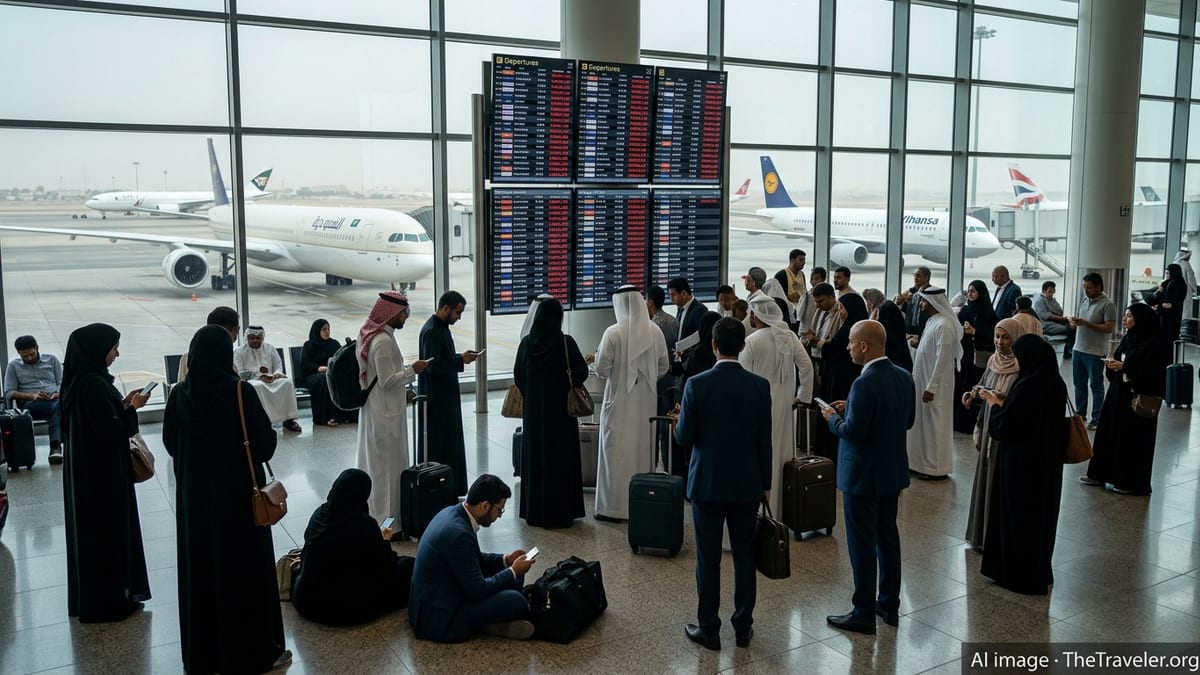
Wave of Cancellations Hits Saudi and Gulf Gateways
Publicly available airport and airline data for the week of March 18 to 24 indicate a sharp spike in cancellations affecting services to and from Riyadh, Jeddah and Dammam, as carriers adjust to fast-changing airspace and security conditions in the Gulf. Industry tracking shows more than 120 flights either cancelled outright or removed from sale on short notice, with further short-haul services operating with significant delays or diversions.
The pattern is most visible on routes linking Saudi Arabia with nearby Gulf states such as Bahrain and the United Arab Emirates, where normally dense shuttle schedules have been thinned to a fraction of their usual frequency. Flights that do operate are often rerouted away from traditional air corridors over the northern Gulf, adding time and complexity to trips that were once among the region’s most routine.
While airlines have periodically adjusted schedules since the start of regional tensions in late February, the latest wave of disruption represents a notable escalation, with cancellations now spreading across both regional and long-haul networks and affecting passengers well beyond the Middle East.
Long-Haul Links to Europe and Asia Severely Disrupted
Services between Saudi Arabia and Europe are among the hardest hit. KLM Royal Dutch Airlines has been operating on a significantly reduced schedule, as the carrier avoids Iranian, Iraqi and Israeli airspace and several Gulf corridors, forcing the cancellation of multiple rotations that would normally connect Amsterdam with Riyadh, Dammam and Jeddah. The reduction has had a knock-on effect for travelers bound for onward destinations across Europe and North America via Schiphol.
Saudi Arabian Airlines has also trimmed frequencies or cancelled selected flights to London and Paris, according to updated online timetables and booking engines, which show previously advertised services as unavailable or zeroed out on certain days. Some passengers report being rebooked on alternative departure dates or via different European gateways, while others are being offered refunds rather than rerouting when equivalent seats cannot be found.
To the east, services touching Shanghai and other key Asian hubs are being reshaped as well. Flight paths that once crossed northern Gulf and Iranian airspace are being re-drawn, and in some cases, entire rotations have been cancelled where operational or insurance constraints make alternatives impractical. This has added fresh uncertainty for business travelers and cargo shippers who rely on predictable schedules between the Gulf and East Asia.
Gulf Carriers Forced to Reroute or Ground Aircraft
Gulf Air, based in Bahrain, is experiencing particular strain because of its reliance on short, high-frequency regional routes that intersect sensitive airspace. Updated departure boards from Bahrain show clusters of cancellations to and from Saudi cities, while a smaller number of long-haul departures are departing with significant schedule changes or aircraft swaps as the airline consolidates capacity.
Qatar Airways, which has already been operating under a revised schedule following the closure and partial reopening of Qatari airspace earlier this month, is now canceling or consolidating additional services involving Saudi Arabia as well as beyond points such as London and Paris. Public travel advisories and schedule updates indicate that the carrier is focusing on a limited core network and running selected repatriation-style flights, while maintaining flexibility to pull departures at short notice if security conditions deteriorate.
In Saudi Arabia itself, publicly available travel advisories note that King Khalid International Airport in Riyadh is handling a reduced pattern of flights, with ongoing disruptions, delays and cancellations. The combination of airspace restrictions, shifting risk assessments and congested alternative routings is constraining the number of aircraft that Gulf-based carriers can realistically deploy each day.
Knock-On Effects for Dubai, Bahrain and Regional Hubs
The disruption in Saudi skies is closely intertwined with events at neighboring hubs, particularly Dubai and Bahrain. In the United Arab Emirates, earlier drone and missile incidents near Dubai International Airport prompted temporary suspensions of flights and heightened security postures, prompting several foreign and regional carriers to pare back schedules into Dubai and other Emirati airports.
As a result, itineraries that once relied on smooth connections through Dubai or Bahrain now face multiple weak points. Passengers traveling from Saudi Arabia to destinations such as London, Amsterdam or Shanghai may find that even if one leg is operating, a connecting segment has been cancelled or rerouted via an unfamiliar airport, undermining the reliability of traditional Gulf super-connector itineraries.
Travel data analysts note that as more airlines divert around the Strait of Hormuz and adjacent conflict-affected corridors, air traffic is being funneled through narrower bands of controlled airspace over the Arabian Peninsula, Red Sea and eastern Mediterranean. This is contributing to congestion, tighter separation requirements and increased fuel burns, factors that in turn make certain marginal routes less commercially viable until conditions stabilize.
Passengers Face Rolling Changes and Limited Options
For travelers, the immediate impact is a landscape of rolling changes. Many passengers only learn of cancellations within days or even hours of departure, as airlines continuously recalibrate operations. Some carriers, including Qatar Airways, have introduced more flexible rebooking and rerouting policies, allowing travelers on cancelled flights to be re-accommodated on partner airlines or alternative routings without additional fare collection, subject to availability.
However, publicly shared traveler accounts highlight the uneven nature of this process. While some have successfully secured new itineraries via secondary hubs in Europe or Asia, others report long call-center wait times, limited seat availability on alternative carriers and difficulties obtaining timely refunds. With hundreds of flights across the wider Gulf network affected since late February, competition for remaining seats on unaffected routes has intensified, pushing some passengers to postpone or abandon travel plans altogether.
Travel advisories circulating among corporate travel managers and risk consultancies now generally recommend that anyone planning to transit Saudi Arabia or neighboring Gulf hubs in the coming days build in additional flexibility, monitor airline notifications closely and consider routings that avoid the most heavily affected air corridors where possible. With regional tensions still evolving, further adjustments to airline schedules into and out of Saudi Arabia remain likely in the near term.