

More news on this day
Thousands of travelers were left stranded across Saudi Arabia on March 1 as cascading delays and cancellations at King Abdulaziz, King Khalid, King Fahd, and Prince Mohammad Bin Abdulaziz airports rippled across regional and long haul networks, disrupting Saudia, Flynas and other carriers on key routes to Dubai, Cairo, Istanbul and New York.
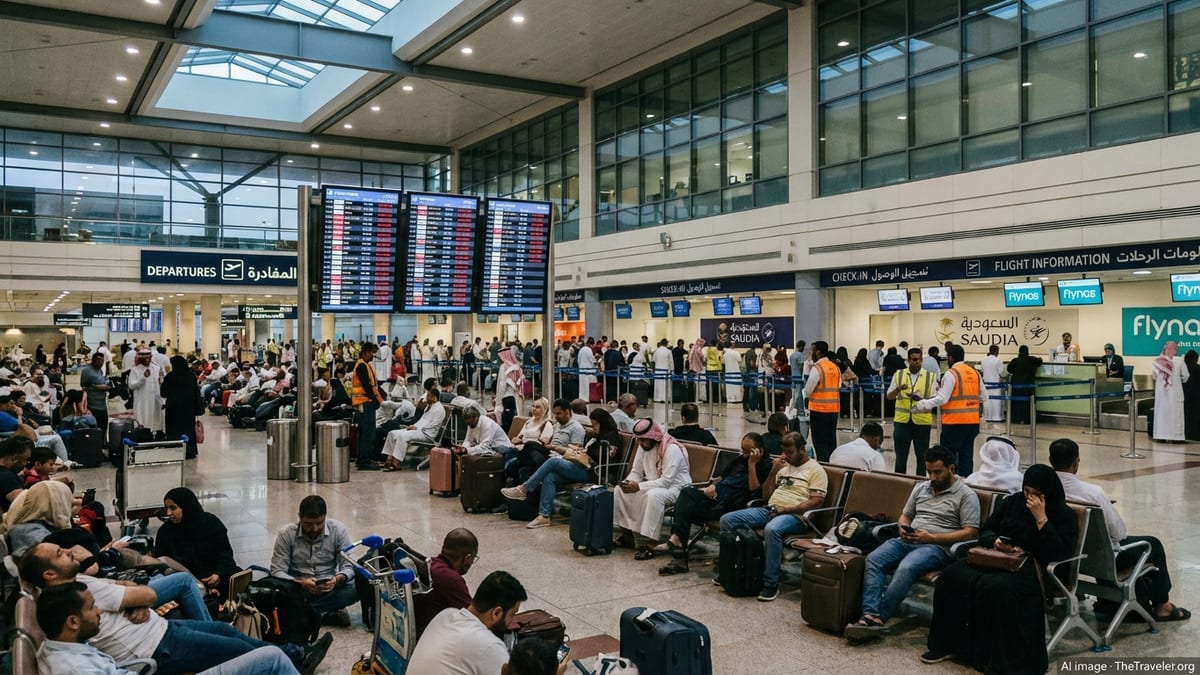
Regional Crisis Pushes Saudi Airports to Breaking Point
The disruption followed a sharp escalation in regional tensions linked to strikes involving the United States, Israel and Iran, which triggered widespread airspace closures and forced airlines to reroute or suspend services across the Middle East. Saudi airspace has become a primary detour corridor for flights avoiding neighboring countries, putting unprecedented pressure on air traffic control and airport operations.
A snapshot of operations on Sunday showed at least 167 flights delayed and 298 canceled across Saudi Arabia’s four major hubs, according to industry and airport data reviewed by travel industry analysts. Those figures shifted throughout the day as airlines adjusted schedules, but they underscored the depth of the shock hitting one of the region’s busiest aviation markets.
King Khalid International Airport in Riyadh and King Abdulaziz International Airport in Jeddah bore the brunt of the turmoil, handling diverted services while attempting to clear mounting departure backlogs. King Fahd International in Dammam and Prince Mohammad Bin Abdulaziz in Madinah, key gateways for business travelers and religious pilgrims, also reported significant disruption as ground operations strained to cope with irregular traffic flows.
Saudi aviation authorities reiterated that the measures, including selective suspensions and diversions, were driven by aviation safety and security protocols rather than domestic instability. Passengers, however, faced hours of uncertainty in overcrowded terminals with limited information and rapidly changing departure boards.
Routes to Dubai, Cairo, Istanbul and New York Hit Hard
Among the worst affected were heavily traveled corridors linking Saudi Arabia to Dubai, Cairo, Istanbul and New York, routes that serve as lifelines for business travelers, labor migrants, pilgrims and tourists. Flights to Dubai in particular saw multiple cancellations and extended delays as carriers navigated congestion in Gulf airspace and intermittent operational holds at airports across the region.
Services to Cairo and Istanbul experienced rolling knock on effects as aircraft and crew became out of position, forcing airlines to consolidate flights or cancel rotations entirely. Long haul links to New York, already tightly scheduled, were further complicated by crew duty time limits and the need to avoid volatile airspace, prompting some airlines to extend block times or reroute via more southerly tracks.
For passengers, that translated into missed onward connections, unexpected overnight stays and the sudden need to rearrange visas, hotel bookings and ground transport. Travel agents in Riyadh and Jeddah reported a surge in last minute rebooking requests as travelers scrambled to secure any available seat out of the country, often accepting multi stop itineraries that added many hours to their journeys.
Embassies and consular missions in the kingdom activated emergency hotlines to assist citizens stuck in transit, with particular concern for elderly passengers, families with small children and groups of religious travelers whose itineraries are tightly choreographed around fixed pilgrimage schedules.
Saudia, Flynas and Global Carriers Scramble to Recover
Saudi Arabia’s national carrier Saudia confirmed widespread schedule adjustments, including cancellations on high profile regional legs to Dubai, Abu Dhabi, Doha and Bahrain, as well as select longer haul services. The airline’s emergency coordination center has been tasked with monitoring fast moving developments and coordinating with airport operators and regulators to restore regular operations as soon as conditions allow.
Low cost operator Flynas, which relies heavily on dense regional networks and quick aircraft turnarounds, reported a spike in delays as congestion on the ground and in the air eroded schedule resilience. The carrier has been offering fee waivers for rebooking on affected routes and urging passengers not to travel to the airport without a confirmed flight status.
International airlines including Gulf and European carriers also pared back operations into Saudi hubs, publishing rolling updates as they evaluated route viability in the shifting security environment. Industry analysts noted that some carriers opted to cancel entire rotations rather than risk incremental delays that could cascade across their global networks.
Airlines across the board have encouraged passengers to make use of mobile apps and call centers to manage disruptions, with many offering full refunds or free date changes for travel through the first week of March. However, high call volumes, language barriers and patchy mobile connectivity for some travelers have hampered efforts to process changes quickly.
Scenes of Confusion in Packed Terminals
Inside the terminals, scenes were reminiscent of peak holiday crushes, but with far less certainty about when flights would depart. At King Abdulaziz International in Jeddah, long lines formed at check in counters and transfer desks, while departure lounges filled with passengers camping out on the floor as they waited for updates that often arrived in small increments via overhead announcements.
In Riyadh, stranded passengers described hours long waits at airline service desks, with families stretched across rows of seats and prayer areas pressed into service as makeshift rest zones. Some travelers booked hotel rooms at their own expense outside the airport after learning that their rebooked flights would not depart until at least the following day.
At King Fahd International in Dammam and Prince Mohammad Bin Abdulaziz in Madinah, the impact was particularly acute for religious visitors and short stay business travelers with fixed return dates. Local transport operators reported an uptick in requests for last minute ground transfers between cities as passengers tried to shift to airports with marginally better prospects of departure.
Airport operators boosted staffing levels in security, customer service and baggage handling, but those measures struggled to keep pace with the volume of disrupted itineraries. Volunteers from local community groups and religious organizations were seen assisting elderly travelers and distributing bottled water and light snacks in some waiting areas.
Uncertain Outlook as Airlines Watch Regional Skies
With regional airspace patterns still in flux on Sunday evening, airlines and regulators avoided firm predictions about when full normality would return. Some carriers signaled that reduced schedules and tactical reroutings were likely to persist at least through March 2, cautioning that further geopolitical developments could extend the period of disruption.
Operational planners are now juggling competing demands: maintaining safety margins around conflict zones, preserving crew duty time compliance and restoring network reliability for both domestic and international passengers. Any additional closures or new security advisories could force carriers back to the drawing board just as they begin to stabilize operations.
Travel industry observers say the episode highlights the vulnerability of regional aviation to sudden geopolitical shocks, particularly in hub and spoke systems that funnel large volumes of traffic through a handful of major airports. For Saudi Arabia, which has invested heavily in positioning itself as a global aviation and tourism hub, the current crisis has become an early test of new infrastructure and contingency planning.
For now, authorities are urging patience from passengers and emphasizing real time communication as the most effective tool in navigating the disruption. With hundreds of flights still delayed or canceled and terminals crowded with weary travelers, the focus remains on gradually clearing the backlog while keeping a close watch on a volatile regional sky.