

More news on this day
Air travel across Saudi Arabia has been significantly disrupted in recent days, with publicly available flight information indicating 191 delays and 100 cancellations affecting major carriers and key hubs serving Riyadh, Jeddah, Dammam, Mecca and Medina.
Get the latest news straight to your inbox!
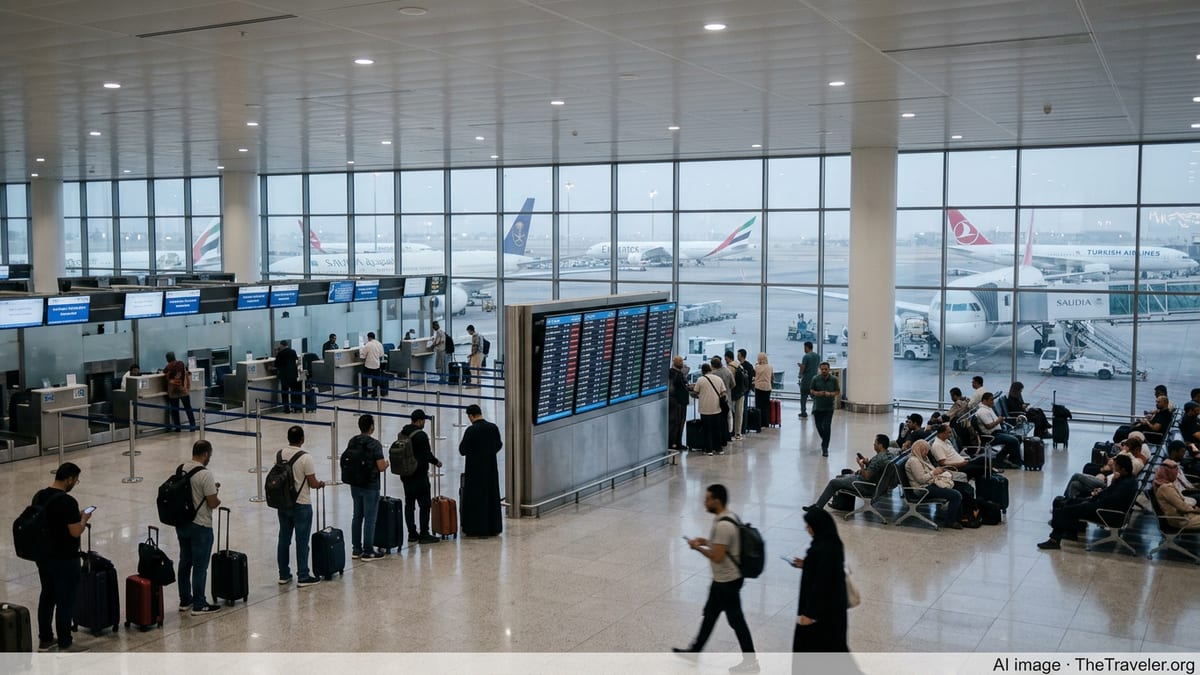
Regional Tensions Ripple Through Saudi Airspace
Published travel advisories and aviation updates in early March 2026 point to ongoing regional tensions and intermittent airspace restrictions across the Middle East, creating a challenging operating environment for airlines serving Saudi Arabia. Reports indicate that precautionary airspace management measures and rerouted traffic are contributing to schedule disruptions at major Saudi gateways.
Analyst bulletins note that Saudi airspace remains open but limited, with particular constraints affecting flows into and out of Riyadh, Jeddah and Dammam. While the main airports continue to operate, fluctuating capacity and changing routings have forced airlines to adjust timetables at short notice, resulting in an elevated number of delayed and cancelled flights.
Within this context, the tally of 191 delays and 100 cancellations reflects a snapshot of one of the more acute recent disruption periods. The figures underscore how fast-changing regional dynamics can translate into operational challenges for carriers and uncertainty for passengers, even when airports themselves are not formally closed.
Flight-tracking data and airport schedule boards referenced in local and regional coverage show that some services continue to operate close to time, particularly domestic connections, while many international routes face extended departure holds, missed slots or rerouting via alternative hubs.
Impact on Saudia and Gulf Carriers
The disruption has hit both Saudi Arabia’s national airline Saudia and major Gulf carriers that rely on the kingdom’s airports as important origin and destination markets. Publicly available schedules and traveller reports describe a pattern of rolling delays for Saudia across domestic and regional routes, along with selective cancellations where aircraft and crews are needed elsewhere in the network.
Emirates, Qatar Airways and Turkish Airlines have also been affected, particularly on sectors linking Riyadh and Dammam with their respective hubs. According to published coverage and passenger accounts, services to Dubai and Abu Dhabi have faced higher cancellation rates than some long-haul connections, reflecting operators’ decisions to prioritise routes that avoid constrained air corridors.
For Qatar Airways, connections between Saudi cities and Doha have seen periodic adjustments, with some flights retimed or consolidated. Turkish Airlines, which carries significant religious and labour traffic through Istanbul, has had to navigate altered routings and extended flight times, further complicating its tight connection waves for Europe, North America and Asia.
Industry observers note that these disruptions are not uniform across all carriers or routes. Some airlines have maintained near-normal operations on select city pairs, especially where alternative routings are more readily available, while trimming frequencies on others. This uneven pattern has added complexity for travellers trying to compare options or secure reliable onward connections.
Riyadh, Jeddah and Dammam: Pressure on Primary Gateways
Riyadh’s King Khalid International Airport, Jeddah’s King Abdulaziz International Airport and Dammam’s King Fahd International Airport sit at the centre of the disruption. Advisory documents cite limited flights and an elevated risk of delays and cancellations at Riyadh in particular, linked to regional airspace closures and rerouted overflight traffic.
At Jeddah, publicly accessible airport information suggests that operations remain more stable but still subject to knock-on disruption as aircraft and crews arrive late from other parts of the region. Delays on inbound sectors can quickly cascade across the schedule, pushing departures back and condensing peak periods, especially during busy Umrah travel days.
Dammam, serving Saudi Arabia’s Eastern Province, appears to be experiencing a mix of schedule changes and selective cancellations, according to flight-tracking websites and passenger forums. Travellers have reported short-notice retimings and rerouting via other Saudi airports, with some itineraries shifted to connect through Riyadh or Jeddah instead of using direct services.
The combined effect at these three hubs is a more congested and less predictable operating environment. Airlines are being forced to adjust aircraft rotations, lengthen minimum connecting times and, in some cases, hold aircraft on the ground until updated routing clearances are confirmed, adding further pressure to already tight schedules.
Pilgrimage Corridors to Mecca and Medina Disrupted
The disruption is particularly sensitive in Mecca and Medina, which depend on reliable air links for Umrah and other religious travel. While Mecca itself is served primarily via Jeddah and, to a lesser extent, through connecting routes from other Saudi cities, any instability at the main gateways quickly affects pilgrims’ journeys to and from the holy city.
Medina’s Prince Mohammad bin Abdulaziz Airport has also experienced schedule volatility, reflected in reports of altered or cancelled flights on key routes operated by Saudia, Emirates codeshare partners, Qatar Airways and Turkish Airlines. Travel forums describe affected itineraries for passengers returning from pilgrimage, with some rerouted via alternative hubs or rebooked onto later departures.
Tour operators and individual travellers planning religious trips have had to contend with a more fluid situation than usual. Publicly available guidance from travel advisories now commonly recommends allowing additional time between flights, considering flexible tickets where possible and maintaining contingency plans for overland travel between Jeddah, Mecca and Medina if air schedules change at short notice.
Despite these challenges, most coverage indicates that the core pilgrimage corridors remain open, with a significant proportion of flights still operating, albeit sometimes with extended delays. For many travellers, the main impact is uncertainty and longer journey times rather than outright inability to travel.
What Travellers Are Experiencing on the Ground
First-hand accounts shared in public forums and social media paint a varied picture of the passenger experience. Some travellers report relatively smooth journeys, with only minor delays or schedule adjustments, while others describe multiple cancellations or last-minute changes that have extended journeys by many hours.
Common themes include longer-than-usual waits at departure gates, frequent schedule updates on airport displays and mobile apps, and crowded transfer areas as waves of delayed flights arrive at once. Passengers connecting through Riyadh, Jeddah and Dammam report a higher level of uncertainty around tight connections, prompting many to seek same-day rebooking or overnight accommodation when misconnects occur.
Publicly available airline notices advise travellers to monitor their flight status closely, arrive at the airport earlier than usual and remain flexible about rerouting options. Travel insurers and advisory services similarly emphasise the value of retaining all documentation of delays and cancellations, as this can be important when seeking reimbursements or making claims under applicable policies.
Looking ahead, aviation commentators suggest that the extent and duration of disruptions will depend on how regional airspace management evolves over the coming days and weeks. For now, the count of 191 delays and 100 cancellations offers a clear indicator of the scale of the challenge facing airlines and passengers alike across Saudi Arabia’s key air travel corridors.