

More news on this day
Saudi Arabia has become the latest state to tighten airspace amid the escalating Iran war, deepening a web of closures and diversions across West Asia just as Thailand moves to shield stranded foreign tourists with overstay waivers and emergency financial aid.
Saudi Corridor Strains as Regional Skies Narrow
As fighting between Iran, Israel and the United States grinds into its second week, airspace across much of West Asia remains either closed or heavily restricted, forcing airlines into complex detours and leaving passengers scattered at hubs from Europe to Southeast Asia. Iran, Iraq, Israel, Kuwait, Bahrain, Qatar and Syria have all shut their skies to most civilian traffic, while the United Arab Emirates has kept only limited corridors open around damaged airports in Dubai and Abu Dhabi.
Saudi Arabia, which initially preserved a crucial east–west route, is now grappling with unprecedented congestion as more carriers divert through its remaining open corridors. Aviation advisories describe Saudi air traffic control as saturated, with delays rippling outward to Europe, Africa and Asia as jets queue for increasingly scarce slots over the kingdom.
The narrowing of usable airspace has upended the traditional role of Gulf hubs as dependable bridges between continents. Airlines are cutting frequencies, operating one-off relief services and, in some cases, abandoning certain routings entirely until the security picture in West Asia stabilizes.
For passengers, that means a journey that once involved a routine change of planes in Doha, Dubai or Abu Dhabi can now require multiple rebookings, overnight stops and, for many, an unplanned stay in countries far from home as flight options vanish or become prohibitively expensive.
Turkey, UAE, Iran and Gulf States Lock Down Skies
The regional squeeze began in earnest after coordinated US and Israeli strikes on Iran triggered retaliatory missile and drone attacks across the Gulf, prompting a wave of airspace closures. Authorities in Iran, Israel, Iraq, Kuwait, Bahrain, Qatar and Syria rapidly sealed their skies, with flight-tracking data showing near-total voids over parts of the region that normally carry some of the densest traffic on earth.
In the Gulf, the United Arab Emirates moved to suspend most regular services while damage assessments were carried out at Dubai International and Abu Dhabi airports. Qatar followed with a full airspace shutdown as it dealt with attacks near key military and energy infrastructure, halting operations at Doha’s Hamad International Airport and grounding Qatar Airways’ core network.
Turkey, which straddles Europe and Asia, has not closed its airspace outright but has imposed tight route restrictions and suspended services to multiple Middle Eastern destinations. Airlines there have cancelled or curtailed flights to conflict-adjacent states, citing elevated security risks and uncertainty over when neighboring skies will safely reopen.
With Bahrain and Kuwait also shut and Jordan, Oman and Saudi Arabia limiting flows, the effect has been to fracture the main east–west trunk lines that previously relied on Gulf overflights. Long-haul carriers from Europe, India and East Asia have scrambled to reroute via Central Asia or the Caucasus, often adding hours to flight times and significant extra fuel burn.
Thailand Becomes a Pressure Valve for Stranded Travelers
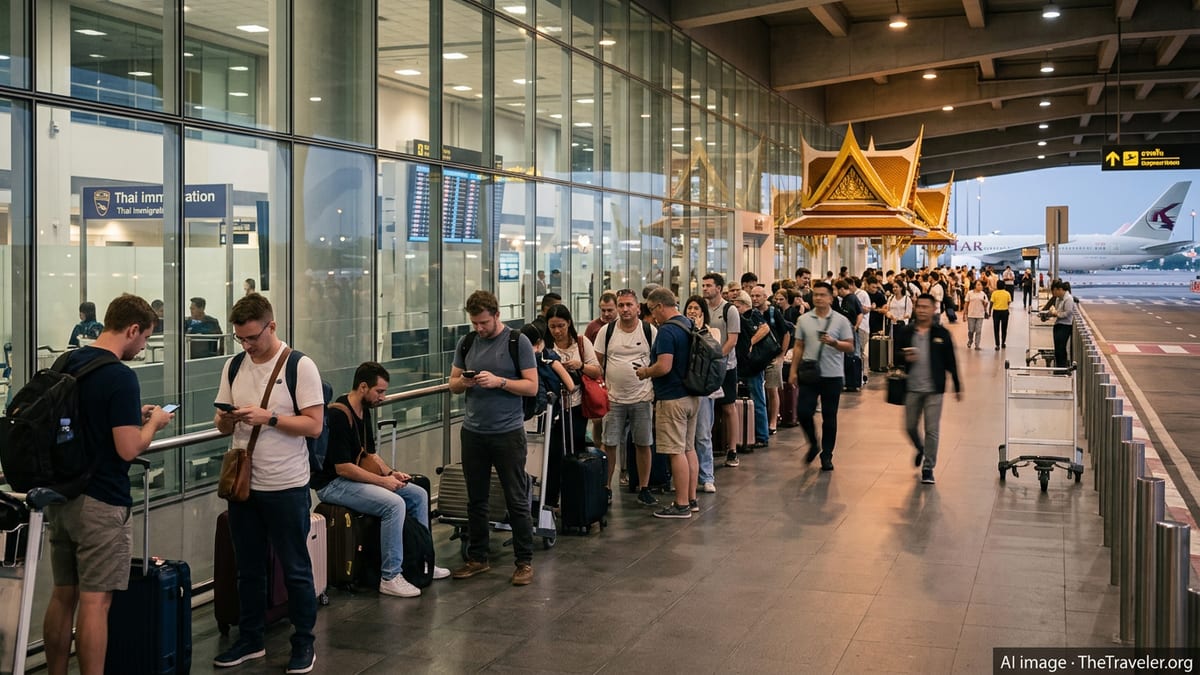
As West Asia’s aviation grid seized up, Thailand emerged as both an inadvertent cul-de-sac and a safety valve for travelers trying to stay mobile without transiting the Gulf. Bangkok and Phuket, already among the world’s busiest tourist gateways, have seen rising numbers of passengers who can arrive but cannot continue onward because their onward connections through Doha, Dubai or other Middle Eastern hubs have been cancelled.
Thai authorities say thousands of foreign visitors are now in the country on itineraries that assumed smooth connections through West Asia. Many had booked complex round-the-world or multi-stop journeys that relied on Gulf carriers, only to find themselves effectively parked in Thailand when airlines halted operations on their onward legs.
Local carriers and ground handlers report heavy demand for rerouted services that bypass the Middle East entirely, particularly via East Asian hubs such as Singapore, Seoul and Tokyo. But seat availability remains limited, especially during the current peak season, leaving many travelers resigned to extending their stays in Thailand while they wait for a viable exit route.
Tourism officials, mindful of the sector’s importance to the Thai economy and the reputational damage caused by images of stranded tourists, have moved quickly to coordinate with airlines, hotel groups and provincial authorities to keep visitors informed and supported.
Overstay Penalties Eased as Thailand Rolls Out Support
In a significant step for travelers stuck in limbo, Thailand has introduced temporary relief on its normally strict overstay rules. Immigration authorities have instructed officers to waive the standard 500 baht per day overstay fine for visitors who can prove they are stranded by flight cancellations or airspace closures linked to the West Asia crisis.
Officials emphasize that the leniency applies to genuine force majeure cases, verified through airline documentation or other travel evidence. Visitors who overstay for unrelated reasons are still subject to fines and potential blacklisting, but those whose return flights have been scrapped or repeatedly postponed are being granted extensions without penalty.
Alongside the immigration reprieve, the Ministry of Tourism and Sports has activated a Foreign Tourists Assistance Fund to provide up to 2,000 baht per person per day in emergency support for eligible travelers whose budgets are being stretched by unplanned extra nights in Thailand. The fund is designed to cover basic living expenses rather than full holiday costs, and is being administered in cooperation with local tourism bodies and hotel associations.
Hotel and resort operators have been asked to offer discounted rates and flexible cancellation policies for guests caught out by the crisis. Industry groups say many properties in Bangkok, Phuket, Chiang Mai and Pattaya are now extending special “stranded traveler” offers, aiming both to ease the immediate hardship and to reinforce Thailand’s image as a hospitable destination in times of disruption.
Global Aviation Faces Prolonged Uncertainty
The combination of Saudi Arabia’s strained air corridors, widespread Gulf airspace closures and Thailand’s emergency visitor policies underscores how deeply the Iran war has penetrated global travel networks. Airlines and regulators caution that even if some skies reopen in the coming days, schedules will remain volatile as carriers rebuild complex long-haul patterns and assess ongoing security threats.
Aviation analysts note that the current shutdown rivals the early days of the Covid pandemic in its geographic reach and sheer complexity, with knock-on effects stretching from Indian and Pakistani airports to hubs in Europe, East Asia and Australia. Each incremental restriction in West Asia forces another series of timetable changes elsewhere, amplifying the disruption for weeks beyond any formal ceasefire.
For now, travelers are being urged to monitor airline updates closely, register with consular services where appropriate and build extra contingency into any itinerary that might normally have transited the Middle East. As Thailand’s relaxed overstay regime and financial aid package suggest, destination countries are increasingly being drawn into the front line of crisis management, offering practical relief to stranded visitors while waiting for a clearer picture of when the region’s skies will fully reopen.