

More news on this day
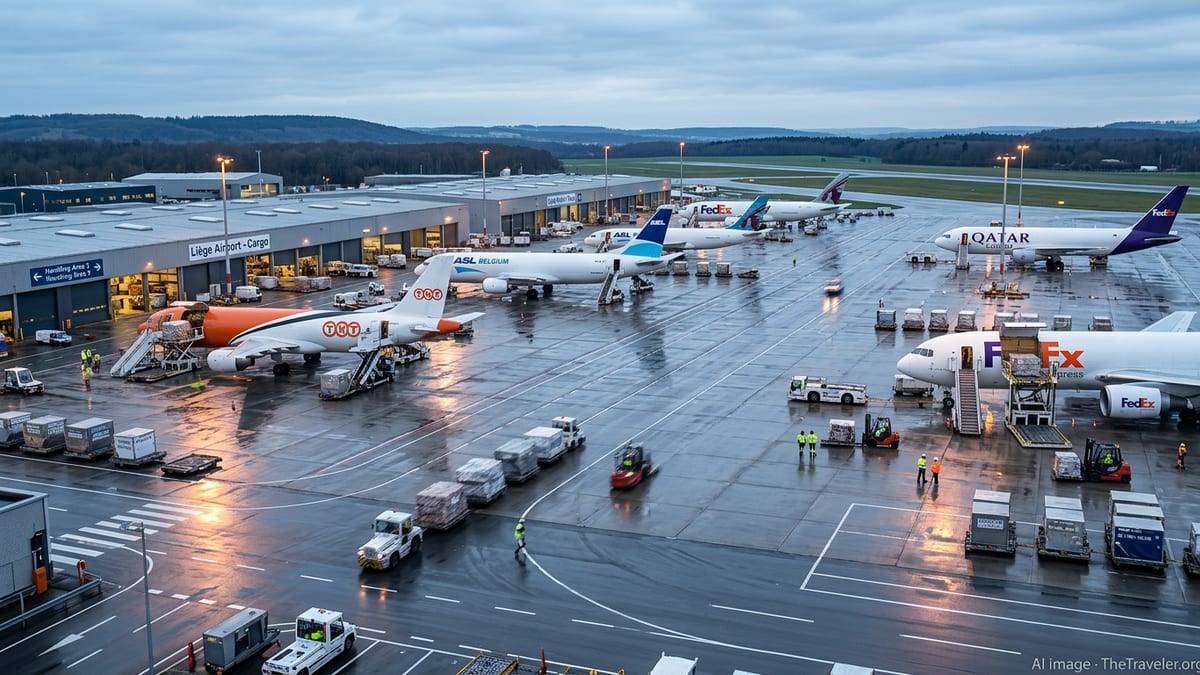
Liège Airport, Belgium’s main cargo gateway, is bracing for a seismic shift after SAL Saudi Logistics Services agreed to acquire Aviapartner Liège in a multimillion-euro deal that hands the Riyadh-based operator a strategic foothold at one of Europe’s fastest-growing freight hubs.
A Saudi Cargo Powerhouse Lands in Wallonia
SAL Saudi Logistics Services has agreed to buy 100 percent of Aviapartner Liège’s share capital for around €28 million, according to recent disclosures, valuing the Belgian cargo handler at just over 1 times its latest annual revenue. The deal covers the entire local operation at Liège Airport, including facilities, contracts and roughly 200 employees, and will be completed on a cash-free, debt-free basis once regulatory approvals are secured.
The transaction plugs SAL directly into the heart of Europe’s cross-border freight network. Liège has emerged as one of the continent’s top cargo hubs, handling more than 1.3 million tonnes of freight in 2025 and recording double-digit volume growth. The airport’s 24/7 operating model, focus on cargo rather than passenger traffic and strong presence of express integrators and e-commerce players have turned the Walloon platform into a preferred gateway for time-sensitive and high-value goods.
For SAL, which already manages cargo handling across Saudi Arabia’s key airports and is expanding under the Kingdom’s Vision 2030 logistics push, Liège offers an immediate springboard into the European Union market. The company has framed the acquisition as a cornerstone of its international growth plan, promising to leverage existing airline relationships and infrastructure at the Belgian hub to build a wider long-haul cargo network connecting Asia, the Middle East and Europe.
While the purchase price is modest in global M&A terms, analysts note that the strategic value lies in Liège’s network position and future capacity rather than its current earnings. With demand from Asian e-commerce platforms, pharmaceuticals and high-tech exporters still rising, SAL’s move is widely seen as a bid to secure long-term access to scarce and increasingly contested airport cargo real estate in Western Europe.
What Changes for Liège’s Cargo Ecosystem
The sale of Aviapartner’s Liège cargo operations follows the divestment of its Brussels Airport cargo arm to Worldwide Flight Services earlier this month, marking a sharp strategic pivot for the Belgian group toward passenger and executive handling. At Liège, the handover to SAL will reshape competitive dynamics in a market that already includes major handlers such as Swissport and WFS, as well as dedicated e-commerce infrastructure linked to Chinese platforms.
In the short term, operations on the tarmac and in the warehouses are expected to remain largely unchanged, with all staff transferring to the new owner. Both Aviapartner and SAL have stressed continuity for airline customers, freight forwarders and trucking providers that rely on Liège’s round-the-clock operations. However, industry observers anticipate a gradual ramp-up in capacity, digitalization and specialized handling capabilities as SAL integrates the station into its broader network.
Liège Airport itself has been investing heavily in cargo infrastructure, adding new terminals and cold-chain facilities for perishables, pharmaceuticals and other temperature-sensitive goods. The arrival of a financially strong, Gulf-based handler with global ambitions is likely to accelerate that trajectory, especially in areas such as e-commerce fulfillment, cross-dock operations and value-added services like assembly, labeling and customs preparation.
For local stakeholders in Wallonia, the transaction is a double-edged development. On one hand, the new ownership promises capital, new airline contracts and potentially more volumes, reinforcing Liège’s status as a jobs-rich logistics engine. On the other, it deepens the airport’s dependence on long-haul freighters and global trade flows at a time when environmental constraints, night-flight debates and regional industrial policy are growing more intense.
Aviapartner Retreats from Cargo to Focus on Passengers
Aviapartner’s exit from dedicated cargo handling at both Brussels and Liège underscores a decisive reshaping of its European business model. The company, which serves around 400 airlines and handles more than 120 million passengers annually across Europe and Africa, has signaled that future growth will come from passenger-related services: check-in and boarding, baggage handling, ramp services and assistance for passengers with reduced mobility.
The back-to-back sales of its Belgian cargo assets to WFS at Brussels and now to SAL at Liège effectively mark the end of an era for Aviapartner in all-cargo operations in its home market. Executives have framed the move as a way to concentrate capital and management attention on higher-margin, scale-driven activities in passenger aviation, rather than tying up resources in infrastructure-heavy cargo terminals.
This repositioning also reflects broader structural changes in the European ground handling sector. Intense price competition, rising labor and energy costs and the need for continuous investment in automation and security technology have made it harder for mid-sized players to sustain a full-service portfolio. By exiting cargo at Belgium’s two main freight airports, Aviapartner is effectively ceding that space to global handlers backed by larger balance sheets, while seeking to defend and expand its position at major passenger hubs.
For airlines that have relied on Aviapartner at Liège, the transition to SAL introduces a new operational partner but also the prospect of more integrated end-to-end solutions, especially on routes connecting to or through Saudi Arabia. Contract renewals and new agreements negotiated under the SAL banner will be closely watched as an indicator of how fast the new owner intends to reshape the station’s commercial profile.
Implications for Global Logistics Flows
Strategically, SAL’s acquisition is part of a wider pattern of Gulf and Asian operators securing stakes in key logistics nodes along major trade corridors. By anchoring itself at Liège, SAL is effectively tightening the link between the Red Sea, the Arabian Gulf and the dense industrial and consumer markets of Western Europe, with potential knock-on effects for routings, capacity deployment and transit times.
Liège already plays a central role in the Europe–China e-commerce corridor, with dedicated freighter operations feeding large fulfillment centers nearby. SAL’s existing partnerships with Asian carriers and logistics players, along with Saudi Arabia’s investments in free zones and bonded facilities, create room for more tightly coordinated door-to-door products. Shippers could see faster, more predictable flows for high-value goods, with Saudi hubs acting as consolidation and redistribution points for flows between Asia, Africa and Europe.
For competing European airports, the move raises the stakes. As capacity constraints and environmental pressures tighten at traditional hubs, cargo operators are increasingly looking for secondary platforms that combine runway availability, flexible night-flight regimes and good highway and rail access. SAL’s bet on Liège reinforces the airport’s positioning in this niche and may draw incremental freighter traffic away from more congested gateways.
However, the consolidation of cargo handling and infrastructure in the hands of a few large, globally active players also concentrates risk. Disruptions at a single hub or within one logistics group can ripple quickly across networks. Regulators in Belgium and at the EU level are expected to scrutinize the deal, not only for competition concerns but also for its alignment with sustainability and labor standards in a sector that remains under close public and political scrutiny.
What Shippers and Travelers Should Watch Next
For freight forwarders, e-commerce platforms and manufacturers, the near-term question is how quickly SAL will move to integrate Liège into its digital and operational backbone. Enhanced shipment visibility, standardized service levels between Saudi and European stations and new capacity on key trade lanes are all potential benefits that could emerge once systems and processes are aligned.
Tariff structures and value-added service menus are also likely to evolve. SAL has indicated in previous partnerships that it aims to bundle ground handling, warehousing and complementary logistics services, rather than offering purely transactional ramp handling. That approach could encourage deeper, longer-term contracts but may also prompt some shippers to reassess their mix of partners across the region.
Passengers passing through Liège may notice little change on the surface, as the airport remains primarily a cargo platform with limited commercial flights. But the broader travel ecosystem is indirectly affected. Stronger cargo connectivity can make certain long-haul passenger routes more viable at nearby airports, while the expansion of logistics parks around Liège continues to attract international investment, business travelers and specialized workforce mobility from across Europe and the Middle East.
Over the coming months, attention will focus on regulatory approvals, the treatment of the transferred workforce and the first slate of new or expanded airline contracts under SAL’s leadership. How these pieces fall into place will determine whether the acquisition becomes a blueprint for further Saudi-led expansion into European logistics, or a more cautious, incremental step in an increasingly contested global cargo landscape.