

More news on this day
Thousands of passengers across the Middle East, Europe and North America faced severe travel disruption on March 1, 2026, as Saudi Arabia’s King Abdulaziz International Airport in Jeddah reported more than a hundred cancellations and scores of delays amid sweeping airspace closures triggered by US and Israeli strikes on Iran.
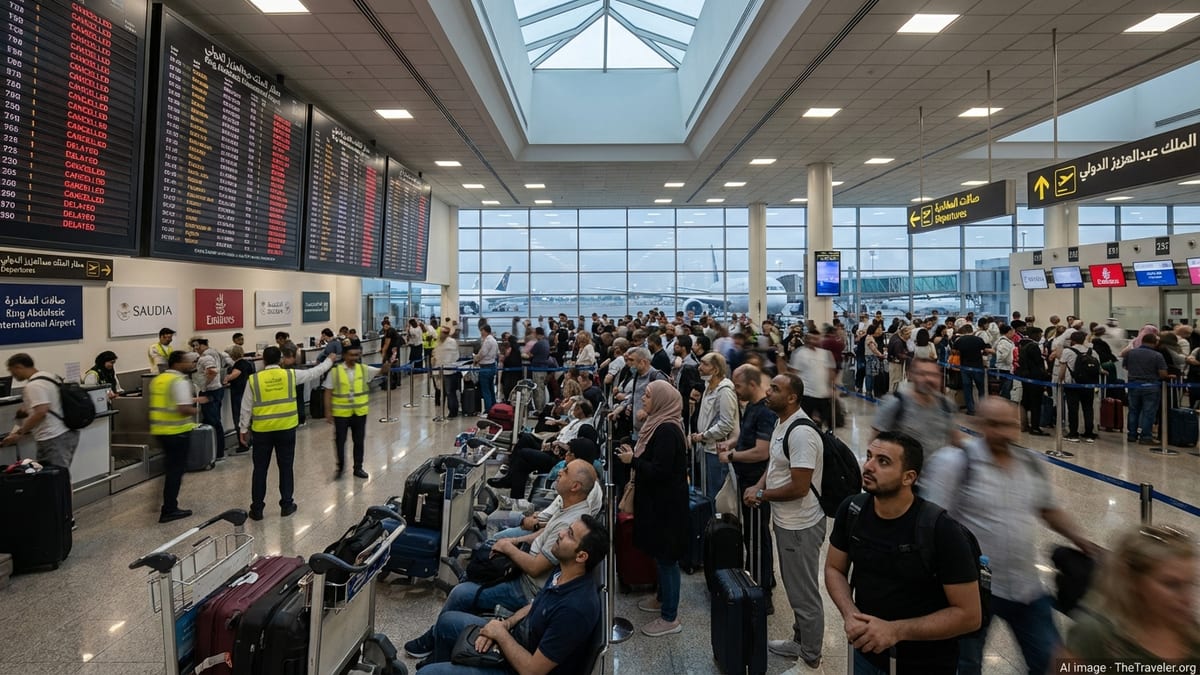
King Abdulaziz Airport Becomes a Flashpoint in Regional Aviation Turmoil
Data from aviation analytics cited by regional travel industry outlets shows King Abdulaziz International Airport emerging as one of the hardest hit hubs in the current crisis, logging about 110 to 115 flight cancellations and more than 120 delays in a single 24 hour period. The disruption is part of a wider collapse in Middle East connectivity after coordinated US and Israeli attacks on Iranian targets prompted Iran and several Gulf states to shut or severely restrict their airspace.
At Jeddah, the gridlock is particularly acute because the airport is both a key gateway for religious pilgrims and a major transfer point linking Asia, Africa and Europe. Long queues built up at check in and transfer desks as airlines attempted to rebook passengers or hold them in hotels until new routings could be found. Ground staff described an almost continuous wave of schedule changes as flight plans were rewritten around newly declared no fly zones.
Saudi flag carrier Saudia has borne a large share of the fallout, cancelling dozens of departures and arrivals through Jeddah while coping with significant knock on delays across its domestic and regional network. International carriers including Emirates, Etihad, Pegasus Airlines, Wizz Air and IndiGo have also scrubbed or rerouted services touching the Red Sea hub, contributing to the unusually high number of aircraft left parked at remote stands.
US–Israel–Iran Escalation Ripples from Gulf Skies to Global Gateways
The shutdowns at Jeddah and other Saudi airports are part of a far broader shock to global aviation triggered by the latest escalation between the United States, Israel and Iran. Following large scale strikes on Iranian territory, authorities in Iran, Israel, Iraq, Kuwait, Bahrain, Qatar and the United Arab Emirates moved to close or heavily restrict their skies, instantly severing some of the world’s busiest long haul corridors between Europe, Asia and Africa.
Major Gulf hubs in Dubai, Abu Dhabi and Doha suspended most operations as a precaution, with radar tracking services showing large swathes of normally congested airspace almost empty. Airlines have reacted by cancelling thousands of flights across the region over the weekend and racing to design new routings that loop around closed flight information regions, often adding several hours and an extra fuel stop to journeys that normally overfly the Gulf and Iran.
The resulting bottleneck has shifted additional traffic into Saudi airspace, where controllers are working with constrained routings and rapidly changing military advisories. While the kingdom’s skies have remained open, the surge in diversion traffic combined with the knock on effects of neighbouring closures has intensified pressure on airports such as Jeddah, Riyadh, Dammam and Madinah, compounding the disruption already caused by airlines proactively cancelling vulnerable sectors.
Passengers Stranded from Dubai to New York as Long Haul Links Collapse
The chaos at King Abdulaziz International is being felt far beyond Saudi borders, with thousands of travellers stranded or delayed in cities including Dubai, New York, London, Athens and Vienna. Many of these passengers were booked on itineraries that rely on the Gulf and Saudi Arabia as intermediate hubs between Europe or North America and destinations in South and Southeast Asia or East Africa.
At Dubai International Airport, usually one of the world’s busiest transit gateways, terminal halls filled with confused transit passengers after Emirates and flydubai cancelled a large portion of their schedules and halted many connections that would normally continue onward to Saudi airports. Similar scenes have been reported at Abu Dhabi’s Zayed International Airport, where Etihad Airways temporarily suspended departures, and at Doha, where Qatar Airways cut services amid local airspace restrictions.
On the other side of disrupted routes, departure boards at New York’s John F. Kennedy, London Heathrow and major European hubs showed a growing list of cancellations and severely delayed departures to Jeddah and other Middle Eastern cities. Some flights left hours late on elongated routings that detour over the Mediterranean and Red Sea, while others were simply pulled from the schedule as airlines grappled with crew duty limits and uncertainty over when key air corridors might reopen.
Airlines Scramble to Rebook, Divert and Communicate Amid Uncertainty
Carriers operating into Saudi Arabia have responded with a mix of outright cancellations and ad hoc operational workarounds. Saudia has cancelled numerous Jeddah flights while prioritising limited capacity for essential domestic links and time sensitive international connections. Emirates, Etihad and flydubai have rerouted or diverted select services around the Gulf, but have warned passengers that schedules will remain highly fluid as the security picture evolves.
Low cost operators such as Wizz Air and Pegasus Airlines have opted for more sweeping suspensions on routes touching the Gulf and Israel, cancelling services into Saudi Arabia and nearby markets for several days at a time. For passengers, that often means being rebooked days later, accepting refunds or arranging complex self built itineraries via alternative hubs in Europe, North Africa or South Asia where capacity still exists.
Airports and airlines alike are urging travellers headed to or from Saudi Arabia to avoid making unnecessary trips to terminals before confirming their flight status. With call centres overwhelmed, many carriers are directing customers to mobile apps and social media channels for the latest information, while cautioning that real time changes may still occur up to the moment of departure.
Travel Advisories, Safety Concerns and What Comes Next for Saudi Hubs
Saudi aviation authorities and major airport operators have issued advisories highlighting that while the kingdom’s airports remain open, operations are being affected by regional security developments beyond their direct control. Passengers are being told to expect longer journey times, last minute gate or schedule changes and the possibility of overnight stays as airlines adjust to ongoing overflight restrictions in neighbouring states.
Security analysts say the immediate priority for carriers is to keep aircraft and passengers out of potential conflict zones, even at the cost of commercial disruption. That approach is driving the current wave of cancellations and diversions affecting Jeddah and other Saudi airports, as airlines err on the side of caution while monitoring the risk of further missile or drone activity in the wider region.
Industry observers add that a full return to normality at King Abdulaziz International will depend on how quickly airspace around Iran and the Gulf is reopened and whether further military action can be avoided. In the meantime, travellers with imminent plans involving Jeddah are being urged to maintain flexible itineraries, closely track airline updates and prepare for significant delays as Saudi Arabia’s busiest Red Sea hub navigates one of the most serious regional aviation crises in recent years.