

More news on this day
Saudi Arabia is accelerating a strategic realignment with the United States that mirrors and deepens the long-standing US partnerships with Qatar, Bahrain, the United Arab Emirates, Kuwait and Oman, a shift that analysts say could rewire global trade corridors, transform air travel networks and recalibrate energy security across multiple regions.
Get the latest news straight to your inbox!
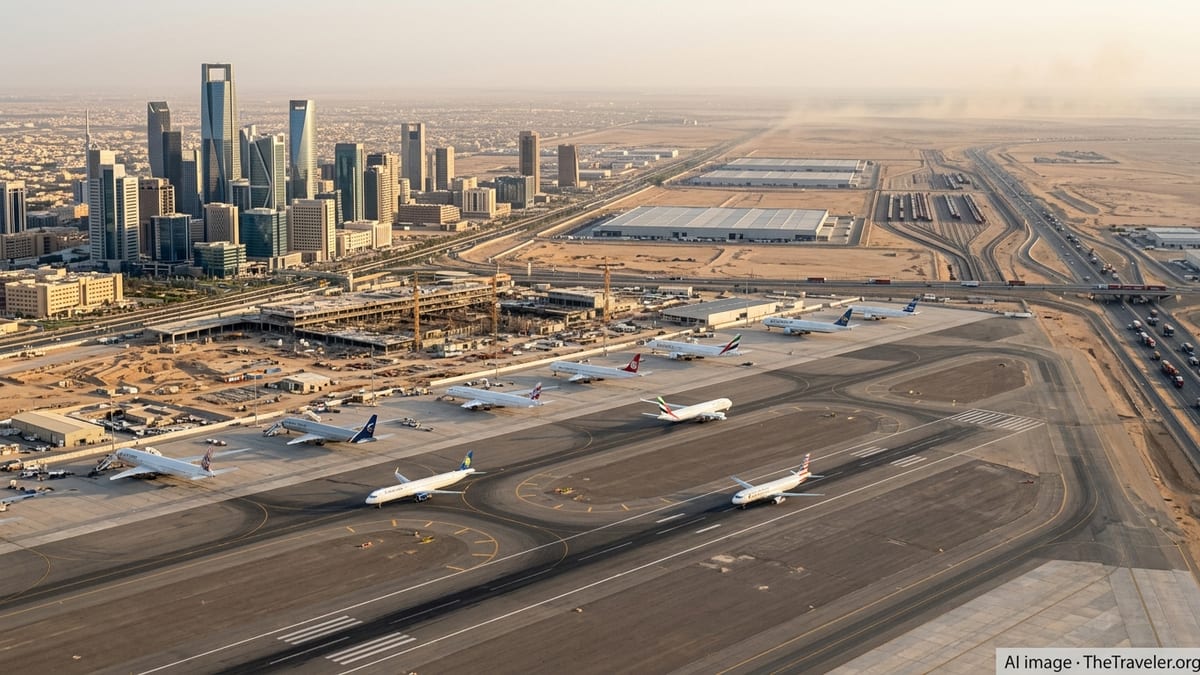
A New Phase in US–Gulf Strategic Alignment
Publicly available policy documents and recent summit communiqués indicate that Saudi Arabia and the wider Gulf Cooperation Council are moving into a more tightly coordinated phase of engagement with Washington, with security ties now increasingly linked to trade, aviation and advanced technology cooperation. Commentators note that this represents an evolution from traditional energy-for-security arrangements toward broader economic and infrastructure partnerships that bring Riyadh more closely into line with the strategic trajectories already pursued by Qatar, Bahrain, the UAE, Kuwait and Oman.
Regional strategic reports for 2025 and 2026 highlight that discussions around a formal US–Saudi security framework have unfolded in parallel with negotiations on defense procurements, civil nuclear cooperation and high-technology investment. Observers say this multidimensional approach is intended to lock in long-term alignment at a time of shifting global power balances, while also underpinning Saudi Arabia’s Vision 2030 program to diversify away from oil and position itself as a logistics and services hub.
This tightening web of US–Gulf partnerships is increasingly viewed as part of a wider response to competing connectivity initiatives led by other major powers. By embedding energy, digital infrastructure and transport projects into security discussions, the United States and its Gulf partners are, in effect, building a layered architecture that extends from defense and intelligence to commercial aviation, shipping and data networks.
Trade Corridors: From Oil Lanes to Multimodal Networks
The emerging alignment is being expressed most clearly in the push to create new trade corridors that link Asia, the Gulf and Europe. The India–Middle East–Europe Economic Corridor, announced at the G20 summit in New Delhi in September 2023 and now moving into an implementation phase, places Saudi Arabia and the UAE at the center of a multimodal network designed to connect Indian ports to Europe via Gulf rail and logistics hubs. Project updates released in early 2025 describe construction of new rail lines, ports and highways as a significant step toward operational reality.
Analysts describe this initiative as both an economic and geopolitical statement, positioning Gulf partners of the United States as critical nodes in an alternative trade architecture that complements, and in some respects competes with, existing routes through the Suez Canal and initiatives promoted by other major powers. For Saudi Arabia, integration into such corridors supports its drive to expand container throughput, free zone activity and value-added logistics, while anchoring long-term relationships with US and European operators and financiers.
Regional logistics strategies published under Saudi Arabia’s National Transport and Logistics Strategy emphasize ambitions to turn the kingdom into a global logistics hub serving three continents by 2030. Partnerships announced by Saudi cargo and ground-handling companies with foreign operators in 2025 are framed as tools to deepen supply-chain integration, expand air and sea freight capacity and standardize digital customs and tracking systems, all areas where US-based technology and service providers play a prominent role.
Aviation Ambitions and the Remaking of Global Air Travel
In aviation, Saudi Arabia’s shift is particularly visible. Official Vision 2030 documents and supporting aviation briefings outline goals to connect the kingdom with 250 international destinations, handle hundreds of millions of passengers annually and attract more than 150 million tourists by 2030. New and existing carriers in the region, including Riyadh Air and several low-cost operators, are positioning themselves to compete directly with established Gulf hubs in Doha, Dubai and Abu Dhabi.
King Salman International Airport in Riyadh, now under development, is being designed to handle 100 million passengers per year by 2030, with a planned capacity of 185 million passengers by mid-century. Industry coverage of a 2025 executive partnership agreement between the airport’s development company and US engineering group Bechtel describes a focus on new passenger terminals and advanced airside infrastructure, signaling a long-term bet on Riyadh as a global connecting hub that can sit alongside Doha’s Hamad International Airport and Dubai International in attracting long-haul transfer traffic.
Recent announcements of strategic collaborations between Saudi aviation authorities, international airport operators and satellite-connectivity providers highlight a trend toward using US and allied technologies to differentiate the passenger experience and improve operational efficiency. Partnerships to equip new fleets with advanced inflight connectivity and to develop air taxi and advanced air mobility ecosystems suggest that high-bandwidth satellite systems, digital air traffic management tools and new urban air corridors will be part of the region’s next competitive frontier.
For travelers, the result could be a significant redistribution of long-haul flows between Asia, Europe and North America. As Saudi gateways are upgraded and new carriers expand their fleets, route planners are expected to test additional one-stop options through Riyadh, Jeddah and Dammam, adding to the well-established transit choices already available via Doha, Dubai, Abu Dhabi, Kuwait City and Muscat.
Energy Security and the Reconfiguration of Global Flows
On the energy front, publicly available diplomatic analyses of evolving US–Saudi ties point to efforts to embed oil, gas and emerging clean-energy cooperation inside a broader framework of security and economic coordination. Commentators say energy policy discussions now sit alongside talks on air and maritime security in the Red Sea and Gulf waters, with the aim of protecting both traditional hydrocarbon exports and new value chains for hydrogen, ammonia and critical minerals.
Energy think-tank assessments for 2024 and 2025 underline that, despite growing investment in renewables, the United States and its Gulf partners remain highly interdependent in managing oil-market stability. The United States benefits from predictable Gulf supply and from Gulf investment in its own refineries, petrochemical assets and clean-energy ventures, while Saudi Arabia and neighboring producers rely on US technology, capital and security cooperation to safeguard production and shipping lanes.
At the same time, Saudi Arabia’s domestic diversification agenda is fostering a series of downstream and industrial projects intended to capture more value from energy exports. These include petrochemical complexes, green hydrogen schemes and energy-intensive manufacturing zones that are being promoted in tandem with logistics and aviation investments. Analysts argue that, by embedding such projects within a US-aligned security environment, Riyadh and fellow GCC capitals seek to reassure investors and off-takers that key energy and trade routes will remain open even in times of geopolitical tension.
Implications for Travelers and Global Connectivity
The convergence of security, trade and aviation strategies across the US–Gulf axis carries tangible implications for travelers and the global tourism sector. As Saudi Arabia accelerates resort developments along its Red Sea and Arabian Gulf coasts and opens previously restricted regions to international visitors, new air links and streamlined visa policies are expected to draw a growing share of long-haul leisure traffic that might previously have bypassed the kingdom.
Observers note that the competitive dynamic among Gulf hubs is likely to sharpen, with Qatar, the UAE, Bahrain, Kuwait and Oman enhancing their own airport and airline offerings in response to Saudi Arabia’s large-scale investments. This could translate into more routing options, competitive fares and differentiated products for passengers, particularly on routes connecting North America and Europe with South and Southeast Asia or East Africa.
For the United States, the deepening of alliances with Saudi Arabia and other Gulf partners is set to reinforce connectivity in both directions. Increased Gulf investment in US airports, aircraft orders and tourism promotion, along with expanded US airline services to Gulf hubs, are expected to further weave the two regions together. Industry analysts suggest that, taken together, these developments amount to a structural shift in how global trade, travel and energy security are organized, with the Arabian Peninsula emerging as an even more central crossroads in the decades ahead.