

More news on this day
Saudi Arabia’s national carrier Saudia has temporarily halted flights to eight international cities, extending a growing wave of aviation disruptions across the Middle East as regional tensions and airspace restrictions continue to reshape travel plans for thousands of passengers.
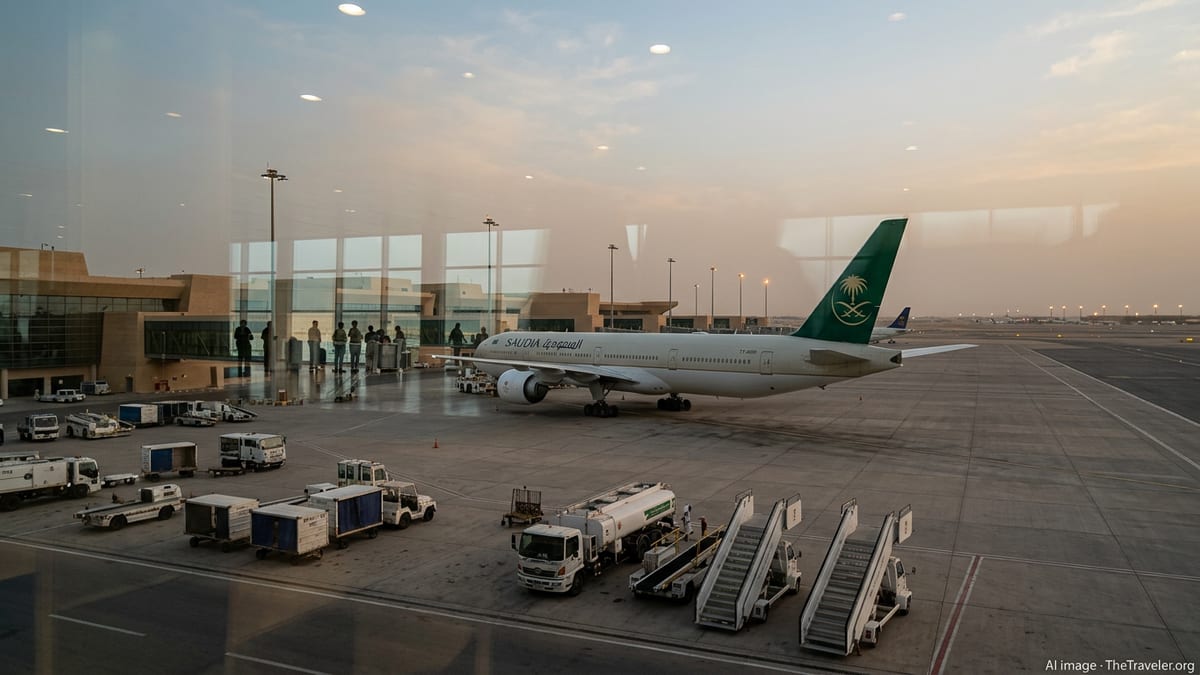
Eight Destinations Affected as Saudia Extends Suspension
Saudia confirmed this week that flights to Amman, Kuwait City, Abu Dhabi, Dubai, Doha, Bahrain, Moscow and Peshawar remain suspended as a safety precaution, with the measure currently running through March 6 at 23:59 GMT. The carrier cited “ongoing regional developments” and evolving risk assessments as the basis for the decision, which impacts both inbound and outbound services on the affected routes.
The move follows an initial round of cancellations introduced after a sharp escalation in the conflict involving the United States, Israel and Iran, which has triggered widespread airspace closures and re-routings across the region. By formally extending the suspension window, Saudia has signaled that it does not expect a rapid normalization of conditions on key Gulf and regional corridors.
Saudia said its Emergency Coordination Center is monitoring the situation around the clock in coordination with national and international authorities. The airline has reiterated that passenger and crew safety remains its overriding priority, and that commercial considerations are secondary as long as security risks around certain airspaces and destinations remain elevated.
Customers booked to travel to any of the eight cities are being contacted directly through the details linked to their reservations, with options that typically include rebooking on later dates, rerouting where feasible, or requesting refunds according to fare conditions.
Regional Security Concerns Ripple Across Middle East Skies
The decision by Saudia comes against a backdrop of sweeping disruptions to commercial aviation in the Middle East following strikes and counterstrikes between the United States, Israel and Iran. Several countries, including Bahrain, Iraq, Kuwait, Qatar, Syria and the United Arab Emirates, have at various points closed or tightly restricted their airspace, forcing airlines to cancel flights or adopt longer, more circuitous routings around conflict zones.
Flight-tracking data in recent days has shown reduced or absent traffic over parts of Iran, Iraq, Syria and Israel, along with heavily thinned schedules in some Gulf hubs. Major international carriers have suspended services to a range of Middle Eastern destinations or announced temporary embargoes on overflying specific territories, citing guidance from aviation safety regulators and internal security assessments.
For regional airlines, including Saudia, these conditions present a layered challenge: in addition to the direct risk to aircraft operating near potential military activity, reduced navigable airspace complicates contingency planning and leaves fewer viable diversion or alternate airport options. Industry analysts note that even when specific cities remain technically open, the surrounding airspace picture may render safe, efficient operations unworkable in the short term.
The disruption is being felt far beyond the immediate conflict zone. The Middle East sits astride vital air corridors linking Europe and Africa with South and East Asia, and any prolonged restrictions can reverberate through global aviation networks, adding time and cost to long-haul journeys or forcing large-scale cancellations.
Impact on Travelers, Tourism and Business Links
For travelers, Saudia’s suspensions add another layer of uncertainty at the start of a busy spring travel period. Passengers bound for or connecting through Amman, Kuwait, the United Arab Emirates, Qatar and Bahrain face itinerary changes that may involve last-minute rerouting via alternative hubs or postponing trips altogether.
Tourism and business flows are also taking a hit. Popular visitor gateways such as Dubai, Abu Dhabi and Doha serve as major transfer points for passengers heading to and from Saudi Arabia, while Amman is a key entry point for travelers visiting Jordan’s cultural and historical sites. The temporary loss of direct connectivity to these cities constrains both inbound tourism to Saudi Arabia and outbound regional travel for Saudi residents.
Corporate travel and trade links are being disrupted as well. Moscow and Peshawar, though outside the immediate Gulf corridor, form part of Saudia’s wider international network, supporting energy, construction, labor and investment ties between Saudi Arabia, Russia and Pakistan. With direct flights suspended, businesses reliant on timely in-person meetings or project oversight must turn to virtual alternatives or accept longer, more complex travel routings.
Travel agencies report a surge in demand for real-time information as clients seek clarity on which flights are still operating and what options exist for rebooking. Industry observers say clear communication and flexible policies from airlines will be critical to maintaining customer confidence during a period of heightened volatility.
How Saudia Is Managing Operations and Passenger Support
Operationally, Saudia is emphasizing coordination and communication as it navigates the rapidly shifting environment. The airline’s emergency coordination center is in continuous contact with aviation authorities, security agencies and airport operators to reassess risk levels on affected routes and to evaluate when and how services might safely resume.
Passengers are being urged not to proceed to the airport unless they hold a confirmed booking on a flight that Saudia has explicitly indicated is operating. Instead, customers are advised to check their flight status through official airline channels and to monitor notifications sent to the email addresses and phone numbers associated with their reservations.
Where flights have been canceled, Saudia is offering re-accommodation options, subject to availability, including the possibility of rerouting via alternative cities that remain open and are deemed safe. In some cases, waivers on change fees or fare differences may be applied, particularly for tickets issued before the most recent escalation in tensions, though specific conditions can vary by fare type.
The carrier has also called on passengers to allow additional time for security procedures and potential congestion at airports that are still operating, as shifting travel patterns and consolidation of services can push more travelers onto fewer available flights and routes.
Broader Middle East Aviation Outlook in Coming Days
Saudia’s temporary suspension of flights to eight cities highlights the fragility of air connectivity in a region where geopolitical developments can affect aviation with little notice. While some airlines may attempt to restore limited services as security advisories evolve, industry experts caution that a full return to normal schedules is unlikely until there is clearer and sustained de-escalation on the ground.
In the coming days, attention will focus on whether regional airspace restrictions are eased or extended, and on how quickly carriers can adapt their networks if conditions stabilize. Even if formal closures are lifted, some airlines may opt to avoid certain overflight regions for longer periods, prioritizing conservative risk management over rapid capacity restoration.
For travelers with upcoming plans involving the Middle East, flexibility and vigilance remain essential. Aviation and travel industry groups continue to advise passengers to stay closely aligned with airline communications, to consider alternative routings where possible, and to maintain contingency plans as the situation evolves.
For now, Saudia’s stance encapsulates the region’s aviation mood: cautious, highly alert and firmly focused on safety, with commercial ambitions temporarily subordinated to the complex realities of flying through one of the world’s most strategically sensitive airspaces.