

More news on this day
Saudia has issued an urgent suspension of flights linking Riyadh with key Gulf gateways including Abu Dhabi, Kuwait City, Dubai and Bahrain, as rapid-fire airspace closures across the Middle East throw regional and long-haul travel into disarray.
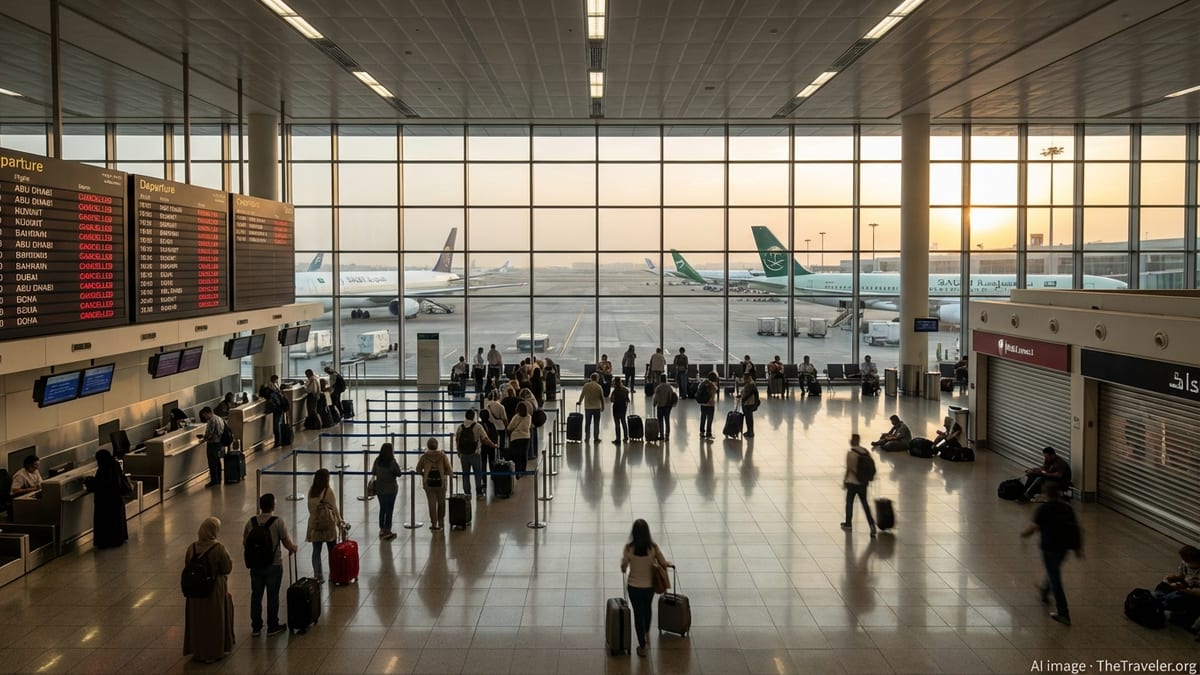
Saudia Issues Emergency Suspension to Eight Destinations
Saudi Arabia’s flag carrier confirmed on Saturday that it has halted services to and from a cluster of high-traffic regional cities, citing evolving security developments and widespread airspace restrictions. The suspensions cover flights between Saudi airports and Amman, Kuwait, Dubai, Abu Dhabi, Doha, Bahrain, Moscow and Peshawar, with the notice explicitly tying the move to regional airspace uncertainty.
In a statement released in Riyadh, the airline said the cancellations are effective until March 2 at 23:59 GMT, underscoring that the measures are temporary but subject to change at short notice. Saudia stressed that affected passengers are being contacted directly through the details attached to their bookings and urged travelers not to proceed to the airport without first confirming their flight status.
The carrier emphasized that passenger and crew safety remains its overriding priority, framing the suspensions as a precaution aligned with guidance from aviation regulators and security authorities. Saudia’s Emergency Coordination Center is working in tandem with Saudi and international agencies as the airspace picture shifts hour by hour.
The move effectively severs, at least for several days, routinely busy corridors between Riyadh and neighboring hubs such as Abu Dhabi, Kuwait and Bahrain, concentrating pressure on any remaining operational routes within the kingdom.
Gulf Airspace Closures Hit Riyadh, Abu Dhabi, Kuwait and Bahrain Links
The Saudia decision comes against the backdrop of abrupt airspace closures that have swept across much of the Gulf and wider Middle East following coordinated United States and Israeli strikes on Iran earlier on Saturday, and subsequent Iranian retaliation. Authorities in Kuwait, Bahrain and other Gulf states have closed or severely restricted their skies, prompting airlines to pull services and reroute aircraft around emerging risk zones.
Travel advisories issued by Saudi airports in Riyadh, Jeddah and Dammam urged passengers headed to destinations affected by the unfolding events to verify flight details directly with airlines before leaving home. Operators warned that departure boards are changing in real time as new airspace notices are issued and updated.
In the United Arab Emirates, airspace has been partially shut, and Dubai’s two airports have suspended all flights until further notice, effectively freezing one of the world’s busiest international hubs. With Abu Dhabi also affected by the broader closure of UAE airspace, routes between Saudi cities and the Emirati capitals have been among the first to be halted, disrupting both point to point travel and global connections that rely on Gulf transit.
Regional aviation analysts say the sudden loss of Kuwait, Bahrain and UAE skies removes critical waypoints between Europe, Asia and Africa, forcing airlines to plot longer and more fuel intensive detours or pause operations entirely until security agencies deem the corridor safe again.
Ripple Effects for Regional and Global Carriers
Saudia is one of many airlines now redrawing their route maps across the Gulf. Pakistan International Airlines has temporarily suspended flights to the UAE, Bahrain, Kuwait and Doha, while rerouting services bound for Saudi Arabia to avoid conflict affected zones. Other regional carriers have issued similar advisories, warning that schedules may be revised repeatedly over the coming days.
The closures have also affected European, Asian and African airlines that normally overfly Iran, Iraq and the Gulf on long haul routes. Some aircraft already in the air have been forced to divert or return to their departure airports after airspace shut while they were en route, adding to operational complexity and costs.
Industry data providers are tracking hundreds of cancellations and diversions, with the tally expected to climb if airspace restrictions extend beyond the initial time frames signaled by authorities and travel advisories. Travel agents in key feeder markets have begun issuing their own alerts, warning clients that services operated by Emirates, Qatar Airways and other Gulf carriers are either paused or heavily curtailed.
Aviation consultants note that if the disruptions remain brief, the immediate impact will be limited largely to stranded passengers and a spike in fuel and crew costs. A more prolonged closure of Kuwaiti, Bahraini, Emirati and surrounding airspace, however, could reshape schedules and fares on some of the world’s busiest east west routes.
Passengers Face Cancellations, Airport Congestion and Changing Advice
For travelers holding tickets into or through Riyadh, Abu Dhabi, Kuwait, Manama and other affected cities, the most visible impact is a wave of last minute cancellations and lengthy queues at airport service desks. With airline contact centers under heavy pressure, some passengers are turning up at terminals only to discover that their flights have been pulled or rerouted.
Saudi aviation authorities and airport operators are urging travelers to rely on official airline channels and airport notices for accurate information rather than social media rumors. Carriers including Saudia are offering fee free rebooking and, in some cases, refunds, though conditions vary by ticket type and route.
Travel advisors recommend that passengers booked to transit through Gulf hubs over the next several days remain flexible about routing and dates. In practical terms, that may mean accepting longer journeys via alternative hubs in Europe or South Asia, or postponing nonessential travel until there is clearer guidance on when Gulf airspace, particularly around Riyadh, Abu Dhabi, Kuwait City and Bahrain, will fully reopen.
With governments in the region warning that the security environment remains fluid, industry observers expect airlines to continue adjusting schedules in short cycles, sometimes with only hours between new regulatory notices and operational decisions.
What the Disruption Means for Future Gulf Travel
The latest wave of suspensions underscores how quickly geopolitical shocks can reverberate through aviation networks anchored in the Gulf. Over the past decade, cities such as Riyadh, Abu Dhabi, Dubai, Kuwait City and Manama have positioned themselves as indispensable nodes connecting continents; the current closures reveal how exposed those hubs are when surrounding airspace is suddenly constrained.
In the near term, airlines are likely to prioritize restoring core routes that connect residents and key business centers once regulators allow, with secondary leisure or connecting services returning later. Travelers may see more conservative scheduling, with additional buffer times built into flight plans to accommodate potential reroutes around sensitive areas.
Longer term, industry experts suggest that carriers and regulators will revisit contingency planning for conflict related airspace shocks, including alternative routings, cross border coordination mechanisms and clearer communication protocols with passengers. For now, the focus remains firmly on managing today’s urgent crisis, with Saudia’s sweeping suspensions between Saudi cities and nearby hubs in Abu Dhabi, Kuwait and Bahrain emblematic of the scale and suddenness of the disruption.
As the situation develops, travelers and the industry alike are watching for the first signs of a phased reopening of airspace, which will determine how fast normal traffic patterns across the Gulf can resume and how deeply this episode will shape perceptions of air travel reliability in the region.