

More news on this day
Travelers at Savannah/Hilton Head International Airport faced fresh disruption this weekend after six flights operated by Delta Air Lines, PSA Airlines and Mesa were cancelled, interrupting key connections to Atlanta, Charlotte, Nashville, Boston, Baltimore and other major cities at the height of the spring travel rush.
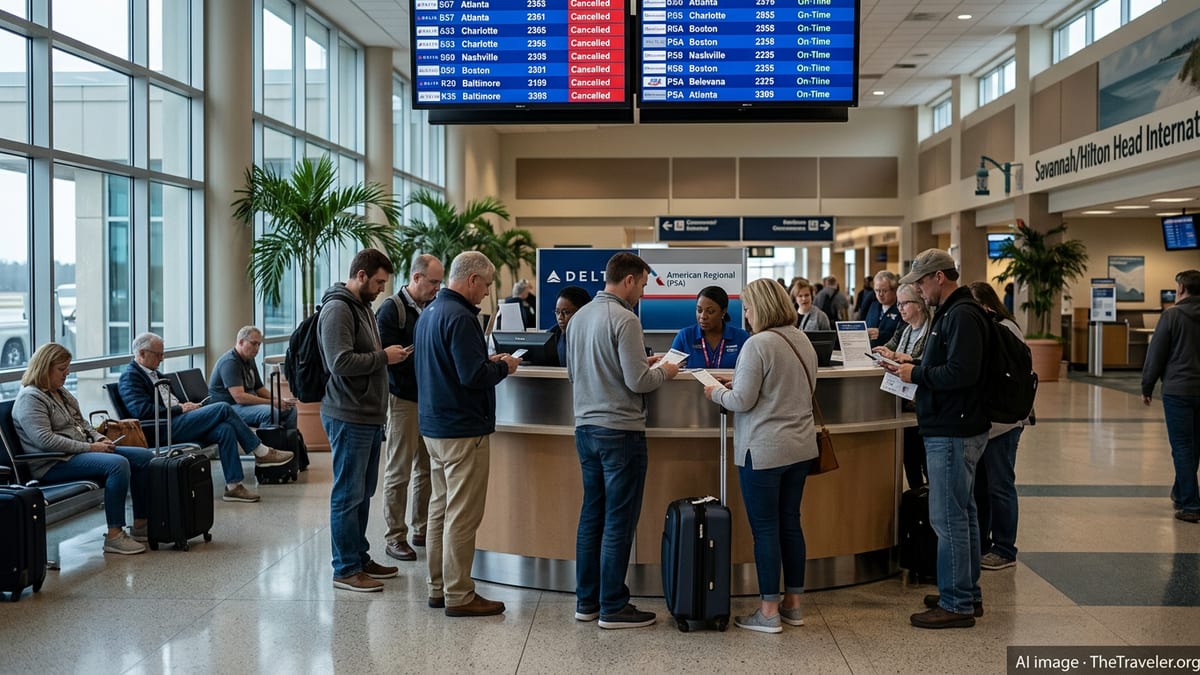
Six Cancellations Hit Key Savannah Connections
Operational data reviewed on March 8 showed a cluster of six cancellations tied to Delta, regional carrier PSA Airlines and Mesa at Savannah/Hilton Head International Airport, an important coastal gateway for both Georgia and South Carolina. The affected services included high-demand links to major hubs such as Atlanta and Charlotte, as well as point-to-point routes to Nashville, Boston and Baltimore that feed both leisure and business traffic.
The cancellations, which unfolded across the morning and afternoon schedule, reduced options for travelers relying on Savannah as a launch point for cross-country and international itineraries. With many passengers ticketed on connecting journeys through Atlanta and Charlotte, the loss of even a handful of departures translated into missed onward flights and extended unplanned layovers.
While Savannah typically records a modest cancellation rate relative to larger U.S. airports, the targeted nature of the latest disruptions magnified their impact. Flights to Atlanta and Charlotte act as lifelines into two of the country’s busiest hub systems, so any interruption quickly cascades beyond the immediate region.
Airport representatives did not immediately release a full breakdown of passenger counts, but airline sources indicated that each cancelled sector was expected to be near or at capacity given strong early March demand and limited spare seats on alternative departures.
Weather and Network Strain Behind Latest Disruptions
The cancellations at Savannah occurred against a backdrop of wider operational strain across the national network, following rounds of severe weather that repeatedly disrupted hubs including Atlanta in recent days. Thunderstorms, low visibility and knock-on crew and aircraft positioning issues have produced rolling schedule adjustments that are still filtering through regional airports.
Delta, which operates multiple daily flights between Savannah and Atlanta as well as links to other hubs, has been working to stabilize its schedule after storms and ground delay programs slowed operations at Hartsfield-Jackson Atlanta International Airport. When a hub is forced to trim operations, spokes like Savannah often absorb secondary cancellations as carriers prioritize core trunk routes and long-haul services.
PSA Airlines, which flies regional jets under the American Airlines brand, and Mesa, which operates for several major network carriers, faced similar pressures. Regional operators typically run tighter fleets with fewer spare aircraft and crews, meaning that a disruption in one city can easily propagate to others, especially on weekends when aircraft utilization is high.
Industry analysts note that early March is a vulnerable period for weather-related disruptions and that even routine storms can have outsized effects when airlines are operating near peak capacity. In that environment, cancellations at a single midsize airport can represent only a small fraction of national totals yet still cause significant local inconvenience.
Passengers Scramble to Rebook as Options Narrow
Inside Savannah/Hilton Head International, affected travelers on Saturday reported long waits at airline service counters and on customer-service phone lines as they sought to secure new itineraries. With key departures to Atlanta, Charlotte and northeastern cities removed from the board, some passengers were offered rebookings that added many hours or even an additional day to their journeys.
Others opted to drive to larger regional airports such as Atlanta, Jacksonville or Charleston in hopes of accessing a broader range of flight options. For travelers heading to cities like Boston and Baltimore, where nonstop alternatives from Savannah are limited, that meant quickly arranging one-way rental cars or ride-share trips out of pocket before seats elsewhere disappeared.
Families returning from spring break getaways and cruise connections were among those most affected, as many had little flexibility in work and school schedules. Business travelers with meetings scheduled for Monday reported weighing whether to press for same-day solutions involving multiple connections or to reschedule plans entirely.
Airlines reminded customers that in the event of a cancellation initiated by the carrier, travelers are generally eligible for rebooking at no additional cost on the next available flight with open seats. In some cases, particularly when overnight stays are required, hotel or meal vouchers may be offered subject to each airline’s policies and the underlying cause of the disruption.
Airport and Airlines Coordinate Recovery Efforts
Airport operations staff at Savannah/Hilton Head International worked with airline station managers to adjust gate assignments, manage crowding in the departures hall and keep information boards updated as schedules shifted. Public address announcements urged passengers to monitor their airline apps and email notifications closely, as gate changes and rolling delays remained possible even for flights still listed as operating.
Delta and other impacted carriers activated their standard irregular-operations playbooks, calling in additional customer-service staff, expanding access to self-service rebooking tools and, where feasible, upgauging aircraft on remaining flights to absorb displaced passengers. Airline representatives stressed that safety and regulatory crew-rest requirements remained paramount even amid pressure to restore capacity quickly.
The airport’s information desks fielded questions from travelers about ground transportation, nearby hotels and estimated recovery times. Local tourism and hospitality partners, including hotels near the terminal, saw a spike in last-minute bookings from stranded passengers who were unable to depart until Sunday or Monday.
By late afternoon, operations appeared to be stabilizing, but the reduction in frequencies on several routes meant that some customers would remain out of position for at least another news cycle. Analysts said full normalization of seat availability on popular Savannah routes could take several days, depending on how smoothly operations run at upstream hubs.
What Savannah Travelers Should Do Next
Air travel experts recommend that passengers flying into or out of Savannah over the coming days proactively check the status of their flights well before leaving for the airport and again upon arrival at the terminal. Even with the immediate wave of cancellations now identified, further adjustments are possible if aircraft and crews remain displaced across the national network.
Travelers with flexible schedules are advised to consider off-peak departures, including early-morning or late-evening flights, which may offer better odds of operating on time and more open seats for rebooking. Those with tight connections in Atlanta, Charlotte or other hubs might look at slightly longer layovers to allow extra buffer for minor delays that could otherwise cause missed onward flights.
For future trips, consumer advocates suggest building in additional contingency time when traveling through hub-and-spoke systems during active weather seasons, especially when using smaller origin airports such as Savannah/Hilton Head International. Purchasing tickets on a single itinerary rather than separate legs can also make it easier to secure rebooking assistance when disruptions occur.
With airlines, airports and travelers all adjusting to another weekend of turbulence in the U.S. aviation system, the situation at Savannah underscores how quickly a small number of cancellations can reverberate across a region’s air links. For many passengers, the focus now is simply on getting where they need to be and hoping that the next round of storms stays away from the radar.