

Late afternoon view contrasting Botswana's Savuti and Khwai landscapes, featuring wildlife and local guide.
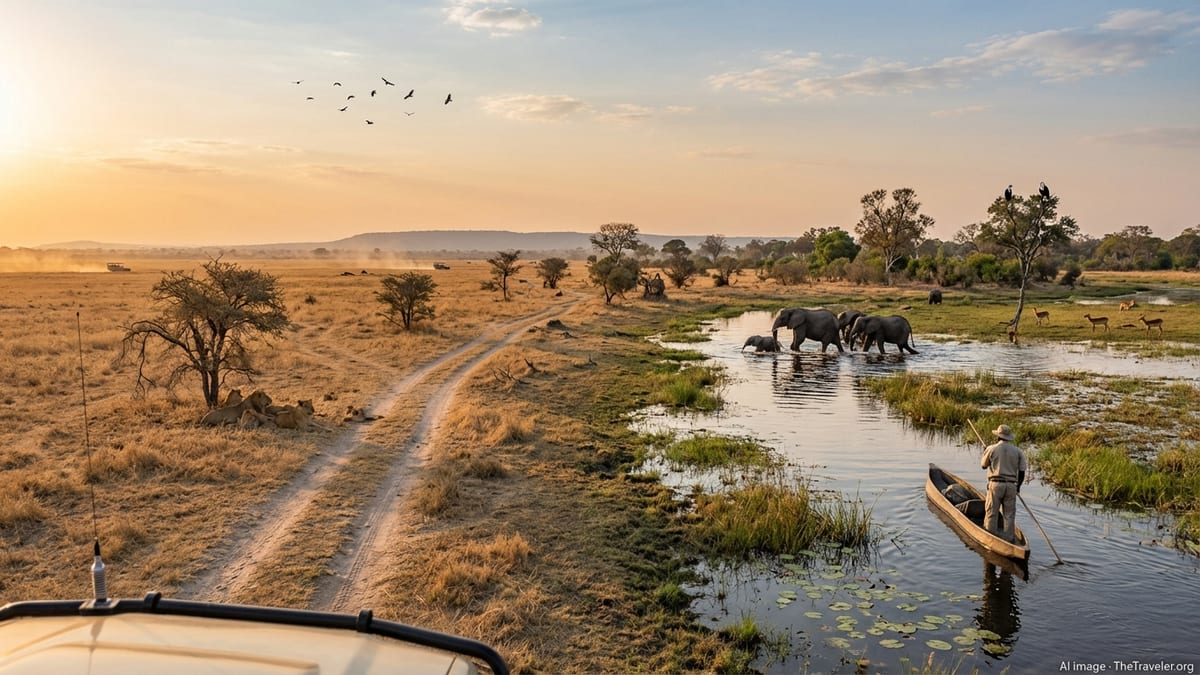
If you are planning a Botswana safari and find yourself trying to choose between Savuti and Khwai, I have been in your shoes. I split my time between these two legendary areas, hoping to answer one central question for myself: is it better to base a trip around Savuti’s raw predator territory or Khwai’s riverine, mokoro-style safari? I came away with a strong sense of how different these destinations actually feel on the ground, how they work for different travel styles and budgets, and what I would personally do differently next time.
Getting Oriented: Where Savuti and Khwai Really Are
Before I went, I thought of Savuti and Khwai as “two spots in northern Botswana,” more or less interchangeable stops on an Okavango / Chobe circuit. That assumption did not survive the first day of driving. On the map they are not that far apart, but in character they sit on opposite ends of a spectrum between arid predator country and lush Delta-fringe river country.
Savuti lies in the southwest of Chobe National Park, wrapped around the Savuti Channel and Savuti Marsh, part of the broader Mababe Depression that links the Okavango Delta to Chobe. The Channel is famously temperamental: it can run strongly for years and then dry up for decades, with big ecological consequences. This is big-sky, semi-arid country with open grassland, knobthorn and mopane woodland, dust, and long views that feel like classic “lion plains.”
Khwai sits on the north-eastern fringe of the Okavango Delta, just outside the Moremi Game Reserve, along the Khwai River and its associated floodplains and woodlands. The river acts as a lifeline and corridor, drawing animals between the Delta and Moremi and concentrating wildlife along its banks. It is greener and more varied than Savuti: leadwood forests, papyrus-lined channels, open floodplains, and pockets of lagoon. It immediately felt more like an “Okavango experience” to me, complete with mokoro (dugout canoe) trips when water levels allow.
That difference in setting spills into almost every aspect of the trip: the way you game-drive, the light, the dust, the heat, the sounds at night, and the kind of sightings you tend to get. I found that you do not just visit “Botswana” here; you choose your ecosystem quite deliberately, and it shapes your days.
Wildlife & Predators: Brutal Savuti vs Layered Khwai
On paper, both Savuti and Khwai promise serious predators. On the ground, they delivered in very different ways. Savuti lived up to its reputation as a lion and hyena battleground, while Khwai felt more like a layered wildlife tapestry where predators are part of a broader water-driven drama.
In Savuti, the density of big game felt almost aggressive during my late dry-season stay. The Savuti Marsh and surrounding woodland were dotted with elephants, buffalo, wildebeest and zebra. Lions seemed to be everywhere. I watched one pride move parallel to the vehicle for half an hour, then later saw another pride feeding on a buffalo carcass while hyenas circled. The open terrain makes it easier to spot cats at distance. I also saw wild dogs, though that felt more like a stroke of luck than an everyday event. It was intense and sometimes brutal. If your goal is to stack serious predator sightings quickly, Savuti is very hard to beat.
Khwai took longer to reveal its teeth. My first game drive along the river was all about elephants, hippos, red lechwe, and a cacophony of birdlife. It almost felt too gentle after Savuti. Then, late one afternoon, we followed fresh drag marks off a floodplain and found a leopard with a reedbuck in a sausage tree. On another day, we watched wild dogs cross a channel and hunt on the opposite bank. Lions were present too, but the vegetation and winding river make them harder to pick up at a distance. I had to work harder for predator sightings in Khwai, but the backdrop of water, reeds and forest made those moments more atmospheric when they came.
My main surprise was that Savuti’s reputation is deserved, but also limiting if you expect non-stop action every drive. There were still quiet spells, just longer stretches of sandy road between sightings. In Khwai, the variety of habitats meant that even when predators were hiding, there was always something interesting: a fish eagle hunting, a herd of red lechwe bounding through shallow water, or elephants crossing the river in glowing dusk light. If you measure value purely in predator counts per day, Savuti wins. If you care about diversity of scenes as much as kill shots, Khwai quietly catches up.
Land vs Water: Predator Territory or River Safari
This was the heart of my own dilemma before the trip: did I want the archetypal dry-land predator experience of Savuti, or the river-and-mokoro magic of Khwai? After doing both, I can say this is not a subtle distinction. The daily rhythm and feel of your safari shift dramatically depending on whether you are tied to dry land or have water at your doorstep.
Savuti is, for all practical purposes, a classic land-based safari. When the Savuti Channel is flowing it adds scenic drama and attracts more wildlife, but it does not turn Savuti into a water-activity hub. Your days are defined by game drives in open vehicles and, in some cases, short walks if you are with certain mobile operators and conditions allow. I never felt shortchanged by the lack of boat or mokoro activities, because the landscape itself and the big-game density kept my focus glued to the plains. But if your dream of Botswana involves gliding silently through reeds in a mokoro, Savuti alone will disappoint you.
Khwai, by contrast, is proudly amphibious whenever water levels permit. I split my time between classic game drives along the river, night drives in the community concession, and mokoro excursions on quiet side channels. Drifting at eye level with frogs and water lilies while a herd of elephants fed on the bank above me was one of those rare travel moments that felt genuinely different from anything I had done in other African parks. It is not always available: water levels vary seasonally and year by year, and lodges will sometimes switch to walks or extra drives when channels are too low. That variability is worth factoring in if you are fixated on the mokoro idea.
This led to my first major decision moment: how many nights to allocate to each. Initially I had booked more nights in Savuti because I was obsessed with predators. After seeing how rich the water experience was in Khwai, I regretted not balancing the trip more evenly. If I had to redo the itinerary, I would give Khwai an extra night, particularly if traveling in the dry season when the river becomes such a crucial lifeline and the mokoro operations are most likely to be running.
Access, Roads, and Practical Logistics
Logistics do not get as much attention as lion photos on social media, but in Botswana they matter a lot. The combination of deep sand, seasonal mud and long distances can make or break a trip, especially if you are self-driving. I learned that the hard way on the Savuti approach.
Savuti is essentially a pocket of Chobe National Park, and reaching it independently involved serious 4x4 driving for me. In the dry season, the sand tracks between Savuti, Mababe and the main access routes can get deeply churned up. I watched more than one vehicle bogged down in thick sand and helped dig out one rental whose driver had kept tyre pressures way too high. There are no fuel stations between the main towns, and no casual resupply options once inside, so every miscalculation with fuel or water becomes a real problem. In the wet season, the same routes can become muddy and sometimes impassable. If you are not experienced with off-road driving, I would not treat Savuti as an easy first experiment.
Khwai, by comparison, felt more forgiving though still properly wild. Approaches from Maun via Moremi or the dirt roads to the community concession are rough, with sections of sand and water crossings, but I found navigation a little easier and the driving slightly less punishing than the long haul into Savuti. The presence of Khwai village and the community-run tourism infrastructure gives the area a slightly less isolated feel, and there is an airstrip that makes fly-in itineraries straightforward. Both destinations are commonly visited on guided mobile safaris, and that option removes almost all of the logistical stress that I shouldered on my own.
A second big decision moment for me was whether to self-drive both areas or let a mobile operator handle one leg. In hindsight, I would still self-drive Khwai but seriously consider joining a guided mobile or using lodge vehicles for Savuti. The driving there took real concentration and energy, which is not ideal when you are trying to enjoy wildlife and long days in the field. Having compared both approaches, I rate Savuti as much better suited to either experienced 4x4 drivers or fly-in guests who let the lodge deal with vehicle wear and tear and park logistics.
Costs, Camps & Comfort Levels
Botswana is never a cheap safari destination, and both Savuti and Khwai sit in the premium tier. That said, there are meaningful differences. I felt those differences most sharply when I started pricing camps and comparing what I actually got for my nightly rate.
Typical peak-season per-night prices in both areas for mid-range mobile camps are well into the hundreds of dollars per person, with permanent lodges reaching into four figures. Recent price surveys show that mid-range safari rates in Khwai often sit slightly below those in Savuti, and community-run options can shave a bit more off. Camping in Savuti’s public campsite is generally more expensive than camping around Khwai, reflecting both demand and the location inside Chobe National Park. Where I noticed it most was in park and campsite fees stacking up day after day in Savuti, especially once vehicle entry and extra activities were added.
In terms of actual comfort, both areas now offer a range from bare-bones camping to high-end lodges with pools and fine dining. In Savuti, I split time between the public campsite and a more upscale tented camp. The campsite was perfectly adequate but basic: shared ablutions, dusty pitches under camelthorns, and plenty of nocturnal animal traffic. At night I could hear lions very close by, which was thrilling but definitely not restful. The tented camp was a big step up in comfort but came with a price tag that made me very conscious of every extra drink and add-on.
Khwai’s accommodation felt more varied. Around the community concession, there are budget-friendly mobile setups and community campsites as well as luxury lodges perched along the river. I stayed in a simple but comfortable tented camp that struck a good balance: private bucket shower, flush toilet, proper beds, and well-prepared meals without the formality and cost of the top-tier lodges. Because Khwai is outside the national park, some operators can also be a bit more flexible with drive times and activities, which translated into a feeling of better “value per hour” on safari for me.
My third big decision moment was whether to splurge on one ultra-luxury property or spread my budget across more nights in comfortable but not over-the-top camps. Having now seen how good the guiding and wildlife are independent of heavy luxury, I would personally prioritize more nights over maxing out on lodge opulence in both Savuti and Khwai. If I had to pick one area where an extra-comfortable camp makes more of a difference, I would lean toward Savuti simply because of the harsher climate and dust; having a truly comfortable base there felt more important than in the breezier, river-cooled Khwai.
Crowds, Rules, and the Feel of Each Area
One assumption I had before arriving was that Savuti, as part of a big national park, would feel strictly controlled and lightly trafficked, while Khwai, being community-run and outside Moremi, might feel busier. The reality was messier and depends heavily on season and exact location.
In Savuti, vehicle numbers were generally manageable, but at high-profile sightings like a lion kill I still found myself sharing space with several other vehicles, including lodge cars and self-drivers. Park rules prohibit night drives and off-road driving for the general public, which protects the environment but also limits how flexible you can be at dawn and dusk. The result is a classic, almost old-school national park feel: you follow established tracks, respect gate opening times, and accept that some animals simply disappear into mopane beyond your legal reach.
Khwai felt much more fluid. In the community concession, operators are allowed to conduct night drives and, to a degree, go off-road. That meant we could stay with a leopard after dark, follow wild dogs across open plains, and use spotlights to pick up genets, civets and owls. It made the whole experience feel more immersive and spontaneous. The downside is that in peak season, especially along the more accessible stretches of river, vehicle traffic can be heavy and the most famous sightings can attract a crowd. I had one frustrating afternoon where a pack of wild dogs ended up encircled by vehicles jostling for position, and I cut the sighting short simply because I no longer felt good about the disturbance.
In terms of overall atmosphere, Savuti felt more remote and raw but also more regulated and structured. Khwai felt more intimate and adventurous but sometimes busier. If you are uncomfortable with the idea of night drives or off-road approaches to predators, you may actually prefer the stricter rules of Savuti. If, like me, you enjoy stretching the day with a spotlight and seeing what emerges after dark, Khwai gives you freedoms that you will not legally have inside Chobe or Moremi.
Seasonality, Weather, and When I Would Go Again
Both Savuti and Khwai change dramatically between the rainy season (roughly November to March) and the dry season (April to October), and your experience is heavily shaped by when you go. I chose late dry season for my own trip, expecting heat and dust but maximal wildlife concentration. That gamble paid off in some ways and backfired slightly in others.
In Savuti, the late dry season means the grass is low, water sources are limited and the Savuti Marsh becomes a magnet for herds and the predators that follow them. Visibility is excellent, but daytime temperatures can be brutal and the dust relentless. I found afternoon drives physically tiring simply from the heat and the suspended dust in the air. If you are heat-sensitive or traveling with young children, this is something to take seriously. Earlier in the dry season, conditions are cooler but wildlife not quite as concentrated; during the rains, the area greens up, some roads become difficult and game disperses more widely.
Khwai in the late dry season was a joy. The Khwai River still carried enough water to support hippos, mokoro trips, and lush riverine vegetation, while the surrounding areas were drying out, pushing animals towards the water. Temperatures were high but more tolerable than Savuti’s open plains, thanks in part to shade and breezes along the water. Birdlife was prolific. In a wetter year, or earlier in the season, some tracks can become muddy and a few crossings tricky, but the mix of marsh, woodland and drier islands tends to offer something in most months, just with different emphases.
If I were planning again, I would still aim for the dry season, but I would shift slightly earlier, perhaps August or early September rather than the very end of the season. That compromise would retain good wildlife density in both Savuti and Khwai while dialing down the most oppressive heat and dust. I would also be more deliberate about checking recent water levels in Khwai before committing to mokoro-heavy marketing promises. Conditions change year to year, and I have learned not to assume that a glossy brochure’s water level photos match the month I am visiting.
Who Each Place Is Really Best For
After living with both sides of the Savuti vs Khwai equation, it became clear to me that this is not a “which is better” question so much as a “who is it better for and when” question. I went in thinking I needed to pick a winner. I left with a more nuanced sense of which traveler profiles fit each place best.
Savuti is, in my view, the ideal choice for travelers who are fixated on big predators in a raw, open landscape and are willing to accept some discomfort to get it. If you have already done softer Delta safaris and you want to turn up the intensity, Savuti is a logical next step. It also suits photographers who prioritize long sightlines and clear, unobstructed views of animals on open plains. However, it is less suited to people who are anxious about remote conditions, extreme heat, or challenging driving. The combination of dust, strict park rules and the general seriousness of the environment can make it feel less “soft adventure” and more hardcore.
Khwai, on the other hand, is incredibly versatile. It works well for first-time visitors to Botswana who want a Delta feel without committing to extremely expensive inner-Delta lodges. It also suits mixed-interest groups: birders, photographers, and families who want a blend of river scenery, classic game drives, and (when available) mokoro experiences. The community-based nature of much of the concession means that your spend can contribute directly to local projects, which was an added ethical positive for me. The main drawbacks are that some stretches can get busy, and if you go at the wrong time you might not get the full water-activity portfolio you were sold.
If forced to choose only one, I would now lean toward Khwai for most first-timers and more balanced travelers, and reserve Savuti for those who already know they want something intense and predator-focused. My honest recommendation, though, is to experience both if your budget and time allow, but to adjust the balance of nights according to your priorities and tolerance for discomfort.
The Takeaway
Looking back on my days in Savuti and Khwai, the safari I actually lived was a lot more nuanced than the marketing slogans of “predator territory” vs “river safari” suggest. Savuti did deliver the raw predator action I had hoped for. I saw lions on kills, watched hyenas brawling over carcasses, and felt that unnerving thrill of hearing a pride calling from just beyond the firelight. But it also left me tired, dusty, and at times slightly overwhelmed by the harshness of the environment and the intensity of the driving.
Khwai gave me something subtler and, in many ways, more sustainable over time: long, quiet mokoro drifts at sunrise, elephants ghosting through riverine woodland, wild dogs drifting in and out of the reeds, and night drives where the bush suddenly filled with smaller, often overlooked creatures. It was not as relentlessly dramatic as Savuti, and some drives were quiet in terms of headline predators, but the variety and sense of place stuck with me more strongly once I got home.
If your dream safari is to sit with lions every day, accept the dust and effort and go to Savuti, ideally with an experienced guide or mobile operator who can take the driving burden off your shoulders. If your dream is to feel the pulse of the Okavango without blowing your entire budget on inner-Delta lodges, prioritize Khwai and make sure to align your travel dates with likely good water levels. If you can do both, I would now structure it as more nights in Khwai and slightly fewer in Savuti, rather than the other way around.
What I learned the hard way is that in Botswana, the environment shapes your experience as much as the wildlife does. Savuti’s big skies and hard edges are unforgettable but demanding. Khwai’s water and woodlands are softer but no less wild. Knowing which of those landscapes fits your temperament and travel style is the real key to making the right call between predator territory and river safari.
FAQ
Q1: If I can only visit one, should I choose Savuti or Khwai?
If this is your first safari in Botswana and you want a balance of scenery, activities and wildlife, I would personally choose Khwai. You still have excellent predator chances, but you also get river views, possible mokoro trips, night drives and a mix of habitats. I would reserve Savuti for travelers who already know they want a more intense, predator-heavy experience and are comfortable with more heat, dust and stricter park rules.
Q2: How many nights should I spend in each area?
If you are doing both, I found that three nights in Khwai and two in Savuti was a good balance, and I wish I had structured my own trip that way instead of favoring Savuti. Three nights gives you enough time to see Khwai by vehicle, by mokoro (if available) and on a night drive, while two nights in Savuti are usually enough to experience its predator drama without getting burnt out by the harsh conditions.
Q3: Is self-driving realistic in Savuti and Khwai?
It is realistic for experienced 4x4 drivers who are comfortable with deep sand, potential mud and complete self-sufficiency, but I would not recommend it as a casual first-time off-road adventure. In Savuti especially, the tracks can be very sandy in the dry season and very muddy in the rains, and there is no fuel inside the park. In Khwai, the driving is slightly more forgiving, but you still need to be prepared for water crossings and remote conditions. If you are unsure, joining a guided mobile or staying in lodges that provide game drives is a far less stressful option.
Q4: When is the best time of year to visit Savuti and Khwai?
For both areas, the dry season from about May to October offers easier wildlife viewing as vegetation thins and animals concentrate around remaining water. I found late dry season especially productive, though hot and dusty. In Savuti, the dry months mean great predator action but tougher daytime conditions. In Khwai, the dry season highlights the river as a lifeline and can allow for excellent mokoro and game viewing. The rainy season brings lush greenery and fewer people but more dispersed wildlife and sometimes difficult roads.
Q5: Will I definitely be able to do a mokoro safari in Khwai?
No, it depends on water levels, which vary both seasonally and from year to year. In a good year, mokoro trips typically run in the dry season when floodwaters from the Okavango Delta fill the channels. In drier years or at the wrong shoulder times, some channels may be too low or disconnected. Before locking in your trip solely for mokoro, I would confirm with your chosen camp what conditions are likely to be during your exact travel dates.
Q6: Is one area better for families with children?
Khwai tends to be a bit more forgiving for families. The presence of water, slightly cooler microclimate near the river, and the variety of activities can help keep children engaged. Some camps in Khwai are more flexible with private vehicles and tailored activities. Savuti’s heat, dust and long, bumpy drives can be tougher on younger kids, and the predator action can also be quite graphic. That said, if your children are older and very keen on big cats, Savuti can be incredibly memorable.
Q7: How do costs compare between Savuti and Khwai?
Both are expensive by general safari standards, but in my experience Savuti is often a touch pricier, especially for camping within the national park and some of the better-positioned lodges. Khwai offers a wider spread, with community campsites and mid-range mobile setups on the more affordable end and luxury lodges at the top. If you are trying to stretch your budget, it is usually easier to find slightly better value in Khwai than in Savuti without sacrificing wildlife quality.
Q8: Are there big differences in rules and what I am allowed to do?
Yes. In Savuti, as part of Chobe National Park, you are subject to national park rules: no off-road driving for casual visitors, no night drives, and strict gate opening and closing times. In the Khwai community concession, guides can conduct night drives and, within limits, go off-road to follow sightings. That flexibility made a noticeable difference to my experience. If you care about after-dark drives and being able to stay with predators a bit longer, Khwai has the advantage.
Q9: How crowded did each area feel?
In peak season, neither is empty, but they feel different. Savuti game-viewing tracks can get busy around key sightings, yet the overall area still feels fairly wild and spread-out, with strict rules limiting off-road congestion. Khwai can feel busier in certain riverfront sections, especially when multiple camps focus on the same animals and are free to follow them more closely. I had a few moments in Khwai where I felt there were too many vehicles at a single sighting, something that bothered me less in Savuti.
Q10: If I am mainly a photographer, which would you prioritize?
If your focus is on big predators in uncluttered, open settings with long sightlines and dramatic skies, I would prioritize Savuti. Its open plains and marsh edges are built for big-lens photography. If you prefer more varied scenes with reflections, waterbirds, elephants in and around water, and the chance to shoot from eye-level in a mokoro, Khwai is exceptional. Personally, I found that a mix of both gave me a much more varied portfolio, but if I had to choose only one for photography, my decision would hinge on whether I wanted dry drama (Savuti) or water and atmosphere (Khwai).