

More news on this day
Norwich Airport based Saxon Air has expanded its managed helicopter fleet with the addition of a flagship Agusta AW139, strengthening its position in the UK executive charter market and enabling new nonstop links to key European cities.
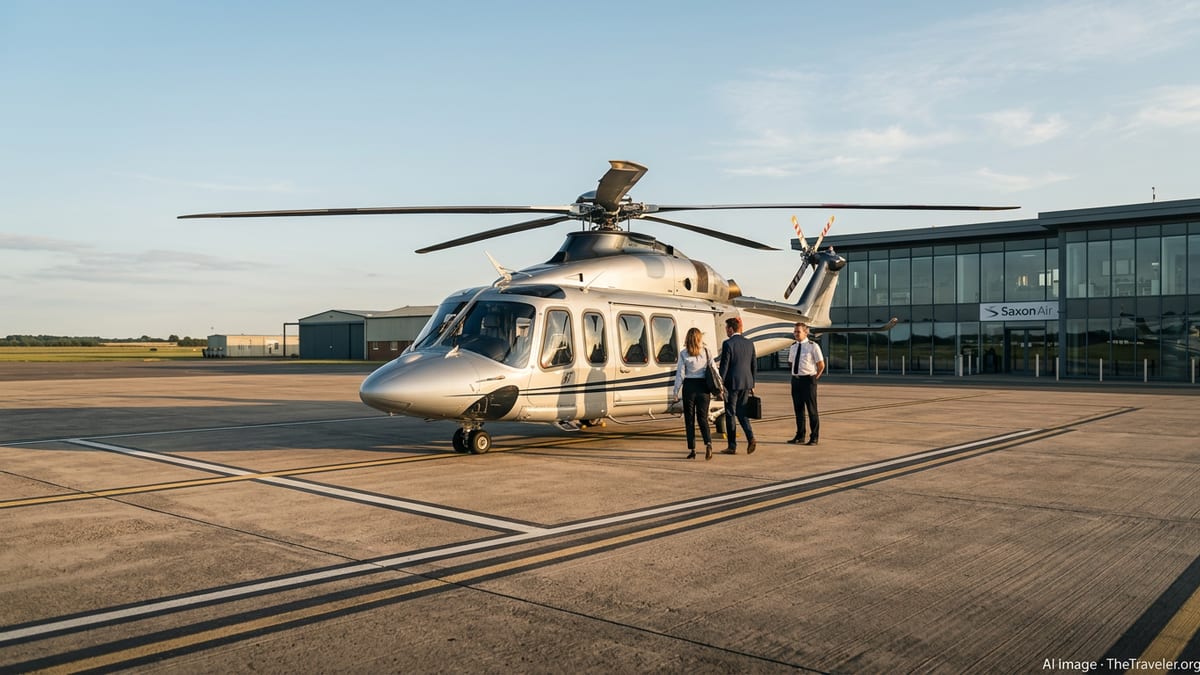
Flagship AW139 Marks Milestone in Saxon Air’s Rotary Growth
The new Agusta AW139 joins Saxon Air’s fleet as a heavy twin flagship at a time of rapid rotary expansion for the Norwich headquartered operator. The aircraft, built in 2025 and delivered into the managed fleet in early March 2026, is being positioned as a step up in capability for corporate groups, high net worth travellers and time critical business movements originating in the east of England and the wider London region.
The helicopter will operate under Saxon Air’s rotary Air Operator Certificate and is managed exclusively for charter, giving clients direct access to one of the most sought after types in the medium twin helicopter segment. The move builds on the company’s existing Leonardo and Airbus single engine portfolio and reflects rising demand for larger cabin aircraft that can comfortably link UK bases with continental Europe.
Saxon Air, which operates from the Klyne Business Aviation Centre at Norwich Airport as well as several satellite helicopter bases, has been steadily broadening its rotary offer over the past two years. The introduction of the AW139 sits alongside recent additions such as the Airbus EC155 and further Leonardo types, underlining a strategy focused on range, comfort and flexible mission capability.
Enhanced Executive Comfort and Performance for European Routes
The AW139 joining Saxon Air’s fleet is configured with a seven seat executive interior, offering a spacious stand up cabin, club seating and generous baggage capacity compared with smaller twin engine helicopters. The layout is designed to appeal to corporate flight departments, private clients and tour organisers seeking a quieter, more comfortable environment for flights of up to two hours.
With its combination of speed, payload and range, the type opens new point to point opportunities from Norwich and London area bases. Saxon Air expects to operate regular nonstop sectors to Paris and other primary European business centres, as well as seasonal leisure destinations and bespoke itineraries connecting city hubs with remote resorts, golf courses and private estates.
The AW139’s twin engine performance, advanced avionics and Category A capabilities are also seen as important advantages for operators working into demanding environments and busy airspace. For clients, those characteristics translate into shorter block times, more direct routings and the ability to maintain schedule certainty when weather or air traffic constraints affect smaller or slower aircraft.
Strengthening Norwich Airport’s Role as a Business Aviation Gateway
The arrival of the AW139 under Saxon Air’s management is expected to further consolidate Norwich Airport’s status as a specialist gateway for business and helicopter aviation in the east of England. The airport already hosts Saxon Air’s purpose built Business Aviation Centre and serves as a base for both fixed wing and rotary charter operations, ground handling and aircraft management.
By basing long range, high capability helicopters such as the AW139 and EC155 at Norwich, Saxon Air can connect the region’s energy, finance and technology sectors directly to European markets without the need for passengers to route through London’s major hubs. This is particularly attractive to time sensitive industries clustered around the North Sea, where rapid access to offshore and coastal infrastructure is essential.
The investment also complements a broader pattern of business aviation growth at Norwich, including recent partnerships with executive jet facility providers and increased use of the airport by charter and private operators. Industry observers note that the combination of modern infrastructure, dedicated FBO services and a diversified fleet is helping reposition Norwich as a credible alternative to more congested southeast England airports for corporate travellers.
Fleet Strategy Focused on Flexibility and Scalability
The addition of the AW139 fits into a carefully structured fleet strategy at Saxon Air, which has seen the company develop a ladder of helicopter and jet options from single engine utility types through to light, midsize and now heavy twin helicopters. This allows the operator to match aircraft precisely to mission profiles, passenger numbers and budget, while maintaining commonality across training, maintenance and operations.
In recent months Saxon Air has grown its UK helicopter fleet into double digits, with further deliveries expected through 2026. The portfolio now spans Leonardo AW109 variants, AW119 single engine helicopters, Airbus H125s and the recently introduced EC155, in addition to the new AW139 flagship. This breadth of capability is central to the company’s ambition to support everything from short hop transfers and event shuttles to cross border corporate shuttles and multi leg charter tours.
For Norwich Airport, that strategy translates into a more robust year round traffic mix and increased utilisation of local aviation services, from maintenance and engineering to ground handling and crew training. For clients, it offers a one stop solution for both rotary and fixed wing travel, with Saxon Air holding separate Air Operator Certificates covering jets and helicopters and the ability to coordinate complex itineraries that combine both.
Implications for the UK Executive Charter Market
Saxon Air’s decision to invest in an AW139 for executive charter use reflects a wider trend in the UK and European market, where demand is rising for larger, more capable helicopters that can bridge the gap between local shuttle work and regional air travel. As corporate travel patterns evolve and clients seek to reduce surface journey times, operators are responding by introducing aircraft types capable of linking secondary cities and regional airports directly with continental hubs.
Industry analysts suggest that Norwich’s proximity to London, coupled with its access to North Sea energy assets and a growing base of high value industries, makes it a logical location for such an upgrade in capability. With the AW139 now available for charter out of Saxon Air’s bases, brokers and corporate flight departments gain another option in a segment traditionally dominated by operators based closer to London’s major airports.
Over the coming months, Saxon Air is expected to showcase the AW139 to charter brokers, corporate clients and travel planners, highlighting its executive interior, range and performance on key city pairs. If early demand meets expectations, the move could encourage further heavy twin investment among UK charter operators and reinforce Norwich Airport’s emerging role as a specialist hub for high end helicopter operations.