

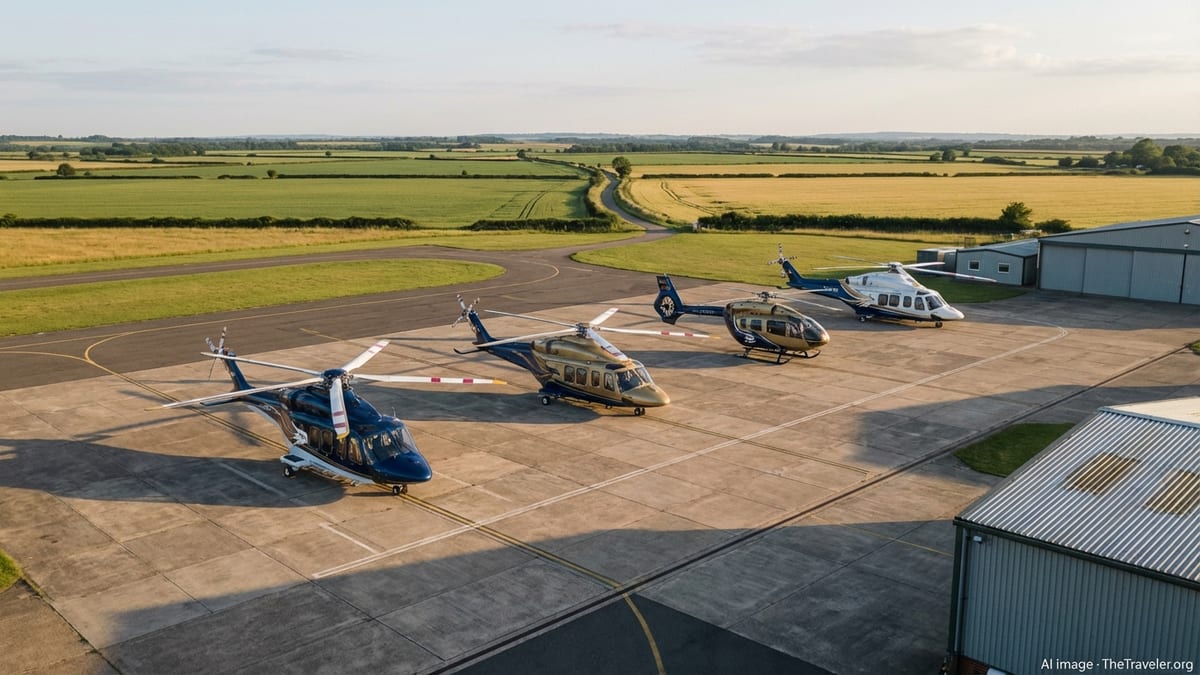
Saxon Air has secured its position as the United Kingdom’s largest onshore helicopter operator after adding five new aircraft to its fast-growing rotary fleet, underscoring a strong rebound in demand for charter, corporate and specialist missions across the country.
Fleet Expansion Cements New Market Leadership
The latest additions bring Saxon Air’s helicopter fleet to 12 aircraft, with the company confirming that a further three helicopters are scheduled to join by April 2026. The pace of growth marks one of the most rapid fleet build-ups seen in the UK’s onshore rotary market in recent years, reflecting both rising demand and the operator’s strategic push to scale.
Five helicopters have joined the Saxon Air roster since December 2025, a period in which the business has deliberately targeted gaps in the UK charter and private aviation landscape. By combining multi-engine and single-engine types with different performance envelopes, the operator is seeking to serve everything from high-speed corporate transfers to short-range scenic flights and utility work.
Company executives say the enlarged fleet elevates Saxon Air to the leading position among UK onshore helicopter operators by aircraft count while also broadening mission capability. The company already holds both rotary and fixed-wing Air Operator Certificates, enabling it to cross-sell helicopter and jet solutions for complex itineraries that include regional airports, heliports and private landing sites.
The move comes at a time when capacity across parts of the UK helicopter market has been tight, particularly around London and the southeast. With additional aircraft now in place, Saxon Air is positioning itself as the go-to provider for short-notice missions, multi-leg itineraries and aircraft management solutions for owners seeking professional oversight of their helicopters.
Diverse Helicopter Types to Cover UK Charter Demand
The expanded fleet features a mix of Leonardo and Airbus models, including the AW109S, AW109 Trekker, AW109SP, AW119Kx and the single-engine Airbus H125. The latest arrival highlighted by the company is an AgustaWestland AW109SP, adding further depth to its twin-engine offering for higher-speed, executive-focused missions.
By operating several variants of the popular AW109 family alongside the AW119Kx, Saxon Air can tailor aircraft selection to different payload, range and airfield requirements. The AW109 series is well regarded in business and VIP transport for its combination of speed, cabin comfort and performance in varied weather conditions, while the AW119Kx brings single-engine efficiency to missions where a smaller footprint and lower operating cost are advantageous.
The Airbus H125s in the fleet give the operator a highly versatile single-engine platform frequently used worldwide for sightseeing, aerial work, training and utility roles. For the UK market, Saxon Air is using the type to plug what it describes as a clear gap between premium multi-engine charter flights and lower-cost single-engine services, creating a flexible option for leisure and point-to-point transfers where airstrip infrastructure is limited.
Fleet diversity also supports resilience. With multiple aircraft types available, the company can mitigate maintenance downtime and better match aircraft availability to seasonal peaks such as summer events, major sporting fixtures and coastal tourism, all of which are important demand drivers for onshore helicopter charter in Britain.
Strategic Bases Strengthen National Coverage
Saxon Air maintains helicopter bases and crews at Denham, Elstree, Oxford, Redhill and Norwich, a network that gives it access to many of the UK’s busiest economic corridors and leisure destinations. These locations sit within reach of London, the Midlands, East Anglia and the southeast coast, key regions for both corporate travel and high-end tourism.
Denham and Elstree provide convenient access to central London while avoiding the congestion of major airports, making them popular for business travellers and private clients seeking rapid connections to offices, events and private residences. Redhill, south of the capital, offers strong links to the Gatwick corridor and the south coast, while Oxford connects the company to a cluster of technology and life sciences businesses as well as the Cotswolds’ luxury hospitality sector.
Norwich, Saxon Air’s long-standing base, remains a cornerstone of the operator’s network. Located close to the offshore energy industry in the North Sea and within reach of a broad catchment of rural estates and coastal destinations, the base provides operational flexibility for both corporate and leisure flights. Maintaining aircraft and crew across multiple sites also allows the company to reposition capacity quickly when demand surges in specific regions.
The broad geographic footprint is central to Saxon Air’s claim of being the UK’s largest onshore helicopter operator, not just in terms of fleet size but also in the physical reach of its operations. With more aircraft and more bases, the company is working to shorten response times, reduce positioning costs and offer more competitive pricing on common routes.
Growth Strategy Backed by Rotary Market Momentum
Saxon Air’s head of rotary sales has described the helicopter division as being in the midst of a major growth phase, with the aim of doubling the fleet from seven aircraft at the start of 2025 to fourteen by March 2026. The latest five-aircraft expansion keeps the company firmly on track toward that target and signals confidence in the long-term prospects of the UK onshore rotary sector.
Industry observers note that demand for helicopter charter and management has been buoyed by several converging trends, including increased appetite for time-saving travel among high net worth individuals, a resurgence in live events and hospitality, and a growing reliance on helicopters for access to remote or infrastructure-poor destinations. Against this backdrop, operators with scale and modern fleets are well positioned to capture market share.
Saxon Air’s dual focus on charter and aircraft management further underpins its strategy. By offering turn-key management solutions, including crew, maintenance oversight and regulatory compliance, the company can attract private owners who wish to offset ownership costs by making their helicopters available for charter when not in personal use. This model increases fleet utilisation while broadening the range of aircraft and interior configurations available to charter clients.
The operator’s recent recognition in industry awards also supports its growth narrative. Saxon Air Helicopters has collected consecutive Helicopter Charter Operator of the Year titles and repeated shortlistings in recent years, signalling strong customer satisfaction and operational performance at a time when safety and service quality are under heightened scrutiny across the aviation industry.
Service Portfolio Extends Beyond Pure Charter
While charter flights remain the most visible part of Saxon Air’s operations, the company has built a broader services portfolio spanning sales, acquisitions, aircraft management and technical oversight. This multi-layered offering positions the business as a one-stop shop for helicopter owners, corporate flight departments and high-end travel partners seeking tailored aviation solutions.
On the transactional side, Saxon Air provides advisory services for buyers and sellers of helicopters, covering type selection, pre-purchase inspections, regulatory compliance and long-term support arrangements. The company’s experience with a variety of Leonardo and Airbus models enables it to guide clients through complex considerations such as mission profile, expected utilisation and total cost of ownership.
Continuing airworthiness management and training support form another pillar of the business. By centralising engineering planning, parts logistics and compliance documentation, the company aims to reduce downtime and administrative burden for operators and owners. Training support helps ensure that pilots and technical staff remain current on aircraft types and regulatory requirements, which is particularly important as new models and avionics systems enter service.
This integrated approach has become a competitive differentiator in a market where some smaller operators focus solely on charter. For travel agencies, concierge companies and corporate travel managers, partnering with an operator that can provide both aircraft and advisory expertise eases the process of arranging complex itineraries or standing flight programmes for key clients and executives.
Implications for UK Travel, Tourism and Events
The expansion of Saxon Air’s helicopter fleet arrives at a time when the UK is preparing for a busy calendar of events, from major sporting fixtures and racing festivals to cultural gatherings and luxury hospitality openings. Increased helicopter capacity, particularly around London and key regional hubs, is expected to support both domestic tourism and inbound high-spend visitors.
Short-notice availability is particularly important for event-led traffic, where weather, scheduling changes and late ticket sales can drive sudden spikes in demand. By adding aircraft and dispersing them across several bases, Saxon Air aims to absorb those surges while keeping flight times to and from temporary helipads, country estates and racecourses as efficient as possible.
For the wider travel ecosystem, a stronger onshore helicopter network can complement rail and road infrastructure by providing rapid connections between airports, city centres and remote destinations. Luxury hotels, resorts and private estates increasingly market helicopter access as part of their guest experience, and operators like Saxon Air serve as the link between ground-based hospitality and airborne mobility.
The company’s growth also highlights the role of regional airports and airfields in supporting premium travel and tourism. Facilities at places such as Norwich and Oxford provide hangarage, maintenance space and passenger handling that enable helicopter operators to scale, while generating additional traffic and revenue for local aviation economies.
Safety, Standards and Regulatory Oversight
As Saxon Air grows its fleet and expands geographically, maintaining safety standards and regulatory compliance remains central to its operating model. The company’s rotary activities are conducted under an established Air Operator Certificate, which governs areas such as crew training, maintenance regimes, operational procedures and quality management systems.
Industry experts point out that the UK’s regulatory environment for commercial helicopter operations has become progressively more stringent, particularly around pilot duty time, weather minima, maintenance oversight and passenger safety briefings. Larger operators with dedicated safety and compliance teams are often better equipped to keep pace with evolving requirements, from updated avionics mandates to changes in airspace management.
Saxon Air’s track record in industry awards and its continued investment in modern aircraft types with advanced avionics and safety features are seen as indicators of a safety-first culture. Many of the helicopters in its fleet incorporate digital avionics suites, autopilot systems and navigation tools designed to reduce pilot workload and enhance situational awareness, especially in the demanding weather often encountered over the UK.
For travellers and corporate buyers, these factors can be just as important as price and convenience. As the company moves into a leadership position in the UK onshore market, its ability to scale operations while sustaining a strong safety culture will be closely watched by both regulators and customers.
Positioning for the Next Phase of UK Rotary Aviation
With twelve helicopters in service and additional aircraft due by early 2026, Saxon Air is entering a new chapter that could reshape competitive dynamics in the UK’s onshore helicopter segment. Scale, fleet diversity and a wide base network give the company tools to capture a broader slice of charter, management and specialist mission work than was previously possible.
Looking ahead, the operator is expected to focus on deepening relationships with key travel partners, event organisers and corporate clients while exploring new mission profiles that make use of its expanded capabilities. Potential growth areas include more structured shuttle services around major events, tailored tourism packages linking multiple regions, and expanded aircraft management programmes for both private and corporate owners.
As demand for flexible, point-to-point travel continues to evolve, the emergence of Saxon Air as the UK’s largest onshore helicopter operator underscores the enduring role of rotary aviation in the country’s transport mix. For travellers, businesses and regional destinations, the company’s enlarged fleet offers new options in a market where speed, access and reliability are becoming ever more valuable.