

More news on this day
A new direct daytime train linking Malmö and Oslo is set to launch on 15 June 2026, promising faster, greener and more scenic travel across Scandinavia’s west coast corridor.
New Cross-Border Link Joins Key Scandinavian Cities
The new Malmö–Oslo service, to be operated by Swedish private rail company Snälltåget, will run daily in both directions from 15 June 2026. Timed for the peak summer travel season, the route is designed to make it easier for residents and visitors to combine Sweden and Norway in a single rail itinerary.
Trains will depart Malmö Central and travel north along Sweden’s west coast via Lund, Helsingborg, Halmstad and Varberg before turning inland towards Trollhättan and crossing the border into Norway. North of the frontier, services will call at Sarpsborg and Fredrikstad before arriving in Oslo, creating a continuous daytime rail link between the two Nordic capitals of culture and commerce.
The journey time is expected to be around six and a half hours, positioning the train as a comfortable alternative to short-haul flights and long-distance coach services. By building on existing regional and long-distance timetables, the new route will also plug into wider Scandinavian and European rail networks, particularly through Malmö’s connections toward Copenhagen and continental Europe.
The announcement follows previous seasonal and trial services between Oslo and Malmö, but is the first confirmed plan for a regular, summer-long daytime operation structured as a straightforward cross-border corridor for leisure and business travellers alike.
Scenic West Coast Route Showcases Nordic Landscapes
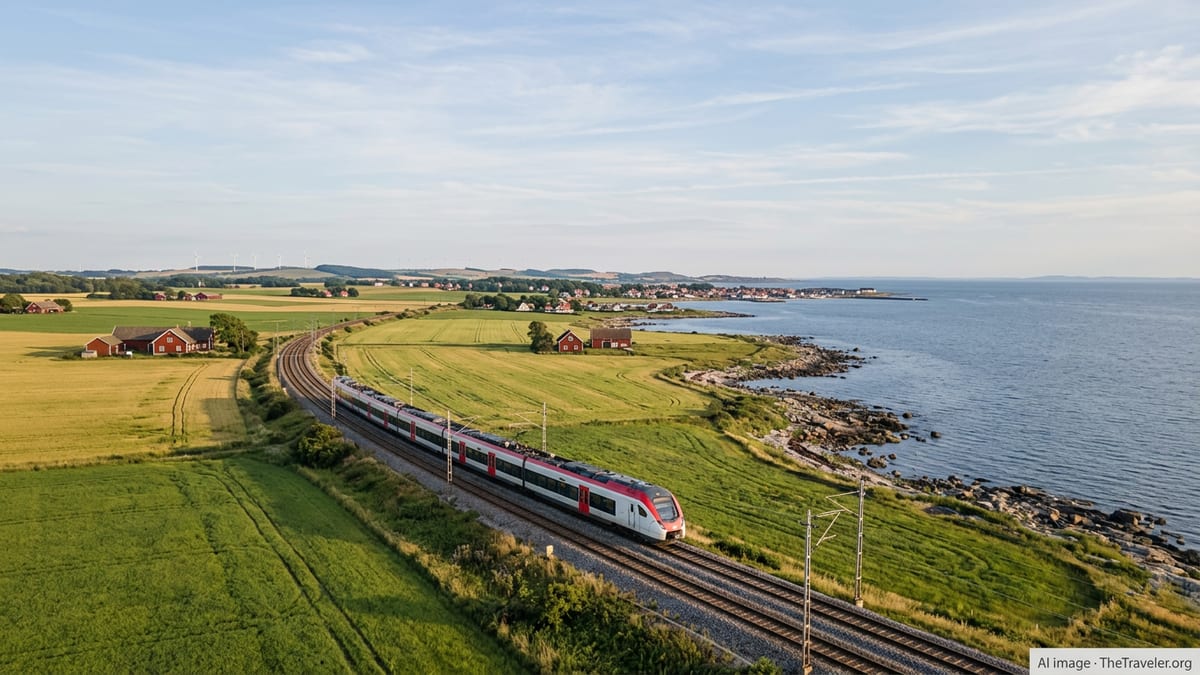
Beyond its practical role, the Malmö–Oslo line is being promoted as one of Scandinavia’s most scenic new daytime journeys. Running largely in daylight during the long Nordic summer, the route strings together views of the Öresund coastline, open farmland, forested stretches and rivers on its way toward Norway’s capital.
South of Gothenburg, passengers will pass seaside towns and stretches of the Kattegat coast, an area already popular with domestic holidaymakers for its beaches and cycling routes. The recently upgraded double-track sections and new rail tunnel through Varberg help move more of this traffic below ground, freeing up surface space while giving travellers smoother, quieter running.
Further north, as the train climbs inland and approaches Trollhättan, travellers will catch glimpses of lakes, canals and forested ridges that mark the transition from Sweden’s flat southern plains to more rugged inland terrain. After crossing into Norway, the line follows the Østfold corridor, with views over the Oslofjord’s outer inlets near Sarpsborg and Fredrikstad before curving into Oslo’s rail approaches.
The operator is positioning the service as a relaxed, window-seat journey rather than a high-speed dash. With an onboard restaurant and café car, along with standard and more spacious seating areas, the train targets travellers who value the experience of the journey as part of their holiday, including families, rail enthusiasts and visitors looking for lower-carbon ways to explore the region.
Easy Connections for Multi-City Scandinavian Holidays
The new route is expected to appeal strongly to international visitors planning multi-stop itineraries across Scandinavia. Malmö is already a key link in the chain between mainland Europe and the Nordics, with frequent regional and long-distance connections toward Copenhagen, Hamburg, Berlin and Basel, as well as domestic routes deeper into Sweden.
By starting the service in Malmö rather than Gothenburg alone, planners ensure travellers arriving from Denmark or continental Europe can change trains once and continue directly to Oslo without needing to re-route via Stockholm. This simplifies journeys for passengers arriving on night trains from Germany or Switzerland, as well as those flying into Copenhagen Airport and travelling onward by rail.
At the northern end of the line, Oslo Central Station offers connections to popular Norwegian destinations including Bergen, Trondheim and the fjord country, as well as regional services toward ski and hiking areas. Combined tickets and coordinated timetables are expected to make it easier to plan through-journeys, particularly during the high summer season when demand is strongest.
Travel agencies and online rail platforms are already highlighting Malmö–Oslo itineraries as part of broader “slow travel” packages, encouraging visitors to swap short-haul flights for train journeys that link Copenhagen, Malmö, Gothenburg and Oslo in a single overland loop.
Boost for Climate-Friendly Travel and Regional Economies
Regional officials and transport planners see the Malmö–Oslo launch as part of a wider shift toward climate-friendly travel in northern Europe. Governments in both Sweden and Norway have set ambitious emissions reduction targets, and cross-border rail is a central element of strategies to replace short flights and long car trips with electric-powered trains.
The west coast corridor between Skåne, Halland, Västra Götaland and Østfold is one of the Nordic region’s busiest travel axes, linking major ports, industrial zones and university cities. A reliable daytime rail link is expected to support commuting patterns, conference and event travel, and tourism, while also relieving pressure on key motorways.
Local tourism boards along the route are preparing to promote rail-accessible getaways, from beach towns and coastal nature reserves in southern Sweden to historic fortress towns near the Oslofjord. With intermediate stops built into the timetable, travellers will be able to break their journey for overnight stays, spreading economic benefits beyond the two end-point cities.
For Malmö and Oslo themselves, the line strengthens their roles as southern and northern gateways to Scandinavia’s wider rail map. As more sleeper and daytime trains connect Malmö with the European mainland, and as Norway explores new international links from Oslo, the June 2026 launch marks another step in knitting together a more coherent, traveller-friendly network across the region.
Practical Details for Travellers Planning 2026 Trips
While full fare structures and exact departure times are still being finalized, the operator has indicated that there will be at least one direct Malmö–Oslo departure in each direction every day from mid-June, with potential for additional services during peak holiday weeks. Tickets are expected to go on sale later in 2026’s spring timetable window, both via the company’s own channels and major international rail booking platforms.
Seating will be offered in standard and higher-comfort classes, with power outlets, Wi-Fi and ample luggage space. An onboard restaurant, branded Krogen on other Snälltåget routes, is expected to feature advance table reservations and pre-ordered meals alongside casual café-style service for snacks and drinks.
Travellers are advised to allow extra time in Malmö or Oslo if they are connecting to separate operators, especially for long-distance night trains or ferries. However, integrated planning between regional transit authorities and the new cross-border operator aims to limit transfer times where possible, particularly in Malmö, Lund and Gothenburg.
With its combination of scenic views, straightforward boarding and city-centre to city-centre convenience, the Malmö–Oslo line is likely to become a flagship example of how new rail services can reshape travel habits in Scandinavia. For many visitors in summer 2026 and beyond, boarding this train will offer not just a way to move between countries, but a front-row seat on some of northern Europe’s most inviting landscapes.