

More news on this day
From glass-domed panoramic carriages in Switzerland to freshly relaunched high-speed links between France and Italy, train travel across the Alps is entering a new chapter just as demand for low-carbon, high-scenery journeys is surging.
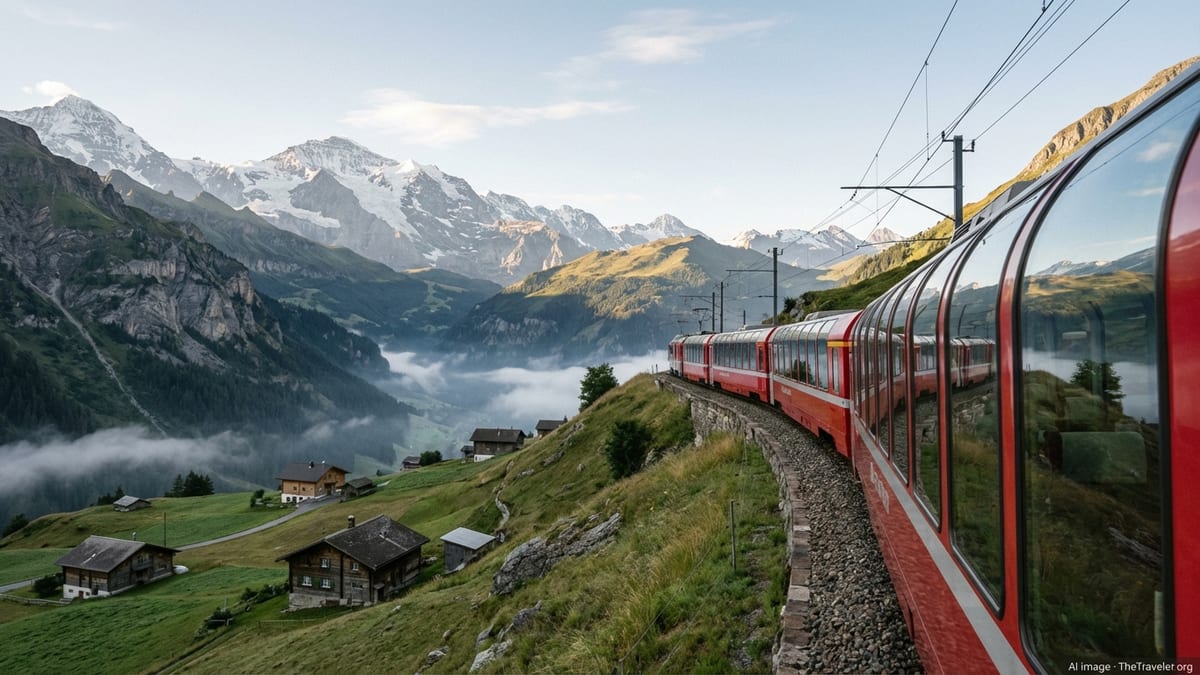
The New Landscape of Alpine Rail in 2026
Travelers planning a rail journey through the Alps in 2026 are finding a fast-changing network shaped by new premium tourist services, evolving high-speed links, and a sharpening focus on climate and safety. On core routes between France, Switzerland and Italy, rail operators are adding capacity and comfort to answer strong post-pandemic demand while still dealing with the legacy of infrastructure disruptions and extreme weather in recent winters.
In Switzerland, the major panoramic routes that helped define the idea of a “scenic train holiday” remain the backbone of Alpine tourism, but with notable upgrades and pricing changes. Flagship services such as the Glacier Express and Bernina Express are investing in higher-end classes and modernized rolling stock, aiming squarely at international visitors who increasingly book complex multi-country itineraries rather than single-day excursions.
On the international front, Italy’s Trenitalia is rebuilding its cross-border passenger strategy after a lengthy interruption to the Paris Milan corridor following a landslide in the Maurienne valley in August 2023. With the high-speed route slated to be fully back in play alongside existing domestic high-speed services, the coming seasons are expected to see tighter rail connections between Paris, Lyon, the Swiss border region and northern Italy for leisure travelers heading into the mountains.
Overlaying all of this is a more volatile mountain environment. A series of severe avalanche cycles in the winters of 2024 to 2026 and temporary shutdowns of key tunnels have underlined how quickly Alpine conditions can disrupt even the best-planned rail journeys, and why booking flexibility and real-time information are becoming as vital as panoramic windows.
Iconic Swiss Scenic Trains: Glacier, Bernina and Gotthard
For many visitors, a rail journey through the Alps begins or ends in Switzerland, whose tourism agencies have long marketed the country as a global benchmark for scenic train travel. The Glacier Express, running between Zermatt and St. Moritz, remains the most famous of these routes, with an eight-hour traverse of high passes, river valleys and 291 bridges that has become a bucket-list experience. Recent investment has focused on the top-tier Excellence Class, which offers guaranteed window seating, multi-course dining and enhanced onboard service aimed at luxury travelers.
Those premium touches come at a price. Seat reservations are compulsory on the Glacier Express for all passengers in both first and second class, and fees have been rising in stages, including higher charges set out in the 2025 and 2026 timetables. Excellence Class, which is only sold for the full Zermatt St. Moritz journey, carries a much higher reservation price and sells in limited numbers per departure, meaning travelers set on that category need to book months in advance during summer or Christmas periods.
The Bernina Express, operated by the Rhaetian Railway, offers a different kind of Alpine crossing between Chur or St. Moritz and Tirano in northern Italy, over some of the steepest standard-gauge tracks in the world. The route is part of a UNESCO World Heritage listing and includes landmarks such as the Landwasser Viaduct and sweeping spiral curves that were designed to manage extreme gradients without cogwheel assistance. Regular panoramic services run year-round, but the operator has warned of short closures for maintenance and construction work on specific sections, particularly outside peak season, so travelers must verify dates before committing to fixed hotel bookings.
Another increasingly prominent option for north south journeys is the Gotthard axis. While the Gotthard Base Tunnel handles most fast passenger and freight traffic beneath the Alps, the tourist-focused Gotthard Panorama Express combines a lake steamer on Lake Lucerne with a panorama train through the historic high route to Lugano. Operating seasonally from roughly mid spring to mid autumn, it offers an atmospheric alternative for those who prefer daylight views of stone galleries, waterfalls and traditional villages to the speed of base-tunnel services.
France to Switzerland: High-Speed Gateways to the Mountains
For travelers starting in France, especially Paris, Switzerland is often the first Alpine gateway. High-speed services from the French capital to Geneva, Lausanne and Zurich continue to provide the main arteries for visitors connecting onward to scenic mountain lines. From Geneva, travelers can transfer to regional trains along Lake Geneva toward Montreux and on to the GoldenPass line, or continue deeper into the Bernese Oberland for connections to Interlaken and the Jungfrau region.
Competition on domestic French high-speed routes is also reshaping access to Alpine hubs. Italian operator Trenitalia has expanded its presence on the Paris Lyon corridor in recent years and launched a Paris Marseille service using its Frecciarossa fleet, increasing options for travelers who want to combine the French Alps or Riviera with rail links into Switzerland or northern Italy. While these trains do not themselves cross the high Alpine passes, they shorten journey times to key interchange cities such as Lyon, Chambéry and Turin for those piecing together multi-leg itineraries.
Rail planners say that as high-speed and regional timetables are updated each December, the main structure of France Switzerland links is likely to remain stable, but frequencies and departure times can shift by minutes or even hours. That matters for travelers trying to make same-day connections to fixed panoramic departures such as the Glacier Express or Bernina Express. Experts recommend allowing generous buffer times at major hubs, since delays on busy high-speed corridors can have knock-on effects even in otherwise punctual Switzerland.
In parallel, regional authorities in eastern France are continuing to promote cross-border commuter and regional trains into Geneva and Basel as climate-friendly alternatives to short flights. For visiting tourists, these services can double as low-cost scenic lines along lakes and rivers, but they rarely include the floor-to-ceiling windows or commentary found on dedicated panorama trains, and they may be more crowded at rush hour than long-distance services.
France to Italy: The Paris–Milan Corridor Returns
One of the most significant developments for Alpine travelers is the gradual restoration of the Paris Milan rail corridor after a lengthy disruption caused by a major landslide in the Maurienne valley in August 2023. The incident forced the closure of a crucial section of the route between France and Italy, leading to the suspension of direct high-speed passenger services and pushing some traffic back onto night trains, detours or coaches over mountain passes.
As stabilization and repair works have progressed, French and Italian rail operators have outlined plans to fully reinstate high-speed services between Paris and Milan, including multiple daily Trenitalia Frecciarossa runs and additional offerings from the French incumbent. The revived route is expected to reconnect Paris with Lyon, Turin and Milan along a direct high-speed spine that is particularly attractive for travelers planning onward connections to the Italian Lakes, Venice or the Dolomites.
For Alpine tourism, the corridor’s return means easier all-rail itineraries from the French capital to the western Alps and northern Italy without resorting to domestic flights. Travelers can, for example, travel Paris Turin by high-speed train in a single daytime journey, then connect to regional services into the Susa valley or further south to Cuneo and the Maritime Alps. Others are expected to use Milan as a southern gateway, combining high-speed arrivals with regional services toward Tirano for the Bernina Express or toward Domodossola for links into the Simplon and Valais regions.
Industry analysts caution, however, that timetables on the Paris Milan axis are likely to remain subject to fine-tuning during the first seasons after full reopening. Seat availability can be tight during holiday peaks, and some departures may be temporarily adjusted for continuing infrastructure works. Prospective passengers are urged to check specific service numbers and book early, particularly if they intend to travel in first class or with family compartments.
Safety, Weather and a Changing Alpine Climate
Even as rail is promoted as one of the safest and most climate-friendly ways to cross the Alps, recent winters have underlined how vulnerable mountain transport can be to extreme conditions. In February 2026, an avalanche struck a regional train near Goppenstein in the Swiss canton of Valais, derailing several carriages and injuring passengers. The incident came amid days of heavy snow and a level-five avalanche alert across parts of the western Alps, prompting temporary closures of mountain roads and precautionary suspensions of some rail and cable-car services.
Authorities stress that serious train accidents remain rare compared with the sheer number of daily services running through Alpine valleys and tunnels, but they also note that climate change is increasing the frequency of rapid freeze thaw cycles, wet snow avalanches and rockfalls. Operators now routinely close high-risk sections of narrow-gauge lines during red-level avalanche warnings and have invested in galleries, snow sheds and monitoring systems intended to protect exposed tracks.
For visitors, the key implication is the need for flexibility and information. Weather-driven cancellations or diversions are more likely in shoulder seasons and during intense storm periods, particularly on routes that run beneath steep south-facing slopes. Travelers are advised to monitor official rail apps and national meteorological services in the days before departure and to avoid locking in non-refundable onward connections that cannot be changed if services are disrupted.
Longer term, scientists and Alpine tourism boards are watching how glacier retreat and thawing permafrost might affect the stability of mountain infrastructure, including bridges, tunnels and station access roads. Hikers and skiers already see the changes on the ground, but for now, most of the mainline rail network continues to operate reliably, with targeted closures for reinforcement and adaptation projects scheduled outside peak periods wherever possible.
Pricing, Reservations and Rail Pass Strategies
For travelers drawn by the romance of curling tracks and snowy peaks, one of the biggest surprises can be the cost. Scenic trains across Switzerland and neighboring countries often require both a valid ticket and a separate seat reservation, priced dynamically and sometimes rising close to departure dates or for specific seasons. On the Glacier Express, reservation fees are mandatory in all classes and have been increased in recent timetable updates, with significantly higher charges for Excellence Class. By contrast, many ordinary intercity and regional trains in France and Italy either roll the reservation into the ticket price or do not require one at all.
Many visitors from overseas opt for national or regional rail passes to simplify travel, particularly in Switzerland where products such as the Swiss Travel Pass can dramatically lower the marginal cost of additional journeys. These passes typically cover standard public transport across trains, buses and boats, but still require separate paid reservations for named tourist trains. That means a traveler can, in some cases, approximate a famous scenic route by patching together regular services on the same corridor without paying the premium for panoramic coaches.
In France and Italy, discount programs attached to specific operators often provide better value than broad multi-country passes for travelers focusing on just one or two countries. Advance-purchase fares on high-speed lines, particularly on off-peak days, can undercut flexible passes by a wide margin, but lock passengers into specific trains. Industry experts recommend that travelers planning a complex Alpine itinerary divide their journey into “fixed” segments, such as a specific panoramic departure that must be reserved, and “flexible” segments where they leave room for local exploration or weather-related changes.
Currency fluctuations and annual timetable changes every December can affect pricing from year to year, but analysts say the underlying trend on flagship scenic routes is upward. As operators invest in new rolling stock, premium classes and on-board catering, they are targeting higher-spending visitors, even as environmental policies and carbon-conscious travelers push more volume toward rail.
Planning Multi-Country Routes Across the Alps
Putting the pieces together for a seamless rail journey across France, Switzerland and Italy requires more than simply booking a single through ticket. Timetables for high-speed, intercity, regional and panoramic trains are published by different operators and coordinated at a national level, but reservations and pricing structures differ sharply by country. Travel planners advise starting with the fixed, low-frequency legs such as the Glacier Express, Bernina Express or Gotthard Panorama Express, then working outward to secure high-speed access from Paris, Lyon or Milan.
A typical loop for first-time visitors might begin in Paris, follow high-speed lines to Geneva or Lausanne, then connect via Interlaken or Chur to a panoramic Swiss route. From there, passengers can drop south into Italy via Tirano, Lugano or Domodossola, eventually reaching Milan for onward high-speed travel back toward France. Variants that include the French Alps often substitute a leg through Lyon or Chambéry, adding regional trains into the Tarentaise or Maurienne valleys before continuing toward Turin.
Rail experts suggest building at least one overnight stay at key junctions such as Geneva, Zurich, Chur or Milan, both to guard against missed connections and to experience the cities themselves. While same-day connections between high-speed and scenic trains are often technically possible, the reality of delays, weather and station navigation means that tight transfers carry real risk. Travelers with checked luggage or ski equipment in particular may underestimate the time needed to change platforms in large stations.
As international rail booking platforms improve, more multi-country itineraries can now be reserved in a single transaction, but there are still gaps, especially for seasonal tourist trains and some regional cross-border services. In many cases, travelers must rely on national rail websites, dedicated tourist-train portals or traditional travel agencies familiar with Alpine products. For complex journeys in peak seasons such as February ski weeks or August holidays, specialist rail tour operators report strong demand from clients who prefer to outsource the ticketing puzzle rather than risk missing a once-in-a-lifetime mountain crossing.
Seasonality, Crowds and When to Ride
The timing of an Alpine rail journey can be as important as the route itself. Operators and tourism officials describe three broad seasons. Winter brings snow-covered peaks and busy ski traffic, especially around February school holidays, when trains into major resorts can be crowded and reservation-heavy. Spring and autumn shoulder seasons offer quieter trains and lower fares, but also more construction work, with short closures on some scenic sections and a higher risk of weather-related disruptions.
Summer remains the peak for classic sightseeing cruises on the Glacier Express, Bernina Express and Gotthard Panorama Express, as well as for boat connections on Swiss lakes and regional lines in France and Italy that thread through vineyard and lakeside landscapes. Panoramic cars can book out weeks in advance on popular days, leading many travelers to opt for early-morning or late-afternoon departures to avoid the busiest midday services. In contrast, some regional lines used heavily by commuters may actually be more relaxed at weekends.
Travel experts say that for many routes there is no single “best” season. Winter offers drama, with deep snow on passes and frozen waterfalls visible from large windows, but shorter daylight hours mean that long stretches may unfold in dusk or darkness. Summer provides more daylight and easier hiking connections from intermediate stations, but heat waves can occasionally affect comfort even on air-conditioned trains and can spur rockfall and landslide warnings in some valleys.
Whichever season travelers choose, the consistent advice from rail operators is to build flexibility into plans, keep digital tickets and reservations accessible on a phone even when printing paper copies, and monitor updates in the days before departure. With Europe’s Alpine rail network evolving quickly and the mountains themselves in flux, the most successful journeys are those that blend careful advance planning with a willingness to adapt once on board.