

More news on this day
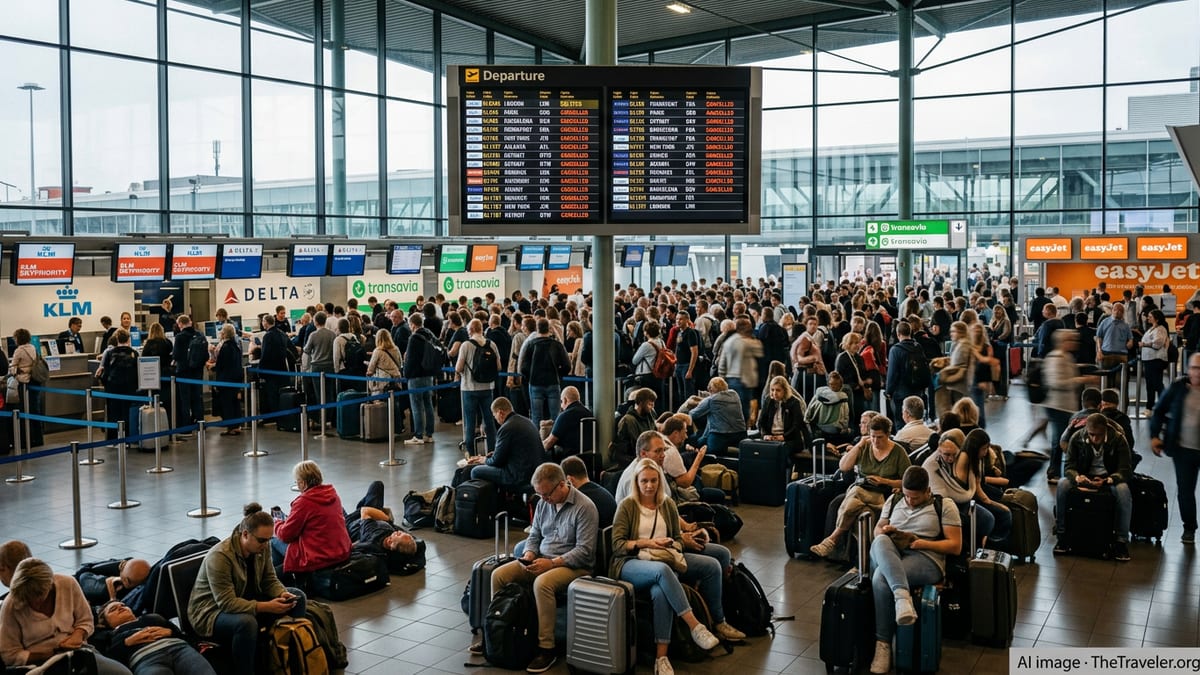
Passengers at Amsterdam Schiphol Airport faced hours of uncertainty as a wave of disruptions affecting KLM, Delta Air Lines, easyJet and Transavia triggered around 120 delays and 11 cancellations on routes linking London, Paris, Barcelona, Frankfurt and multiple destinations in the United States.
Get the latest news straight to your inbox!
Knock-on Disruptions Across Key European Hubs
Operational data and passenger accounts shared on public platforms indicate that the disruption originated at Amsterdam Schiphol, one of Europe’s busiest transfer hubs, and quickly rippled across the airline networks of KLM, Delta, easyJet and Transavia. With Schiphol operating at reduced capacity, aircraft and crews were left out of position, feeding delays across short and medium haul routes.
Flights connecting Amsterdam with major European cities such as London, Paris, Barcelona and Frankfurt were among the most heavily affected, with departure boards showing successive pushbacks in scheduled departure times. Travellers reported rolling delays of one to three hours, along with short-notice cancellations that left them scrambling for alternative itineraries.
The disruption spilled over into evening bank departures and early transatlantic waves, as airlines attempted to re-time services to recover their schedules. Some aircraft eventually departed significantly behind schedule, but others were withdrawn entirely, reducing connectivity between Schiphol and key European gateways for much of the operating day.
Publicly available operational performance data for recent seasons highlights how quickly congestion at a major hub can escalate into a network wide issue, even when only a fraction of daily flights are cancelled. Airlines are often forced to consolidate services or trim rotations to prevent further knock-on delays, which can leave passengers on heavily booked routes with very limited rebooking options.
Transatlantic Links to US Cities Hit Hard
The wave of disruption at Schiphol also affected transatlantic travel. According to flight tracking boards and passenger reports, several services operated by joint venture partners KLM and Delta between Amsterdam and US cities experienced extended delays, while a smaller number were cancelled outright.
Travelers connecting in Amsterdam from European origins such as London, Paris, Barcelona and Frankfurt were particularly vulnerable. Many missed onward links to US hubs after late arriving feeder flights from across Europe, leading to involuntary overnight stays and complicated rebookings. In some cases, itineraries were re-routed via other European gateways, adding additional connections and travel time.
The dependence of long haul operations on tightly timed inbound feeder traffic means that once a hub falls behind schedule, long range departures are among the most difficult flights to recover. Aircraft assigned to transatlantic sectors often operate limited rotations, and crew duty limits restrict how far departure times can be pushed back before cancellations become unavoidable.
For passengers, the result was a mixture of long queues at transfer desks, extended calls to airline contact centers and, for those able to secure alternatives, improvised routings across Europe before crossing the Atlantic. Others reported waiting at airport hotels while monitoring apps and departure boards for signs of available seats on later services.
Airlines Struggle With Capacity, Rebooking and Communication
Publicly shared passenger experiences from Schiphol and affected outstations suggest that capacity constraints, both in the air and on the ground, played a major role in prolonging the disruption. While airlines moved to rebook customers onto later flights, many departures in the same travel window were already heavily sold, leaving limited room to accommodate stranded travelers.
Reports from recent disruption episodes this season at Schiphol point to recurring bottlenecks when large volumes of passengers require rebooking at the same time. Airport check in desks and ticket counters can quickly become overwhelmed, while call centers and digital self service tools face surges in demand that slow response times and leave travelers uncertain about their options.
According to publicly available guidance on air passenger rights in Europe, travelers affected by long delays or cancellations may be entitled to assistance such as meal vouchers, hotel accommodation and ground transport in specific circumstances. However, when disruptions are widespread, obtaining that support on the spot can be difficult, particularly when airline staff are dealing with concurrent operational issues.
The combination of limited spare capacity in airline schedules, congested support channels and high demand for transatlantic and intra Europe travel means that a concentrated burst of delays and cancellations can leave passengers waiting many hours, or even days, before reaching their final destinations.
Growing Scrutiny of Schiphol’s Resilience
The latest episode of disruption adds to a season of heightened scrutiny on Amsterdam Schiphol’s resilience during periods of operational stress. In recent months, travel forums and social platforms have documented repeated instances of mass delays and cancellations at the airport attributed to factors such as adverse weather, air traffic control restrictions and ground handling challenges.
Analysts of European aviation performance have highlighted that hub airports with dense wave based banking structures are particularly exposed when conditions reduce runway or airspace capacity. When a single morning or evening wave is heavily disrupted, connecting times are eroded, aircraft rotations slip and recovery often extends well into the following day.
Schiphol plays a central role in the networks of KLM and its partners, amplifying the impact on passengers when operations are curtailed. Travellers transiting from regional European cities through Amsterdam to long haul destinations can be left with few alternative routings when high demand periods coincide with large scale disruption.
There is also growing debate around how best to balance safety related capacity reductions, such as those caused by low visibility or strong crosswinds, with the need to keep disruption manageable for passengers. While early cancellations can reduce cascading delays, they also concentrate the impact on specific departures and groups of travelers.
What Stranded Passengers Can Do Next
For passengers still dealing with the aftermath of the disruption, publicly available consumer guidance recommends several practical steps. Monitoring airline apps and departure boards frequently can help travelers spot available seats on alternative routings as they open, while proactively requesting rerouting via other European hubs may sometimes shorten overall travel time compared with waiting for the next direct service from Amsterdam.
Keeping records of boarding passes, booking confirmations and receipts for meals, hotels and ground transport can be important for subsequent claims under applicable passenger protection rules. Many airlines provide online forms for requesting reimbursements or compensation after travel is completed, which can reduce the need to wait in long queues at the airport during peak disruption.
Travelers are also advised in publicly available materials to check the specific terms of their tickets and any travel insurance policies, as coverage varies for delays and cancellations caused by operational issues versus extraordinary events. In some cases, credit card benefits may offer additional support for missed connections or extended delays.
As airlines and airports continue to face tight capacity, staffing constraints and increasingly volatile weather patterns, analysts expect that episodes of significant disruption at major hubs like Amsterdam Schiphol will remain a recurring feature of the travel landscape. For passengers, building extra buffer time into tight connections and remaining flexible with routings can offer at least some protection when schedules begin to unravel.