

More news on this day
Amsterdam Airport Schiphol closed 2025 with 68.8 million passengers, posting solid growth even as a newly tightened Dutch government flight cap began to bite, underscoring how Europe’s fourth-busiest hub is learning to do more with less.
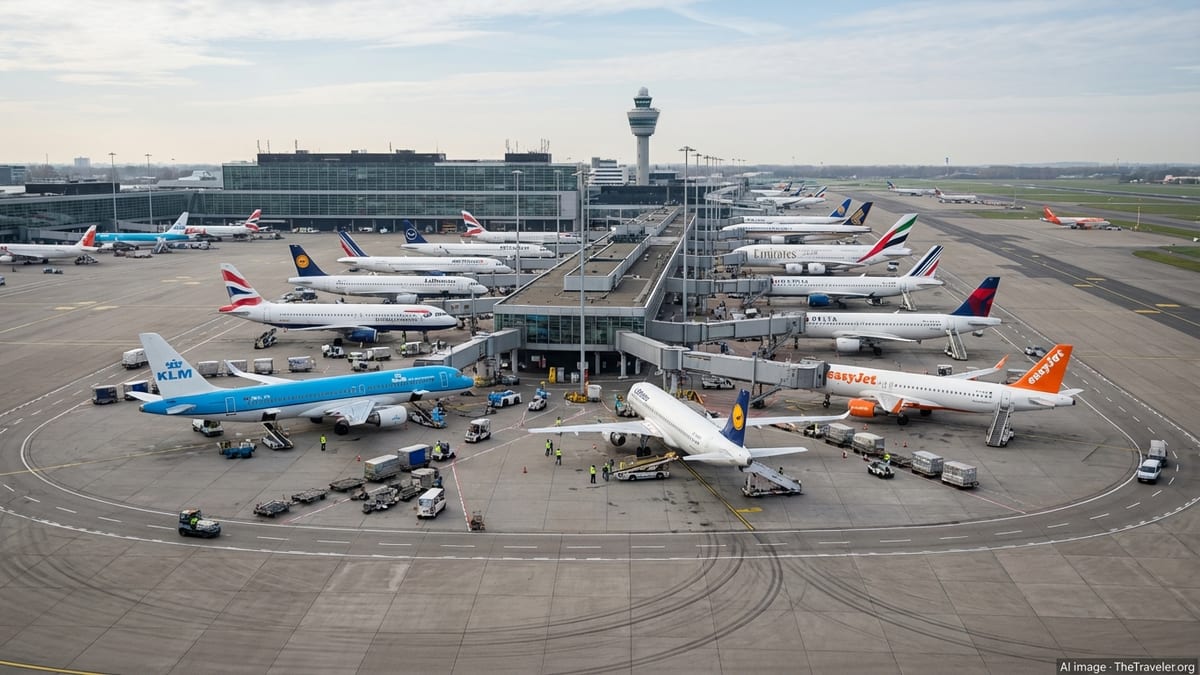
Growth Under a Hard Ceiling
The latest traffic figures confirm that Schiphol’s recovery from the pandemic slump is now entrenched. Royal Schiphol Group’s preliminary data show 68.8 million travelers in 2025, up about 3 percent from 2024 and putting the airport within striking distance of its pre-Covid record of 71.7 million passengers in 2019. Passenger volumes have rebounded despite a turbulent few years marked by capacity cuts, labor shortages and political pressure over noise and emissions.
The rebound is all the more striking because it has taken place against a backdrop of tighter regulatory limits. From 2025 the Dutch government moved to fix a legal cap on flight movements at Schiphol, targeting a maximum of 478,000 takeoffs and landings per year. Final details are still subject to legal and European Union scrutiny, but the direction of travel is clear: the political priority is fewer flights and less noise, not more runway activity.
Within that framework, Schiphol handled 477,552 flights in 2025, effectively pressing up against the new ceiling without breaching it. That left almost no room to grow by adding more movements, forcing airlines and the airport to pursue growth in other ways. The center of gravity has shifted from increasing quantity of flights to increasing quality and capacity per flight.
The paradox is that a policy designed to constrain aviation has coincided with a renewed period of expansion in passenger numbers. For now, at least, the hard movement limit has not translated into a cap on people passing through the terminal. Instead, airlines are upgauging to larger, more efficient jets and driving higher load factors, enabling the hub to capture more demand within the same number of slots.
A Super-Connector With 301 Global Destinations
Schiphol’s traffic performance is underpinned by its role as the Netherlands’ primary international gateway and one of Europe’s top connecting hubs. In 2025 the airport offered nonstop services to 301 destinations worldwide, including 125 long-haul routes outside Europe. That breadth of connectivity keeps it firmly in the top tier of European mega-hubs, alongside London Heathrow, Paris Charles de Gaulle and Frankfurt.
Airport industry body ACI Europe recently ranked Schiphol the continent’s second-best connected airport by direct connectivity, and third by hub connectivity. The figures reflect the strength of its hub-and-spoke model, built chiefly around Dutch flag carrier KLM and its SkyTeam partners, which funnel transfer traffic from secondary European cities onto widebody long-haul services.
Of the 68.8 million passengers using Schiphol last year, 43.6 million were origin and destination travelers who began or ended their journey at Amsterdam. Another 25.2 million were connecting passengers counted twice under industry statistics, illustrating the continued importance of transfer flows to Schiphol’s business model. Although transfer traffic exposes the airport to global economic and geopolitical shocks, it also underwrites frequencies and routes that would be unsustainable on local demand alone.
European short-haul travel remains the backbone of Schiphol’s network. Around 48.9 million passengers flew on intra-European services in 2025, while 19.9 million traveled on intercontinental flights. Spain has now overtaken the United Kingdom as the single most popular market, with routes to Barcelona, Malaga and the Canary Islands among the star performers. The United States, Italy and Turkey also feature prominently among top outbound destinations.
How Schiphol Is Outgrowing the Cap
Schiphol’s apparent ability to sidestep the constraints of a movements cap is rooted in a simple equation: more seats and higher load factors per flight. While the number of aircraft movements rose just 1 percent in 2025, passenger numbers climbed nearly three times as fast. The difference is largely explained by airlines deploying larger aircraft and tightening their capacity management.
Carriers have gradually swapped out older narrowbodies for new-generation Airbus A320neo and Boeing 737 MAX jets, while some high-demand European routes now see more widebodies that previously operated only on long-haul sectors. Low-cost and leisure operators serving Spain, Italy and Greece in particular have pushed average seat counts higher during peak holiday seasons, eking out extra capacity without requiring more slot pairs.
At the same time, the hub structure enables KLM and partners to sustain high load factors by pooling demand from multiple spoke cities onto a limited number of trunk flights. Transfer traffic smooths seasonality and helps fill seats that might otherwise go empty, a key advantage when every movement is precious. In a capped environment, airlines are incentivized to prune marginal frequencies and reassign scarce slots to thicker routes and times of day where aircraft can operate at or near full capacity.
Looking ahead to 2026, Schiphol itself expects between 68 and 72 million passengers based on current airline schedules and fleet plans, even as the official cap of 478,000 movements remains in place. If realized at the upper end of the range, that would finally push the airport beyond its 2019 peak in traveler numbers without adding more flights, providing a real-world test case of volume growth within fixed movement limits.
Quieter Jets, Stricter Charges and Environmental Politics
The political backdrop to Schiphol’s growth is a fierce national debate over noise, pollution and quality of life for residents under the flight paths. Successive Dutch governments have faced pressure from environmental groups and local communities to rein in aviation, particularly in the densely populated Amsterdam metropolitan region. Court rulings, nitrogen emissions rules and European Union noise procedures have all shaped the latest compromise on flight caps.
Under the current policy, the 478,000-movement ceiling is intended as an interim step toward a longer-term target of cutting noise nuisance by 20 percent by 2029 compared with pre-pandemic levels. To reach that goal without slashing connectivity, authorities are leaning heavily on technology and incentives. Schiphol has restructured its airport charges to penalize noisier and more polluting aircraft while offering discounts to the quietest types, sending a clear price signal to airlines.
The strategy appears to be working. Schiphol reports that 32.6 percent of aircraft operating between April and December 2025 fell into the two quietest tariff categories, an increase of nearly nine percentage points in a single year. The airport also expects average noise levels to fall further, predicting flights in the new operating year will be around 15 percent quieter by day and 32 percent quieter at night, based on fleet plans and route allocations.
For the new Dutch government, which has pledged a firmer stance on climate policy even as it seeks to safeguard the country’s trade position, Schiphol represents a delicate balancing act. The hub is vital to the Netherlands’ role as a logistics and business center, yet it is also a symbol for environmental activists campaigning for lower emissions and fewer short-haul flights. The emerging model at Schiphol suggests that a combination of stricter caps, targeted charges and technological change can curb the environmental footprint per passenger without freezing growth outright.
Economic Engine for the Netherlands
Beyond the headlines about caps and court cases, Schiphol’s 2025 performance reinforces its status as a cornerstone of the Dutch economy. Statistics agency data show that the airport accounted for around 88 percent of all air passengers and flights in the Netherlands last year, dwarfing regional gateways at Eindhoven, Rotterdam, Groningen and Maastricht. In total, some 78 million passengers used Dutch airports in 2025, with Schiphol handling the lion’s share.
The airport is also central to the country’s air cargo sector. Amsterdam handled about 1.43 million tonnes of freight in 2025, slightly down on the previous year but still the dominant node in the national cargo network. Bellyhold freight on passenger aircraft now represents a growing share of volumes as full-freighter activity levels off, aligning with airlines’ push for better aircraft utilization and lower unit emissions.
Financially, Royal Schiphol Group reported record profits for 2025, boosted by rising passenger numbers, higher aeronautical revenues and strong non-aviation income from retail, parking and real estate. The company has flagged plans to invest around 10 billion euros in terminal upgrades, new piers and sustainability projects over the coming years. Those investments are aimed at easing congestion, modernizing security and baggage systems, and improving working conditions after operational bottlenecks in 2022 and 2023 dented the airport’s reputation.
For the Dutch state, which owns roughly 70 percent of Royal Schiphol Group, and the city of Amsterdam, which holds a significant minority stake, the airport’s robust profitability offers fiscal breathing room. It also strengthens the argument that Schiphol can afford to finance the noise and emissions mitigation measures demanded by national policy without losing its competitive edge.
Competitive Pressures From Europe’s Other Mega-Hubs
Schiphol’s capped but climbing traffic sits within a broader European context of intense hub competition. According to recent ACI figures, Paris Charles de Gaulle, London Heathrow and Istanbul Airport all handled more passengers than Amsterdam in 2025, while Madrid Barajas is closing the gap. Schiphol ranked fourth among Europe’s busiest hubs, with Istanbul Sabiha Gokcen and other fast-growing airports illustrating how traffic can shift rapidly in response to capacity and policy constraints.
Yet the Dutch hub retains structural advantages. Its compact single-terminal layout minimizes connection times, a selling point for global alliances targeting long-haul transfer traffic. The Netherlands’ open economy and strong corporate base generate high-yield demand, especially on transatlantic and Asia-bound routes. Schiphol’s dense European feeder network, with frequent flights to secondary cities in the United Kingdom, Germany, Scandinavia and Eastern Europe, also helps sustain its role as a transfer gateway.
The challenge will be to defend that position if rivals enjoy more permissive regulatory regimes. Heathrow is exploring options for incremental capacity growth even after its long-contested third runway was put on hold, while Istanbul’s new mega-airport was built with significant headroom for new movements. Madrid and Paris have room to expand within existing infrastructure. If Dutch caps become more restrictive over time, airlines may shift marginal long-haul services or additional frequencies to less constrained hubs.
Schiphol’s management argues that predictability is now its biggest competitive asset. After years of legal uncertainty, an agreed movement cap backed by an EU-compatible noise framework may give airlines the confidence to plan fleet and network investments around Amsterdam. In that sense, a firmly drawn line in the sky could ultimately support, rather than stifle, the hub’s long-term role.
What the Numbers Signal for Travelers
For passengers, Schiphol’s 2025 figures translate into a network that is broad, busy and gradually becoming more stable after several disruptive years. The combination of capped movements and higher-capacity aircraft means peak periods remain crowded, but there is less risk of ad hoc cuts to flight programs as airlines adjust to a more predictable regulatory environment. Travelers benefit from a large menu of destinations and frequencies, particularly within Europe and across the North Atlantic.
At the same time, the pressure on scarce slots is likely to keep average fares relatively firm on some routes, especially at peak times. Airlines are incentivized to prioritize higher-yield traffic when they cannot simply add more flights to absorb demand spikes. Business travelers and long-haul passengers may see product upgrades and improved onboard comfort as carriers deploy newer aircraft, while short-haul leisure customers could face tighter seat pitch on densified jets.
The environmental dimension is increasingly woven into the passenger experience. Night flights are becoming rarer and more expensive for airlines to operate, and older, noisier aircraft are steadily disappearing from the Schiphol schedule. For residents under the approach paths, reductions in noise nuisance will be the ultimate test of the new model. For travelers, the payoff is a hub that can claim greener credentials while still offering a wide choice of connections.
As the Dutch government refines its aviation policy in the coming years, Schiphol’s 2025 performance will be scrutinized as evidence that capacity discipline and growth need not be mutually exclusive. With nearly 69 million passengers already moving through a tightly capped system, the airport has emerged as a proving ground for how a mature European hub can remain unstoppable even when the number of flights is not.