

More news on this day
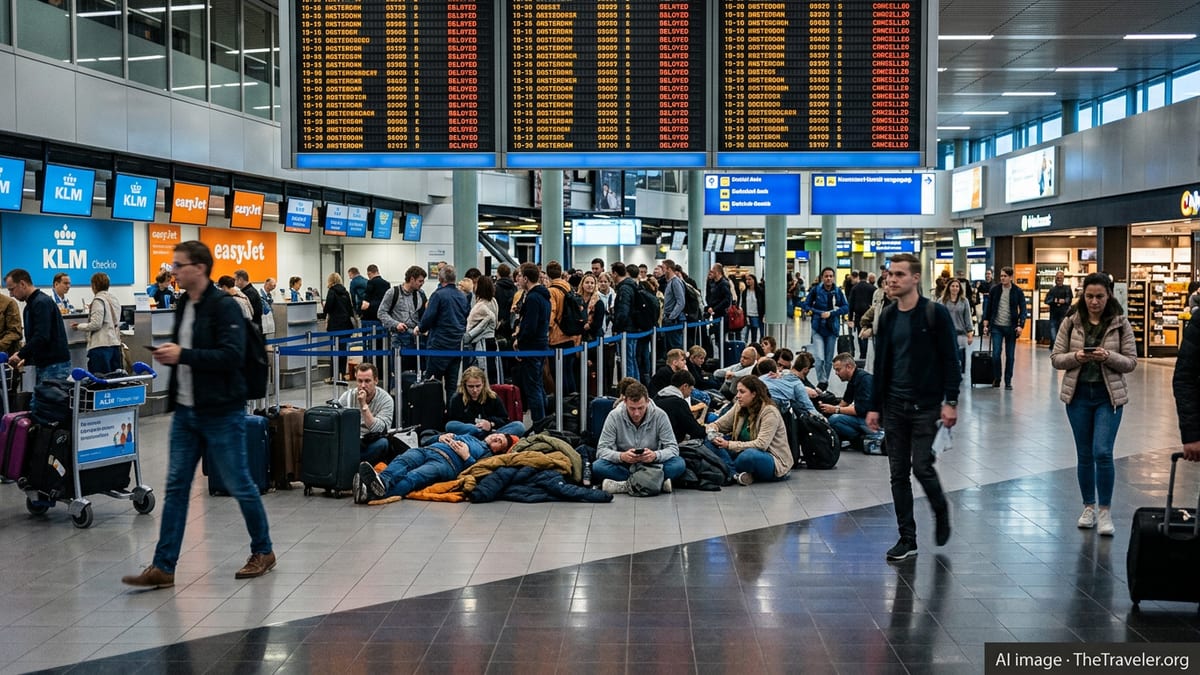
Hundreds of airline passengers were left stranded in the Netherlands on April 9, 2026, as a fresh wave of cancellations and delays at Amsterdam Schiphol rippled across key European and Middle East routes.
Get the latest news straight to your inbox!
Schiphol Cancellations Hit Major European and Middle East Routes
Operational data from flight-tracking services and passenger-rights platforms on April 9 indicate that Amsterdam Schiphol recorded one of the highest disruption levels in Europe, with more than a dozen short-haul and medium-haul services cancelled and many more delayed. Routes to Venice, Bologna, Frankfurt and Florence were among those affected, alongside flights connecting to Riyadh and other Middle East destinations.
Publicly available information shows that KLM, Lufthansa and easyJet were among the carriers most visibly impacted at Schiphol, as tightly timed hub operations struggled to absorb late-arriving aircraft and rolling schedule changes. Passengers reported long queues at transfer desks and self-service kiosks, with some travellers advised to expect overnight stays in the Netherlands while airlines worked through backlogs.
Coverage from European aviation outlets places Schiphol within a wider pattern of disruption that has affected hubs including Heathrow, Frankfurt, Madrid and Oslo in early April. In this latest spell, however, the concentration of cancellations at Amsterdam has had a particular impact on connecting journeys between northern Europe and Italy, as well as links between Europe and Saudi Arabia.
While no single cause has been cited for all affected flights, analysts note that Schiphol is operating under sustained strain after a series of weather events, capacity constraints and network imbalances since the start of the year. These pressures have increased the likelihood that relatively small operational issues translate quickly into significant schedule disruption.
Italian Fuel Constraints and Weather Complications Deepen the Impact
The problems at Amsterdam coincided with fuel rationing at several Italian airports, compounding the difficulty of maintaining schedules on routes between the Netherlands and northern Italy. Industry reports from April 8 indicate that Bologna and Venice, along with other Italian airports, have been operating under jet fuel restrictions, with preference given to certain long-haul and priority services.
These constraints mean that flights linking Schiphol with Venice and Bologna are more vulnerable to knock-on disruption, as aircraft may require additional fuel stops, weight restrictions or schedule adjustments. When combined with delays and capacity limits at Amsterdam, the result has been heightened volatility on Italian routes, with some rotations cancelled and others operating with extended delays.
Weather has also played a recurring role in the recent European disruption cycle. Earlier in the week, coverage from regional media highlighted dense fog and unsettled conditions in parts of the Netherlands, as well as adverse weather across western and northern Europe. Even as conditions improved, residual congestion and aircraft displacement continued to affect timetables at Schiphol and feeder airports.
Travel commentators note that such overlapping pressures create little margin for recovery. Once several rotations are lost in a single day due to local conditions or fuel constraints, crews and aircraft are often left out of position for subsequent services, amplifying disruption well beyond the initial trigger.
Ongoing Middle East Suspensions Add Pressure on Riyadh Connections
Published airline notices show that KLM has already suspended flights to Dubai, Riyadh and Dammam through mid May for safety-related reasons associated with regional tensions. Those suspensions have reduced the number of direct options between the Netherlands and parts of the Gulf, concentrating demand on remaining connections via other European hubs.
With Schiphol now facing its own wave of cancellations and delays, passengers booked on itineraries involving Riyadh and other Middle East destinations have encountered additional uncertainty. Some itineraries rely on connections from Amsterdam to partner hubs such as Frankfurt, while others feed into codeshare services operated by airlines based elsewhere in Europe.
Reports from passenger forums and travel-industry coverage suggest that when feeder flights from Amsterdam to hubs like Frankfurt are delayed or cancelled, travellers risk missing onward departures to the Middle East, even where long-haul flights continue to operate on time. In several cases, this has left passengers stranded in the Netherlands overnight or rebooked days later on alternative routings.
Consumer advocates point out that the interaction between planned route suspensions and unplanned disruption at a major hub can sharply reduce available capacity. This is particularly visible for cities such as Riyadh, where the loss of direct services from Amsterdam places more pressure on indirect connections that are themselves vulnerable to European weather and capacity issues.
Passengers Face Long Waits, Rebookings and Limited Alternatives
Accounts shared on social media platforms and travel discussion boards describe travellers at Schiphol facing multi hour waits at customer service counters and uncertainty about rebooking options. Some passengers reported being advised to accept rerouting via other hubs such as Frankfurt or to shift to next day departures, while others struggled to secure seats at all on heavily booked alternative flights.
Several European consumer publications note that airlines have been offering standard rebooking and refund options in line with their policies, but that limited spare capacity across the network makes rapid recovery challenging. With school holidays and spring events driving higher demand, many flights to Italy and Germany are operating close to full, leaving little flexibility to absorb displaced passengers from cancelled services.
Observers say that travellers with multi leg itineraries have been particularly exposed. A cancellation on a short intra European segment, such as Amsterdam to Bologna or Florence, has in some cases caused travellers to miss onward long haul sectors, triggering complex reissues and extended delays. Some passengers have opted to abandon air connections entirely in favor of rail or road travel across parts of Italy and central Europe.
Passenger advocates continue to remind travellers to document expenses such as hotels and meals, to retain boarding passes and booking confirmations, and to monitor airline alerts closely. With disruption recurring across the continent, those planning to transit through Amsterdam in the coming days are being urged by travel media to build in additional time and remain flexible about routings.
What the Disruptions Reveal About Europe’s Strained Air Network
Aviation analysts argue that the latest problems at Schiphol highlight structural fragilities across Europe’s air transport system. Recent reports from air traffic management bodies and industry groups describe a network operating near capacity at many major hubs, where modest shocks from weather, fuel supply issues or regional security tensions can quickly cascade into widespread disruption.
Amsterdam plays a central role in connecting northern Europe with Italy, central Europe and the Middle East. When its schedule is constrained, the effects are felt across a chain of airports including Venice, Bologna, Frankfurt and Florence, and on long haul links to destinations such as Riyadh. The events of early April have underlined how closely intertwined these corridors have become.
Commentary in specialist travel publications also notes that passengers are increasingly sensitive to recurring disruptions at certain hubs, with some leisure and business travellers actively seeking routings that avoid perceived bottlenecks. However, for many markets there are few practical alternatives to large connecting airports like Schiphol, meaning that capacity constraints and operational shocks continue to translate directly into stranded passengers.
For now, publicly available operational summaries suggest that airlines will focus on gradual recovery, prioritizing the restoration of core frequencies on key routes and repositioning aircraft and crews where possible. Travellers heading through Amsterdam in the coming days are likely to see a mix of stabilising schedules and lingering irregularities, as carriers work to clear the backlog created by the latest round of cancellations and delays.