

More news on this day
Amsterdam’s Schiphol Airport, one of Europe’s busiest international hubs, is grappling with severe operational disruption as waves of flight delays and cancellations ripple through global airline networks and strand passengers worldwide.
Weather Strikes Schiphol as Winter Storms Bite
Schiphol’s latest bout of travel chaos has been driven largely by harsh winter weather sweeping across the Netherlands. On 2 January 2026, Storm Anna brought heavy snow, freezing conditions and powerful crosswinds to the Amsterdam region, forcing airlines and air traffic control to sharply reduce movements for safety reasons. More than 325 flights were cancelled and over 635 delayed in a single day, an operational shock that reverberated through airline schedules well beyond Europe.
The problems did not end with a single storm. Successive snowfalls and persistent low visibility through early January left runways repeatedly covered and deicing teams working at full stretch. On 5 January, authorities and airlines jointly axed around 450 flights in anticipation of worsening conditions and limited deicing capacity, effectively halting a large share of the day’s operations at the airport.
Individual carriers also moved preemptively to protect safety and manage scarce resources. Moroccan flag carrier Royal Air Maroc, for example, cancelled services to and from Schiphol on 5 January, citing deteriorating weather and the knock-on impact of ground handling constraints. For passengers, that translated into last‑minute notifications, long queues at ticket counters and intense competition for the dwindling number of available seats out of the Netherlands.
As snow turned to freezing rain and temperatures fluctuated around the freezing point, operational complexity increased. Ground staff had to juggle runway sweepers, deicing trucks and limited aircraft parking stands, while pilots faced shifting winds and braking‑action checks on slick runways. Even flights that managed to depart often did so after extended holds, pushing delay totals ever higher.
Global Networks Feel the Shockwaves
As Europe’s third‑busiest hub for international traffic, Schiphol plays an outsized role in connecting passengers between North America, Europe, Africa and Asia. When storms or capacity restrictions hit Amsterdam, effects are quickly felt across airline networks worldwide. Delayed aircraft and crew in the Netherlands cascade into late departures and missed connections hours later in cities such as New York, Nairobi and Singapore.
Data from passenger‑rights analysts tracking disruption across Europe show that Amsterdam has featured prominently among the continent’s hardest‑hit airports during recent bouts of bad weather. On 9 March 2026, Europe recorded hundreds of cancellations and well over a thousand delays in a single day, with Amsterdam, London Heathrow and Paris Charles de Gaulle among the main contributors. Each cancelled or heavily delayed wave of flights at Schiphol removed crucial connection opportunities for long‑haul travelers heading onward across the globe.
The ripple effects are amplified by the current instability in Middle East airspace. Ongoing closures linked to regional conflict have already led Gulf and Asian carriers to cancel or reroute hundreds of flights, straining capacity on Europe–Asia corridors. For travelers relying on KLM or its partners to bridge Europe with Asia, Africa and the Americas via Amsterdam, the combination of diversions, longer routings and winter weather has made itineraries more fragile than usual.
As flights into Amsterdam arrive late, onward connections are missed, and airlines are often left with difficult choices: hold departures and risk further knock‑on delays, or leave behind connecting passengers and rely on later flights with limited spare capacity. Either option feeds back into the global pattern of disruption, extending the operational headache for several days beyond the initial weather event.
Long Queues, Missed Connections and Stranded Bags
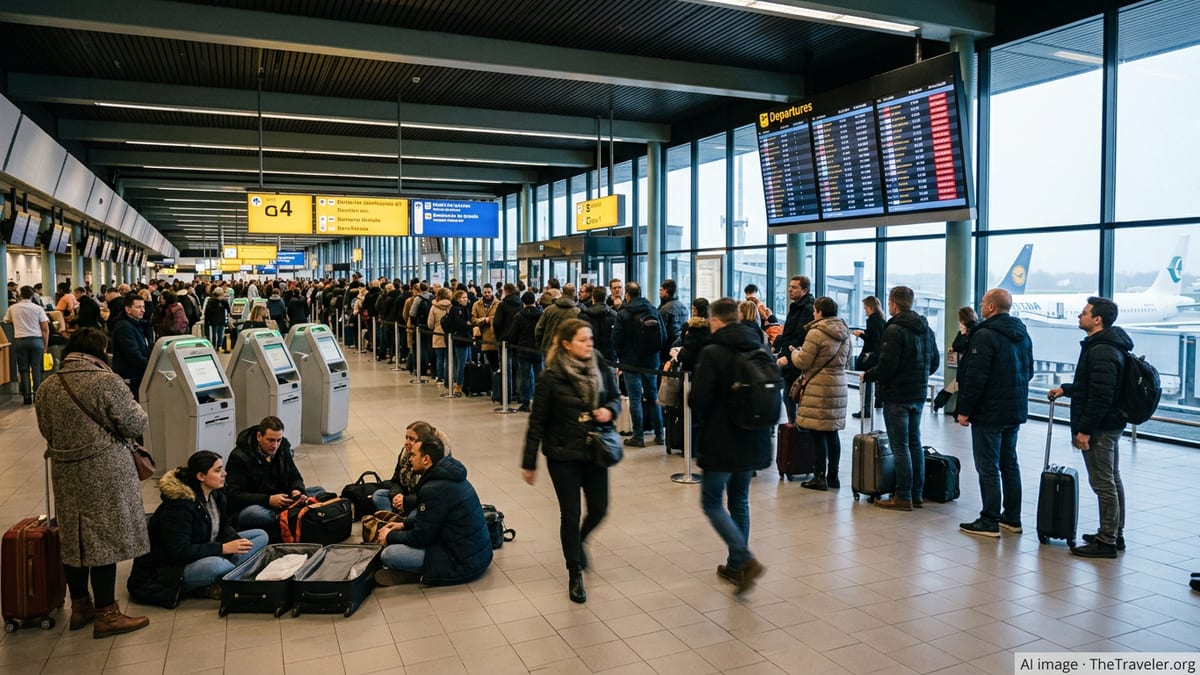
For passengers on the ground at Schiphol, the disruption has translated into familiar yet still distressing scenes. Long lines have stretched across departure halls as travelers seek rebooking assistance, while monitors fill with orange and red status updates as delays lengthen and more flights turn from delayed to cancelled. Families returning from holidays, business travelers with tight schedules and students heading back to campuses have all faced extended waits and improvised overnight stays.
Checked baggage has emerged as a particular pain point. Earlier this winter, technical failures in Schiphol’s baggage handling systems coincided with adverse weather and flight cancellations, leaving tens of thousands of bags stranded in the airport’s underground belt network. Many pieces missed their connecting flights entirely, arriving days later at destinations like Dublin and Riga or, in some cases, remaining untraced for longer stretches as handling agents worked through a growing backlog.
Online forums and social media have filled with accounts of passengers arriving at final destinations without luggage after transiting Amsterdam. While airlines have stressed that safety takes precedence and that they are working to restore regular operations, the combination of disrupted schedules and overwhelmed baggage systems has heightened frustration. Travelers who had carefully timed short connections through Schiphol are reporting missed onward flights and unplanned hotel nights in Amsterdam or other European hubs.
Airport staff and ground handlers, meanwhile, are operating under intense pressure. Snow and ice increase turnaround times for aircraft, forcing handlers to balance tight safety protocols with the need to move flights quickly. Reduced staffing during overnight hours and the challenges of bringing in extra workers at short notice in bad weather further limit how fast the system can recover once a major disruption has taken hold.
How Airlines and Schiphol Are Responding
Airlines using Schiphol, led by Dutch flag carrier KLM, have implemented a mix of contingency measures to keep their networks functioning. These include pre‑emptive cancellations of selected flights ahead of forecast storms, consolidation of lightly booked services onto fewer aircraft, and priority given to long‑haul intercontinental routes where alternative options for stranded travelers are more limited.
KLM and its partners are also leaning heavily on automated rebooking tools and passenger communication systems. Customers whose flights are cancelled or significantly delayed are receiving notifications by email, text message and airline apps, offering revised itineraries where available. In some cases, airlines are re‑routing travelers via alternative hubs in Paris, Frankfurt or London to bypass congestion at Amsterdam, even if that means less convenient routings.
Schiphol’s operator says it is coordinating closely with Air Traffic Control the Netherlands and carriers to balance safety, noise limits and capacity. New slot monitoring and coordination procedures, introduced ahead of the summer 2026 season, are designed to reduce last‑minute schedule changes and smooth peaks in traffic. However, these measures are being tested by the combination of severe winter weather and broader geopolitical shocks affecting long‑haul networks.
On the ground, the airport has deployed extra staff to direct passengers in crowded terminals, reinforce information desks and manage queues at security and border control. Additional deicing vehicles and runway clearing equipment have been in near‑continuous use during snow events, though there are physical limits to how quickly runways and taxiways can be made safe when snowfall is persistent.
What Travelers Should Do If Their Schiphol Flight Is Hit
Travel experts advise that passengers scheduled to travel via Amsterdam in the coming days closely monitor their flight status and build extra time into itineraries where possible. With network schedules still fragile and recovery operations ongoing, same‑day tight connections through Schiphol carry elevated risk, especially for long‑haul journeys involving multiple airlines.
Passengers whose flights are cancelled or significantly delayed may be entitled to assistance or compensation under European passenger rights rules, depending on the cause of the disruption and the airline involved. In many weather‑related cases, compensation may not apply, but carriers are still obliged to offer rebooking or refunds, as well as care such as meals and hotel accommodation in certain circumstances.
Industry groups recommend that affected travelers work primarily through official airline channels, such as carrier websites, mobile apps and verified customer service numbers, to avoid scams that can emerge during major disruption events. During recent snow‑related cancellations at Schiphol, Dutch news outlets reported instances of fraudulent “support” numbers circulating online and on social media, targeting stranded passengers looking for urgent assistance.
For now, aviation analysts caution that the combination of volatile winter weather, constrained airport capacity and geopolitical tensions affecting key air corridors mean that Europe’s aviation system, and Schiphol in particular, will remain vulnerable to further shocks. Travelers planning connections through Amsterdam over the coming weeks are being urged to stay flexible, keep documentation of all expenses and disruptions, and prepare for the possibility that a routine transit through one of Europe’s premier hubs may take longer than expected.