

More news on this day
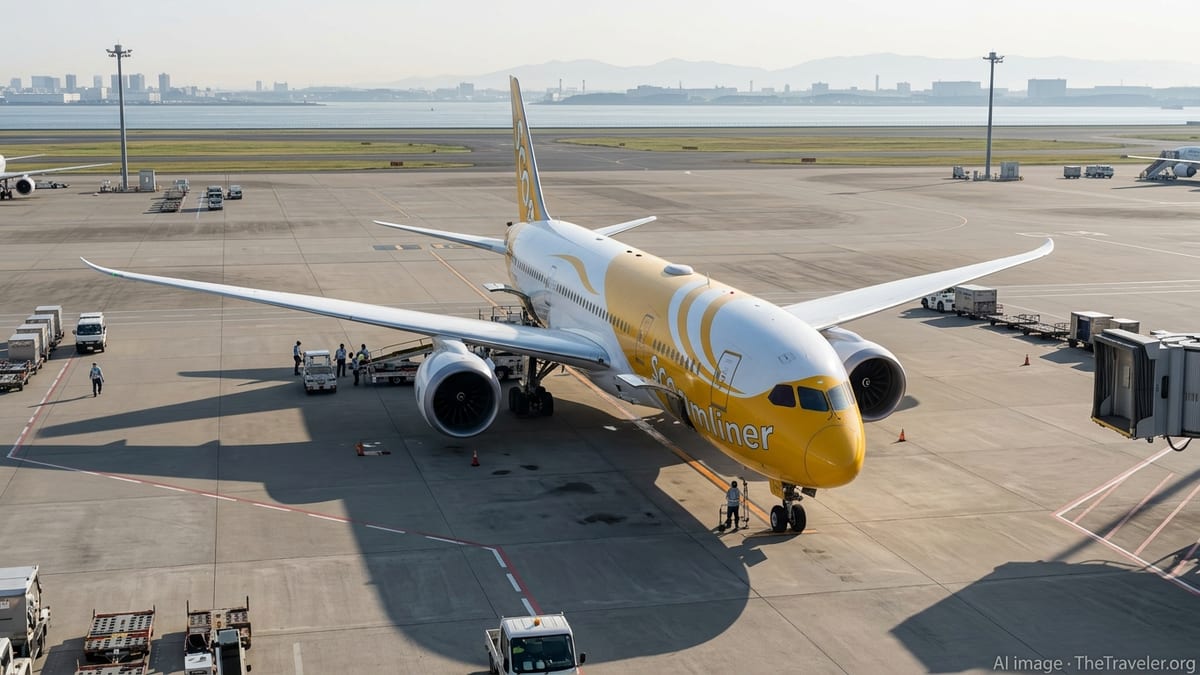
Scoot is preparing to shake up Northeast Asia’s busiest premium corridors by entering Tokyo Haneda with a new daily Singapore service operated by low-cost Boeing 787 widebody aircraft from March 1, 2026, a move that intensifies competition on one of the region’s most strategically important routes.
Get the latest news straight to your inbox!
New Daily Link From Changi to Tokyo’s Downtown Airport
According to Scoot’s published schedules and recent media coverage, the Singapore Airlines low-cost subsidiary will begin operating daily non-stop flights between Singapore Changi and Tokyo Haneda from March 1, 2026. The route will be flown with Boeing 787 Dreamliners configured in an all-economy layout typical of low-cost, long-haul operations.
Publicly available information indicates that Scoot already serves Tokyo via Narita, but the Haneda launch gives the airline access to Japan’s more centrally located capital airport. Haneda’s proximity to downtown Tokyo and its extensive domestic connections are expected to appeal to both leisure travelers seeking shorter transfers into the city and budget-conscious passengers connecting onwards within Japan.
Regional aviation analysts note that Haneda slots are tightly controlled, and entry by a low-cost carrier on a trunk route such as Singapore–Tokyo represents a significant shift in how capacity at the airport is being utilized. The move will see Scoot join full-service operators such as Singapore Airlines, All Nippon Airways and Japan Airlines on the city pair, adding a distinctly low-cost option at an airport historically dominated by full-service brands.
The new service also strengthens the broader Singapore–Japan air corridor, which has seen steady increases in capacity as tourism rebounds and as closer business and leisure ties drive demand between Southeast Asia and Northeast Asia.
Low-Cost Widebodies Move Into Prime Legacy Territory
The deployment of Boeing 787 widebodies on a daily basis into Haneda reflects a broader trend of low-cost carriers using long-range aircraft to penetrate markets traditionally reserved for full-service airlines. Scoot’s Dreamliner fleet has been central to its medium and long-haul strategy, serving destinations in North Asia, the Middle East and Europe with a no-frills model layered on widebody economics.
Industry data and fleet information show that Scoot operates more than 50 aircraft, including Boeing 787-8 and 787-9 jets, giving it the scale to compete on trunk routes in terms of seat capacity even while maintaining a lower cost base. By contrast, many low-cost rivals in the region have remained focused on narrowbody Airbus A320 family or Boeing 737 services, limiting their ability to offer comparable seat comfort and range on longer flights.
The Singapore–Tokyo sector, typically around seven hours in duration, is well suited to a widebody platform in terms of fuel efficiency and payload. For Scoot, concentrating capacity on the 787 allows it to spread operating costs across more seats while offering passengers cabin altitude, lighting and window features associated with newer-generation aircraft, albeit without the bundled inclusions of a full-service airline.
At the same time, the presence of a low-cost widebody operator at Haneda puts pressure on legacy carriers already competing fiercely on price and schedule. Fare sales published in early 2026, including promotions listing Tokyo Haneda from around S$190 one way before add-ons in certain campaign periods, illustrate how aggressively Scoot is positioning itself on Japan routes compared with traditional full-service pricing.
Tokyo Haneda Becomes a Battleground for Budget and Premium Travel
The new Scoot service arrives at a moment when Haneda is evolving from a primarily business and domestic hub into a more mixed international gateway. Schedules published by airports and airlines show multiple daily flights from Singapore to Haneda on Singapore Airlines and Japanese carriers, with Scoot’s entry further increasing total weekly frequencies between the two cities.
For travelers, the shift raises the prospect of more choice across price points and products on a route that is vital for both tourism and corporate travel. Full-service carriers continue to target premium cabins and connecting traffic to North America and the wider Asia-Pacific, while Scoot taps demand from price-sensitive passengers who still prefer the convenience of Haneda over Narita.
Travel industry reporting indicates that low-cost competition has already altered pricing dynamics on other Japan routes from Singapore, particularly to Tokyo Narita and Osaka. With Scoot now securing a foothold at Haneda as well, analysts suggest that yield management for full-service players may become more complex, especially during off-peak seasons when discounting is often used to fill widebodies.
However, constraints on slot growth at Haneda mean that capacity increases are finite, preserving a degree of pricing power for incumbent airlines. Within that framework, Scoot’s arrival is less about flooding the market with seats and more about reshaping the product mix, inserting a no-frills widebody option into what has been a high-yield, business-heavy corridor.
Network Strategy: Linking Japan, Southeast Asia and Beyond
The Haneda launch is part of a broader network expansion that sees Scoot adding new destinations in Thailand and Japan, including Chiang Rai and Okinawa, between late 2025 and early 2026. Public information from airline and tourism releases indicates that these additions are designed to deepen Scoot’s presence in secondary leisure markets while strengthening its role as a connector between Southeast Asia and Northeast Asia.
From Singapore’s perspective, a daily low-cost widebody link to Haneda reinforces Changi Airport’s status as a super-connector, giving travelers from across Southeast Asia the option to route via Singapore to reach central Tokyo at lower headline fares. This is particularly relevant for cost-conscious travelers from emerging markets, who may be more inclined to accept paid extras for baggage and meals in exchange for a lower base fare.
The timing also dovetails with joint ventures and partnerships in the wider Singapore Airlines Group ecosystem, in which Scoot acts as a feeder on leisure-heavy routes while the parent carrier focuses on premium and long-haul connectivity. Observers note that this division of labor allows the group to address different customer segments on the same city pairs, using Scoot to defend market share at the price-sensitive end of the spectrum without diluting the full-service brand.
For Japan, additional connectivity from Southeast Asia into Haneda supports tourism policy goals aimed at attracting more visitors beyond Tokyo itself. With integrated rail and domestic air connections from Haneda, budget-conscious travelers arriving on Scoot can disperse quickly to regional cities, potentially boosting local economies in areas that have benefitted from the country’s recent tourism boom.
What Travelers Can Expect From Scoot’s Haneda Service
While precise in-flight service details are determined by Scoot’s existing long-haul product, the airline’s low-cost model means passengers on the Singapore–Haneda route can expect unbundled fares, with optional extras for checked baggage, seat selection, meals, and onboard Wi-Fi where available. Media reports and Scoot’s own fare disclosures highlight that headline prices on Japan routes frequently undercut full-service competitors, although total trip costs can climb once add-ons are factored in.
The Boeing 787 cabins used by Scoot feature high-density seating, making them less spacious than full-service configurations but benefiting from features such as larger windows and improved cabin pressure. For many leisure travelers, the trade-off between comfort and cost is acceptable on a seven-hour sector, particularly when weighed against the convenience of arriving at Haneda instead of Narita.
Operational performance remains a point of close interest for travelers planning tight connections, especially where Scoot operates as part of a wider itinerary that may include full-service partners. Punctuality and schedule reliability have been recurring themes in traveler discussions about low-cost carriers in the region, reinforcing the importance of leaving adequate buffer time for onward journeys through Changi or Haneda.
With bookings already open for travel after the March 1, 2026 launch, the new daily Scoot service positions low-cost widebody travel at the heart of one of Asia’s most contested aviation markets, signaling that the next phase of competition between Singapore and Tokyo will be fought as much on price and product segmentation as on schedule and brand loyalty.