

More news on this day
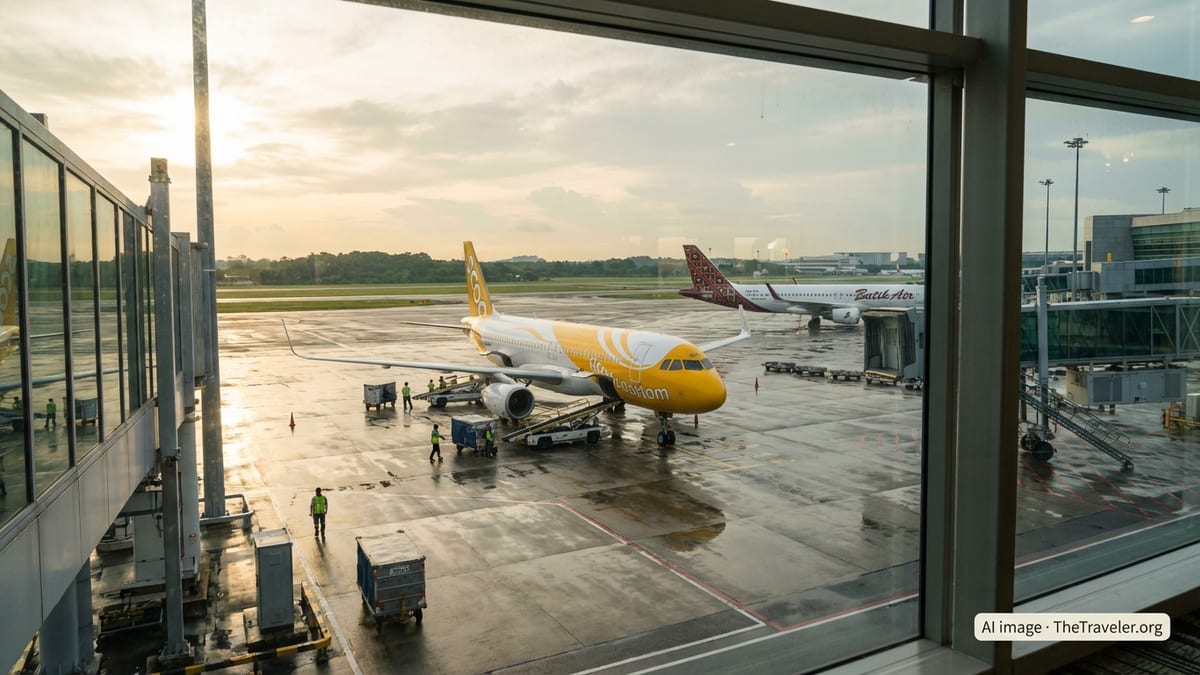
Scoot’s launch of daily flights between Singapore and Medan in February 2026 is reshaping one of Southeast Asia’s busiest short-haul corridors, putting the Singapore Airlines budget arm into direct competition with incumbent Batik Air Indonesia for price-sensitive travellers, regional business traffic and North Sumatra’s growing stream of international tourists.
A New Daily Player on the Singapore–Medan Corridor
The new Scoot service officially took off on 1 February 2026, linking Singapore Changi Airport with Medan’s Kualanamu International Airport once a day on Airbus A320-family aircraft. The launch follows a broader Indonesian expansion plan first outlined by Scoot in October 2025, which included new services to Labuan Bajo, Palembang and Semarang as part of a push to exceed 120 weekly flights to 15 Indonesian cities.
Parent company Singapore Airlines underscored the importance of Medan in a business update released this week, highlighting Scoot’s daily operation as a key plank in the group’s growth strategy for the January to March 2026 quarter. The move fills capacity vacated by rival carriers elsewhere in Indonesia while tightening the airline group’s grip on short-haul connectivity out of Changi.
For North Sumatra, the new service represents more than just another flight. Airport operator Angkasa Pura Aviasi had already signalled in late 2025 that additional Singapore links were a priority, framing Scoot’s entry as a catalyst for inbound tourism, trade and investment flows into Medan and beyond.
Batik Air Indonesia: The Incumbent Guarding Its Turf
Unlike many new routes where a single carrier opens a fresh city pair, Scoot is stepping into a market that Batik Air Indonesia already serves daily. Batik’s ID7146 operates from Singapore Changi to Medan Kualanamu around mid-afternoon, typically using Airbus A320 aircraft on a non-stop schedule of about one hour and thirty minutes.
Flight data for the 2025–2026 period show Batik running the route seven days a week, positioning itself as a dependable option for both point-to-point passengers and those connecting onto the Lion Air Group’s extensive domestic network from Medan. For Indonesian travellers, especially those continuing to secondary cities in Sumatra and Java, Batik’s integrated timetable and familiarity remain strong drawcards.
That said, Batik’s service has faced mounting competition in the broader Singapore–Indonesia market, not only from low-cost carriers but also from full-service airlines such as Singapore Airlines and Garuda Indonesia on other city pairs. Scoot’s arrival on the Medan sector adds a new layer of pressure on schedules, fares and service differentiation.
Schedules, Fares and Fleet: Where Scoot Could Outshine
Key to Scoot’s challenge is how it positions its schedule and pricing against Batik’s entrenched timetable. By operating a daily round-trip with morning or midday timings out of Changi, Scoot can tap both Singapore-origin leisure travellers heading for long weekends at Lake Toba and international passengers connecting via the Singapore Airlines long-haul network.
Promotional fares announced in late 2025 for Scoot’s Indonesian expansion hinted at aggressive entry-level pricing, with economy one-way tickets to new destinations, including Medan, pitched to undercut many full-service competitors. While exact fare structures fluctuate, analysts expect Scoot to lean heavily on dynamic discounting, ancillaries such as seat selection and baggage, and bundle deals that appeal to budget-conscious travellers.
Onboard, Scoot’s use of relatively young Airbus A320-family aircraft is likely to resonate with travellers prioritising reliability and cabin comfort at low-cost fares. Batik also relies on the A320, but Scoot benefits from group-wide efficiencies in fleet utilisation, maintenance and digital sales channels aligned with Singapore Airlines, which can translate into more polished booking experiences and loyalty perks via the KrisFlyer ecosystem.
If Scoot can maintain punctual operations and attractive fares while leveraging Changi’s reputation as a smooth transfer hub, it may gradually pull traffic away from Batik’s more traditional, Indonesia-centric network on this specific route.
Tourism, Trade and the Lake Toba Effect
Beyond airline rivalry, the real story lies in what intensified air links mean for Medan and North Sumatra. Tourism authorities in Indonesia have long promoted Lake Toba as a priority destination, and easier access via Medan is seen as critical to boosting international arrivals. Additional direct capacity from Singapore gives tour operators more flexibility to package short-break itineraries that combine city stays in Medan with nature and culture excursions around Toba.
For Singapore-based businesses, daily low-cost connectivity improves access to one of Indonesia’s most dynamic regional economies. Medan is a centre for palm oil, rubber and agricultural exports, as well as a growing hub for education and healthcare. More seats and overlapping schedules on the route could lower average fares, encouraging more frequent short business trips and cross-border investment.
Local authorities in North Sumatra have welcomed Scoot’s entry as a sign of confidence in the region’s growth prospects. With both Scoot and Batik Air marketing Medan as a gateway, the city stands to benefit from heightened visibility in regional tourism campaigns and airline promotions throughout 2026.
Room for Two, or a Battle for Market Share?
Whether Scoot’s new daily service ultimately outshines Batik Air Indonesia will depend on how demand develops across 2026. Current indicators suggest there is room for both carriers as tourism rebounds and business travel within ASEAN normalises, but sustained fare wars could test profitability on this short sector.
Industry observers note that Medan’s proximity to Singapore, combined with its role as a feeder to domestic Indonesian destinations, could support multiple daily frequencies by different airlines over the medium term. In that scenario, Scoot may carve out the higher share of international and connecting traffic, while Batik Air retains a solid base of Indonesian travellers leveraging the Lion Air Group network.
For now, travellers are the clear winners. Two competing daily flights between Singapore and Medan, both operated by narrow-body jets with similar flight times, create more choice on departure times, fare options and service styles. As 2026 unfolds, the Singapore–Medan skies are set to become a closely watched microcosm of Southeast Asia’s low-cost carrier rivalry.