

More news on this day
Rail travel across Europe is undergoing a renaissance as Scotland’s celebrated Highland routes join classic lines in Norway, Switzerland and Italy on new lists of the world’s most spectacular scenic train journeys for 2025 and 2026.
Get the latest news straight to your inbox!
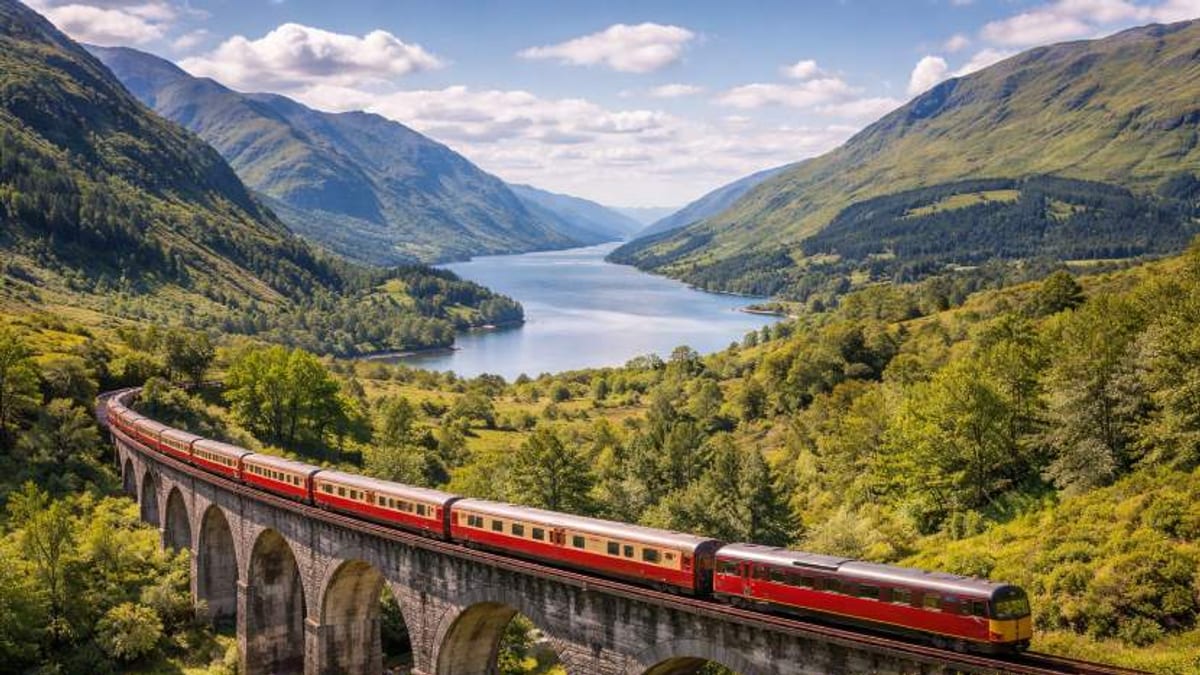
Image by Latest International Railway News, Global Rail Industry News
Scotland’s Highland Railways Step Into the Global Spotlight
Scotland’s entries into the scenic rail spotlight are led by the West Highland Line, the dramatic route linking Glasgow with Fort William and Mallaig through some of the country’s most remote landscapes. Publicly available information shows that the line has repeatedly been highlighted in reader rankings and specialist rail features as one of the world’s most beautiful railway journeys, praised for its shifting views of lochs, moors and mountain passes.
Coverage of Europe’s top photogenic rides for 2025 frequently pairs the West Highland Line with Scotland’s Kyle Line from Inverness to Kyle of Lochalsh, a coastal route that threads past misty inlets, ruined castles and views towards the Isle of Skye. Travel commentators note that these lines together offer a cross-section of the Highlands, from interior wilderness to Atlantic shoreline, without requiring a rental car or long-distance hiking.
Luxury rail is also playing a role in Scotland’s elevated profile. The Belmond Royal Scotsman, which operates multi-day itineraries across the Highlands, has introduced new “Western Scenic Wonders” tours using portions of the West Highland Line, further cementing the railway’s image as a bucket-list journey. Industry materials describe itineraries that linger over locations such as Rannoch Moor, often cited as one of Britain’s last great wilderness areas, and coastal stretches looking across to the Hebrides.
Domestic tourism organizations have increasingly framed these Scottish routes as part of a broader shift toward low-impact, landscape-focused travel. The emphasis on rail allows visitors to access fragile environments such as peat bogs, glens and wild shores while keeping car traffic and infrastructure pressure in check, aligning the Highlands with wider European efforts to promote climate-conscious journeys.
Norway’s Fjord Railways Showcase Nordic Drama
Norway has long been associated with some of Europe’s most cinematic train rides, and current 2025 and 2026 travel features continue to place its lines near the top of global rankings. The Bergen Railway between Oslo and Bergen is frequently described as the country’s flagship scenic route, climbing to one of Europe’s highest mainline summits across the Hardangervidda plateau. Guides highlight its sequence of snowfields, frozen lakes and treeless tundra, often visible even in summer.
Branching from this main line, the Flåm Railway between Myrdal and the village of Flåm consistently appears in lists of the world’s most beautiful short rail journeys. Recent practical guides emphasize the line’s steep gradients, tunnel-packed descent into a side arm of the Sognefjord and near-constant views of waterfalls and cliff faces. The journey, which takes under an hour, is often marketed as a core element of combined rail and fjord itineraries linking Oslo, Bergen and the western fjords.
Norwegian rail experts and regional tourism bodies have also pushed routes further north, such as the Rauma Line between Åndalsnes and Dombås, into the international spotlight. New product launches and operator presentations in late 2024 describe the line as a “reason to travel” in its own right, citing vistas of vertical valley walls, high bridges and the approach to well-known peaks and viewpoints. Enthusiast commentary portrays these journeys as an accessible alternative to strenuous hiking for visitors seeking fjord-and-mountain scenery.
This renewed attention reflects a broader Nordic trend in which rail is promoted as the preferred way to experience the region’s landscapes. With seasonal closures, capacity limits and winter conditions now widely discussed in online planning forums, travelers are being urged to reserve tickets well ahead of peak summer departures, underlining the popularity of Norway’s scenic railways.
Swiss Mountain Expresses Remain the Benchmark
Switzerland’s long-established reputation for spectacular train journeys continues to set the benchmark for scenic rail worldwide. The Bernina Express, running between Chur in Switzerland and Tirano in northern Italy, features prominently in recent rankings of Europe’s most photogenic routes. Publicly available information describes the line as crossing the Albula and Bernina landscapes, a designated World Heritage site, and reaching some of the highest railway altitudes in the Alps.
Travel features for 2025 and 2026 often describe the Bernina itinerary as a condensed Alpine panorama, moving from glaciers and mountain passes to vineyards and palm trees within a single four-hour journey. Panoramic coaches, slow running speeds and a dense sequence of viaducts and spiral tunnels are regularly cited as reasons the experience continues to attract visitors despite competition from newer rail products elsewhere in Europe.
Other Swiss routes, including the Glacier Express and regional lines through the Bernese Oberland and the Valais, are repeatedly grouped with the Bernina Express in expert shortlists of Europe’s top scenic trains. These rankings typically emphasize reliability and year-round operation, allowing travelers to experience stark winter snowscapes, spring meltwater and late-summer alpine meadows on the same routes.
The Swiss model is increasingly referenced by operators and commentators in other countries as they seek to position their own services as “scenic journeys” rather than purely transport links. Panoramic windows, on-board commentary and coordinated timetables with local tourism services are among the features being replicated on emerging and upgraded lines.
Italy’s Coastal and Alpine Routes Add Mediterranean Color
Italy contributes both coastal and mountain character to Europe’s scenic rail map. Along the Ligurian coast, the local trains connecting the villages of the Cinque Terre continue to be highlighted by international travel outlets as among the most memorable short rail experiences in the region. Reports describe tunnels that open suddenly onto cliffside views, terraced vineyards and tightly packed pastel villages clinging to steep slopes above the sea.
Farther north, cross-border services shared with Switzerland, including routes used by the Bernina Express and regional lines through the Valtellina and Lake Como areas, give Italy a second role in the scenic rail conversation. Features on Europe’s most beautiful train rides for 2025 point to these corridors as examples of how rail can link high mountain passes with Mediterranean valleys in a single day, adding cultural and culinary variety to the visual drama.
Italian rail coverage has also begun to draw more attention to lesser-known lines serving the Dolomites and Apennines, where upgraded rolling stock and renewed marketing are encouraging visitors to pair hiking and skiing trips with rail segments. Commentators argue that this combination reduces road congestion in sensitive valleys and broadens access to small communities that might otherwise be bypassed by main highways.
These developments position Italy as both a coastal and alpine partner in Europe’s scenic rail network, complementing the fjords of Norway, the high plateaus of Switzerland and the moorlands and sea lochs of Scotland.
Slow Travel, Sustainability and the New European Grand Tour
The convergence of Scotland, Norway, Switzerland, Italy and other countries in current scenic rail rankings highlights a wider shift in traveler priorities. Industry reports and travel media coverage suggest that visitors are increasingly willing to trade speed for spectacle, choosing long daytime journeys with large windows over short flights or motorways.
Environmental considerations are a significant part of this trend. As governments and rail operators stress the lower emissions of train travel compared with aviation and private cars, scenic routes are being promoted as a way to align holiday choices with climate goals without sacrificing a sense of adventure. Multi-stop itineraries that link several famous lines, such as combining the West Highland Line with the Bergen Railway and a Swiss mountain express, are frequently presented as a contemporary version of the classic European Grand Tour.
Booking patterns reflect this changing demand. Travel planning guides for 2025 and 2026 consistently advise securing seats well ahead of peak seasons on high-profile trains, noting that panoramic coaches and luxury departures on lines such as the Flåm Railway, the Bernina Express and Scotland’s Royal Scotsman can sell out months in advance. At the same time, regional and lesser-known services benefiting from the halo effect of their famous counterparts remain relatively flexible for spontaneous travelers.
The net effect is that Europe’s railways are being reimagined as attractions in their own right. With Scotland now firmly grouped alongside Norway, Switzerland, Italy and others in lists of the world’s most stunning train journeys, prospective visitors are being invited to see the continent’s mountains, coasts and wild interior landscapes not from the air, but at track level, one spectacular window view at a time.