

More news on this day
The Scottish Government has confirmed plans for a new pilot scheme granting free ScotRail travel to companions of blind and sight-impaired passengers, a move intended to remove cost barriers and make Scotland’s rail network significantly more accessible for visually impaired travellers.
Get the latest news straight to your inbox!
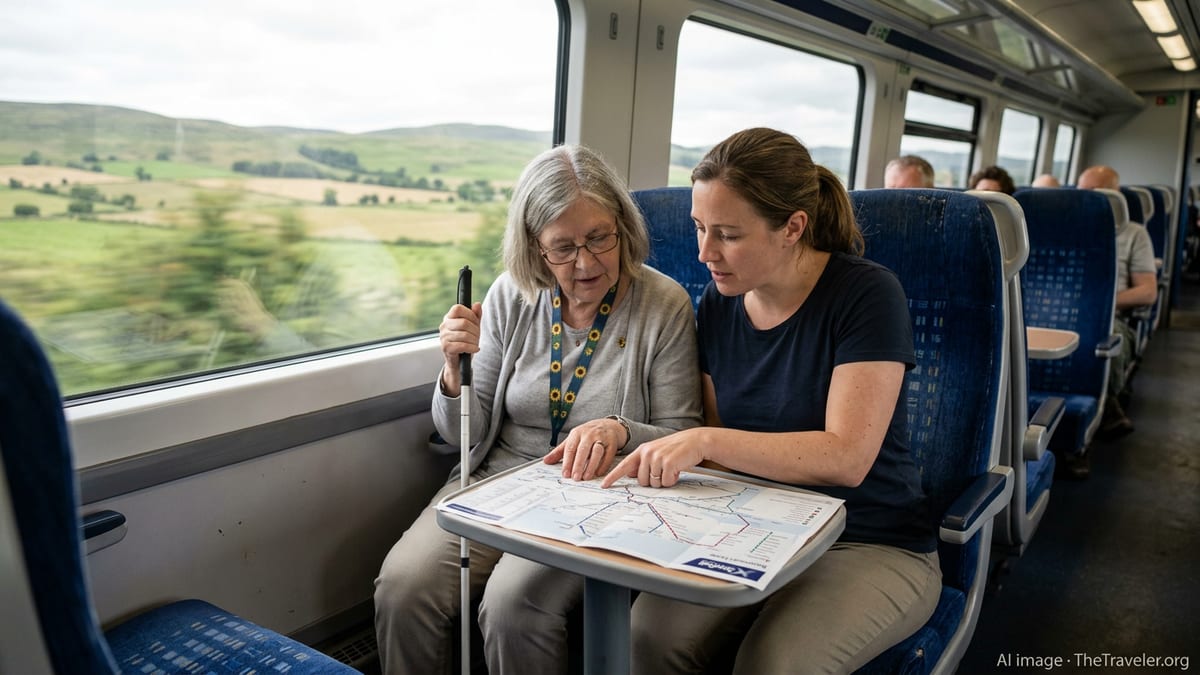
New Pilot Extends Existing Concessionary Travel Rights
The forthcoming scheme will allow companions of eligible visually impaired passengers to travel free of charge on ScotRail services across Scotland for a 12 month trial period beginning 1 April 2025. The initiative applies to people who hold a Blind Persons or Sight Impaired National Entitlement Card that carries the companion entitlement symbol, commonly referred to as the eye plus one or C plus one marking, and brings rail travel closer into line with the support already offered on Scotland’s bus network.
Under current arrangements, many blind and severely sight impaired passengers already benefit from free bus travel and, in some areas, free companion travel on buses. Local authorities and advocacy groups have long argued that limiting companion concessions largely to buses left a gap in provision for longer and intercity journeys that depend on the rail network. By extending free companion travel onto trains, ministers aim to create a more consistent concessionary system across modes of public transport.
The pilot has been developed jointly by the Scottish Government, Transport Scotland and ScotRail as part of Scotland’s Accessible Travel Framework and the Fair Work Action Plan. Policy documents published over recent months flagged that officials were preparing a trial focused on companions traveling with Blind Persons Concessionary Travel cardholders, positioning it as a targeted way to remove practical barriers for disabled passengers who cannot safely or confidently use rail services alone.
How the Free Companion Scheme Will Work
Once the trial begins, eligible cardholders will be able to take one companion with them on standard class ScotRail journeys within Scotland at no cost to the companion, as long as they travel together for the full journey. The visually impaired passenger will continue to travel under the existing concessions associated with their National Entitlement Card, while the companion’s ticket cost will be covered through the pilot scheme.
Eligibility will be linked to the National Entitlement Card programme, which is administered by local authorities on behalf of Transport Scotland. Passengers who are registered blind, severely sight impaired or sight impaired and who meet the criteria for the companion entitlement will need to ensure their card carries the correct symbol before the pilot starts. Councils have already begun updating public information pages to explain the changes and encourage early applications so that regular rail users are ready to travel with a companion from the first day of the trial.
While full operational details are still being finalised, participating councils and ScotRail have indicated that the scheme will cover the majority of the operator’s domestic routes, including commuter, regional and intercity services. The trial will initially run for one year, giving officials time to gather data on uptake, travel patterns and customer experience before deciding whether to extend or permanently adopt the approach for companions of visually impaired passengers.
Advocacy Groups Welcome a Long‑Fought Change
Organisations representing blind and partially sighted people have welcomed the announcement as the result of sustained advocacy. Charities such as Sight Scotland and RNIB Scotland have reported that visually impaired travellers frequently identify cost and the need for support as key barriers to rail use, particularly for longer journeys where assistance is required at multiple stations and on board trains.
Campaigners have argued that, for many visually impaired passengers, independent travel in practice still requires a trusted companion to provide navigation support, guide safely through busy stations and assist with wayfinding where audio and tactile information is limited. When companions are required to pay full rail fares, the cumulative cost can make regular travel unaffordable, even when the disabled passenger travels free or at a discount.
By removing that additional ticket cost for companions, advocacy groups say the pilot recognises the real-world support needs that are not fully addressed by station infrastructure or staff assistance alone. They point out that Scotland already permits free companion travel on buses for many disabled people, and argue that extending the principle to rail is a logical step that reflects how integrated journeys actually work.
Accessibility Efforts Across Scotland’s Rail Network
The free companion pilot forms part of a wider effort to improve accessibility across Scotland’s rail system. ScotRail has recently highlighted changes to its assisted travel service, reducing the notice period required for passengers who request staff support with boarding, alighting or making connections. The operator has promoted that its assistance can now be booked with shorter lead times, aiming to give disabled passengers more flexibility and spontaneity when planning trips.
Alongside operational changes, Transport Scotland has been rolling out initiatives such as the Thistle Assistance programme, which offers discreet cards and apps to help passengers signal their support needs to transport staff. These measures are intended to complement station upgrades, improvements to audio and visual announcements and staff training programmes that focus on disability awareness and inclusive customer service.
Officials say that monitoring the free companion trial will help inform broader decisions about investment and policy across the public transport network. Data collected during the pilot, including how often the concession is used, on which routes and by which groups, will be used to assess whether companion rail travel should be expanded, refined or integrated into a longer-term national concessionary framework.
What the Pilot Means for Visually Impaired Travellers
For visually impaired passengers who rely on family members, friends or support workers to travel by train, the scheme promises to reduce both financial pressure and planning stress. The ability to bring a companion at no cost could make it easier to attend medical appointments, education, work and social activities in other parts of the country, aligning with wider Scottish Government goals around fair work, inclusion and tackling isolation.
Travel experts note that, beyond the immediate financial benefit, the policy signals that decision makers increasingly view accessibility through the lens of lived experience rather than purely infrastructure metrics. Recognising that some disabled passengers will always travel more confidently with a companion is seen as an important step towards designing transport systems that respond to diverse needs, not just minimum compliance standards.
As the April 2025 start date approaches, councils, charities and ScotRail are expected to ramp up public information campaigns to ensure eligible passengers understand how to update or apply for their National Entitlement Cards and how to use the new rail companion entitlement in practice. If the pilot is successful, it could become a permanent feature of Scotland’s concessionary travel landscape and a reference point for similar accessibility initiatives in other parts of the United Kingdom.