

More news on this day
Scotland’s looming clash with Japan at Hampden Park is shaping up to be as much a test of travel logistics as sporting nerve, with upgraded ScotRail services, detailed transport guidance, and new journey-planning tools combining to move tens of thousands of supporters quickly and safely across Glasgow.
Get the latest news straight to your inbox!
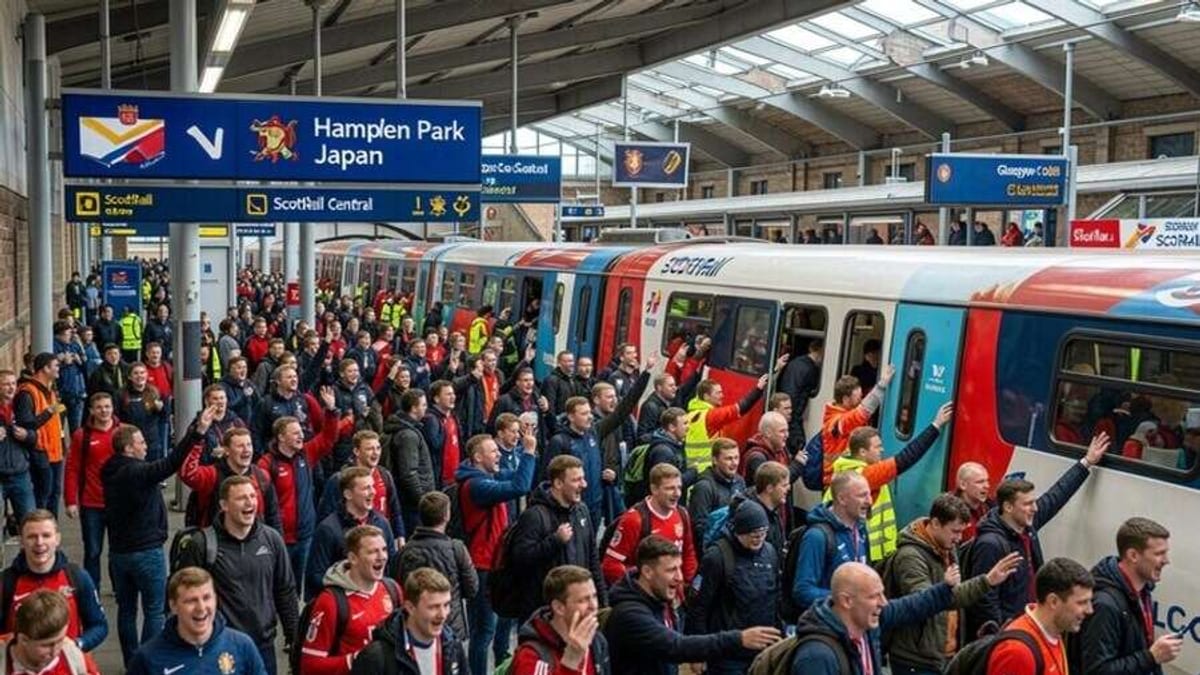
Image by Latest International Railway News, Global Rail Industry News
ScotRail Ramps Up Matchday Capacity for Hampden Crowds
Recent high-profile fixtures and concerts at Hampden Park have provided a live testbed for Scotland’s rail network, and publicly available information suggests a similar blueprint will support the upcoming Scotland versus Japan showdown. Reports indicate that ScotRail has increasingly relied on longer trains and additional services on key routes into Glasgow, particularly between Glasgow Central and the southside stations serving Hampden, such as Mount Florida and King’s Park.
Operational data from major 2025 events shows that this strategy can carry record numbers of spectators with minimal disruption when timetables, staffing and station queuing systems are closely aligned. Published accounts of large Hampden crowds using rail as the primary mode of access indicate that focused planning around a limited number of stations can keep passengers moving even at peak times around kick-off and full-time.
For the meeting with Japan, supporters are being encouraged through official channels to treat rail as the backbone of their matchday travel, while remaining flexible and building in extra time. Journey planners, mobile ticketing and real-time service updates are expected to play a central role, with recent practice across the ScotRail network showing that digital information is now critical in managing the surges associated with major sport and music events.
Observers note that match-specific arrangements, such as later evening departures and extra carriages on trains serving the southside corridor, have become increasingly common for fixtures of this scale. The pattern at previous Hampden occasions points to a similar uplift for the Japan fixture, with the goal of offering frequent, high-capacity services before and after the game.
Fine-Tuned Travel Advice Targets a Friction-Free Experience
Alongside upgrades to rolling stock and timetables, detailed travel advice has emerged as a second pillar of preparations for the Japan visit. Guidance produced for recent cup ties and international fixtures at Hampden typically urges fans to arrive early, avoid private car use where possible, and combine rail journeys with walking routes that disperse crowds across multiple access points.
Stadium travel documents and event briefings reviewed in recent weeks highlight consistent themes: limited parking in the mainly residential streets around Hampden, temporary traffic restrictions on key approach roads, and dedicated pedestrian corridors to keep fans and local residents safe. In advance of the Japan match, similar messaging is expected to be amplified, with emphasis on planning door-to-door routes and checking for any engineering work or speed restrictions that could affect longer-distance rail journeys.
Recent travel guidance for Hampden also places growing weight on accessibility. Publicly available material from the Scottish football authorities and transport operators points to tailored support for disabled supporters, including pre-bookable assistance at key stations and clear information on step-free routes. These measures are likely to be restated and updated around the Japan fixture to ensure that all fans can benefit from the expanded rail offer.
Matchday communications are increasingly designed to be shared across social channels and journey-planning apps, allowing attendees to adjust on the move if services are busier than expected. For the clash with Japan, this integrated approach is expected to underpin advice not just on rail, but on walking times, queuing locations and post-match dispersal options.
Streamlined Journey Solutions From Doorstep to Turnstile
Travel coverage around recent Hampden events indicates a shift away from viewing the train journey in isolation and toward a fully connected matchday experience. For many fans, particularly those coming from outside Glasgow, the trip to see Scotland face Japan will involve a chain of segments: regional rail or coach services into the city, transfers to local trains or the subway, and a final walk through residential streets to reach the stadium gates.
To support this, journey-planning tools used across Scotland increasingly combine real-time rail information with data on other transport modes. Traveline-style platforms and operator apps allow passengers to compare timings and interchange options, identify the most suitable arrival station, and factor in walking distances and any temporary road closures. This multi-modal perspective is becoming central to how travel agencies and fan guides describe the best way to tackle a Hampden matchday.
The expectation around the Japan fixture is that rail enhancements will be complemented by additional buses, event-specific coaches and, where appropriate, park-and-ride options on the outskirts of the city. Reports on previous events suggest that coordinated messaging between transport providers can reduce pinch points, ensuring that fans who cannot or do not wish to travel entirely by train still benefit from a coherent network of choices.
Inside Glasgow, the focus is likely to fall on smoothing transfers between mainline stations and the southside spur to Hampden. Recent practice has seen queuing systems at central hubs, clear signage to help visitors who are unfamiliar with the city, and staff on hand at key junctions to direct spectators to the correct platforms. Similar arrangements are anticipated as Japan’s supporters join the Tartan Army for one of the standout nights of Scotland’s sporting calendar.
Managing Queues, Safety and the Post-Match Surge
Handling the intense surge in demand that follows the final whistle has become one of the defining challenges for Hampden events. Documented examples from football matches and concerts over the last two years show that carefully managed queuing systems at Mount Florida and surrounding streets are now the norm, with fans funnelled into controlled lines before entering the platform areas.
Publicly circulated advice for previous fixtures has explained that, after large events, access to certain stations may only be possible from designated streets, with temporary one-way flows to separate arriving and departing crowds. For the Japan match, similar operational patterns are expected, with supporters advised to follow steward instructions, respect waiting times and avoid blocking nearby residential roads.
Safety considerations also extend to restrictions on alcohol, bag size and prohibited items on rail services and at the stadium. Published policies from recent Hampden occasions make clear that these rules are intended to keep platforms, trains and concourses comfortable at busy periods. With significant numbers of families and international visitors expected for Scotland versus Japan, transport operators are likely to emphasise a welcoming but firm approach to these regulations.
Travel coverage around previous events frequently notes that some spectators choose to walk 15 to 30 minutes away from Hampden before seeking transport in order to bypass the longest queues. Information available ahead of the Japan fixture is expected to acknowledge this pattern, pointing out safe walking routes and reminding passengers to check train times for secondary stations if they opt for this strategy.
Tips for Fans Planning Their Hampden Adventure
For supporters preparing to travel to Hampden Park to see Scotland meet Japan, the emerging picture from recent events offers a clear set of practical lessons. Buying return tickets in advance through official channels, downloading operator apps for live updates, and checking for last-minute timetable changes can make the difference between a rushed dash and a relaxed build-up to kick-off.
Fans are also being encouraged by published guidance to avoid relying on private cars, particularly close to the stadium, where parking spaces are heavily restricted and subject to enforcement. Those who need to drive are generally advised to use park-and-ride sites or city-centre car parks before switching to public transport for the final leg to Hampden.
Given Scotland’s often changeable weather and the likelihood of short waits in outdoor queues, event-focused travel briefings recommend dressing for the conditions, bringing essential items in small bags that comply with stadium rules, and allowing extra time at every stage of the journey. The experience of recent Hampden events suggests that those who travel early, follow the signposted routes and are prepared to be flexible enjoy a notably smoother day out.
As anticipation builds for the meeting with Japan, the combination of reinforced ScotRail services, carefully coordinated travel advice and integrated journey-planning tools is intended to keep the focus on the pitch rather than the commute. If the transport strategy performs as strongly as Scotland hopes its team will, supporters could be set for an occasion that is memorable for its drama at Hampden rather than for delays on the way there and back.