

More news on this day
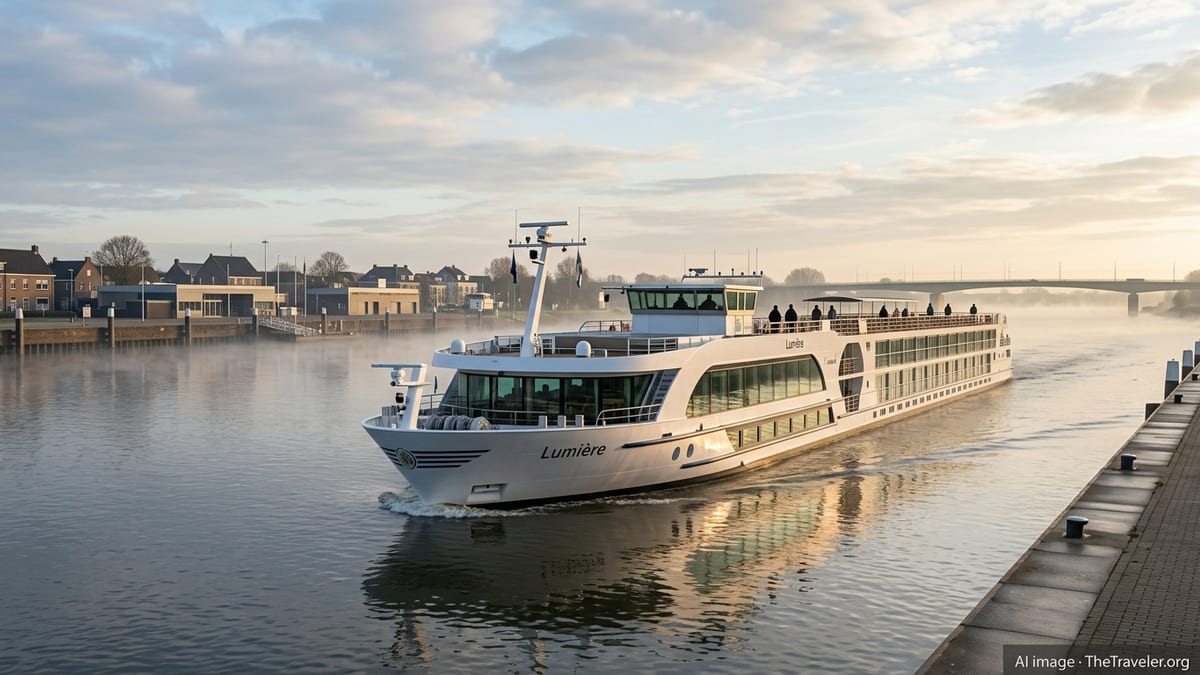
European river cruising is entering a new technological era as Scylla’s newly built Lumière river cruiser debuts with advanced autonomous navigation capabilities, positioning the vessel as a potential template for the future of smart, low‑impact water travel.
Get the latest news straight to your inbox!
World-First Dock-to-Dock Autonomy on Inland Waterways
The Lumière has drawn industry attention after completing what reports describe as the world’s first fully autonomous dock-to-dock voyage by an inland passenger vessel. In a demonstration held on the River Merwede in the Netherlands in October 2025, the 135-meter ship undocked, sailed a multi‑mile stretch between Hardinxveld‑Giessendam and Gorinchem, and docked again without manual steering input.
Publicly available information shows that the trial took place under challenging conditions, including a Beaufort 8 crosswind that would normally demand precise human control. Despite the strong side winds, tracking data and technical summaries indicate that Lumière maintained its course and speed profile within tight parameters, underscoring the maturity of the underlying navigation systems.
Throughout the voyage, the captain and bridge team remained in supervisory control, ready to intervene at any point. This human‑in‑the‑loop model is emerging as a likely template for passenger‑carrying autonomous vessels, balancing innovation with the stringent safety expectations that govern river cruising in Europe.
Inside the Technology Powering Lumière
According to technical briefings from the project partners, Lumière’s autonomous capabilities are built around a combination of Dutch‑developed systems from Shipping Technology and Retina. The configuration links Shipping Technology’s ST BRAIN digital decision engine and Autonomous Lane Assist with Retina’s M‑Pilot manoeuvring suite, creating a closed loop that can manage the vessel’s thrusters, rudders and propulsion pods in real time.
Sensor packages integrate radar, cameras, GPS and river chart data, which are processed to maintain a safe track within marked fairways, adjust to current and wind, and plan docking approaches. The system constantly monitors environmental inputs and vessel behaviour, sending recommendations and status information to bridge displays so that the crew can monitor progress and step in if needed.
Developers describe the setup as a driver‑assistance model adapted for inland waterways. The aim is not to remove the crew, but to give them tools that can handle repetitive or high‑precision tasks, such as keeping to an optimal lane in narrow channels or compensating for sudden gusts during docking. In practice, this can reduce workload and fatigue, while also allowing more consistent fuel‑efficient operation than manual control alone.
Designing a Next-Generation River Cruise Experience
Lumière is not only a technology demonstrator; it is also a fully featured luxury river cruiser designed for commercial deployment on popular European routes. Operator information indicates that the ship measures 135 meters in length and carries around 130 guests in spacious cabins, supported by roughly 50 crew. The vessel has been chartered for itineraries on the Rhône, offering a premium, small‑ship atmosphere aligned with the expectations of upscale river travelers.
The interior layout follows current trends in river ship design, with panoramic lounges, a restaurant with floor‑to‑ceiling windows, and outdoor deck spaces that maximize views along cityscapes and countryside. Noise and vibration reduction measures, paired with advanced manoeuvring systems, aim to make docking and lock transits smoother and quieter for guests.
By integrating cutting‑edge navigation capability into a purpose‑built passenger product, Scylla and its partners are signaling that autonomy is moving beyond experimental testbeds into the mainstream river cruise segment. For travelers, the most visible difference may be more punctual operations, smoother approaches and departures, and a greater sense of seamlessness as the ship glides along Europe’s inland waterways.
Hybrid Power and the Push for Greener River Travel
The Lumière project also intersects with the broader drive toward cleaner propulsion on European rivers. Publicly available specifications highlight a hybrid powertrain designed to support low‑emission or near‑silent operation in sensitive stretches and ports. While details vary across sources, the overall profile suggests an emphasis on optimized fuel use, power management and exhaust treatment compared with earlier generations of river ships.
Autonomous navigation can reinforce this sustainability agenda. By maintaining consistent speeds, plotting efficient routes and executing precise manoeuvres, systems like those on Lumière can cut unnecessary fuel burn caused by human over‑correction or inconsistent throttle use. Over an entire sailing season, incremental savings on each voyage can translate into measurable reductions in emissions.
Regulators along major European rivers are steadily tightening environmental standards, and local communities are increasingly sensitive to the footprint of visiting vessels. In that context, Lumière’s combination of hybrid power and intelligent navigation positions the ship as a test case for how technology can help river cruising align more closely with climate and air‑quality goals.
Implications for the Future of River Cruising
Lumière’s highly publicized demonstration is already prompting discussion across the passenger shipping sector about how quickly autonomous functions might spread to other inland vessels. Industry commentators note that river cruising offers a relatively controlled environment compared with open‑sea operations, with fixed routes, well‑charted channels and closely monitored traffic systems, all of which favour early adoption of smart navigation technologies.
Competing river operators have been investing heavily in newbuilds, interior design upgrades and environmental improvements, but Lumière gives Scylla a distinct technological talking point. For charter partners and guests alike, the ship represents a forward‑looking interpretation of river travel that blends comfort with data‑driven navigation and safety management.
Over the coming years, the systems tested on Lumière are expected to evolve toward more sophisticated functions, including tighter integration with traffic management platforms, predictive routing based on water levels and currents, and deeper links between navigation and onboard energy management. If these developments materialize at scale, the river cruise vessel could become a highly efficient, semi‑autonomous platform that quietly optimizes every phase of a voyage while human crews focus on passenger experience.
For now, Lumière’s successful autonomous sailings mark a pivotal moment: a clear demonstration that advanced automation is no longer a distant concept for the inland cruise sector, but an emerging reality reshaping how river journeys are planned, executed and experienced.