

More news on this day
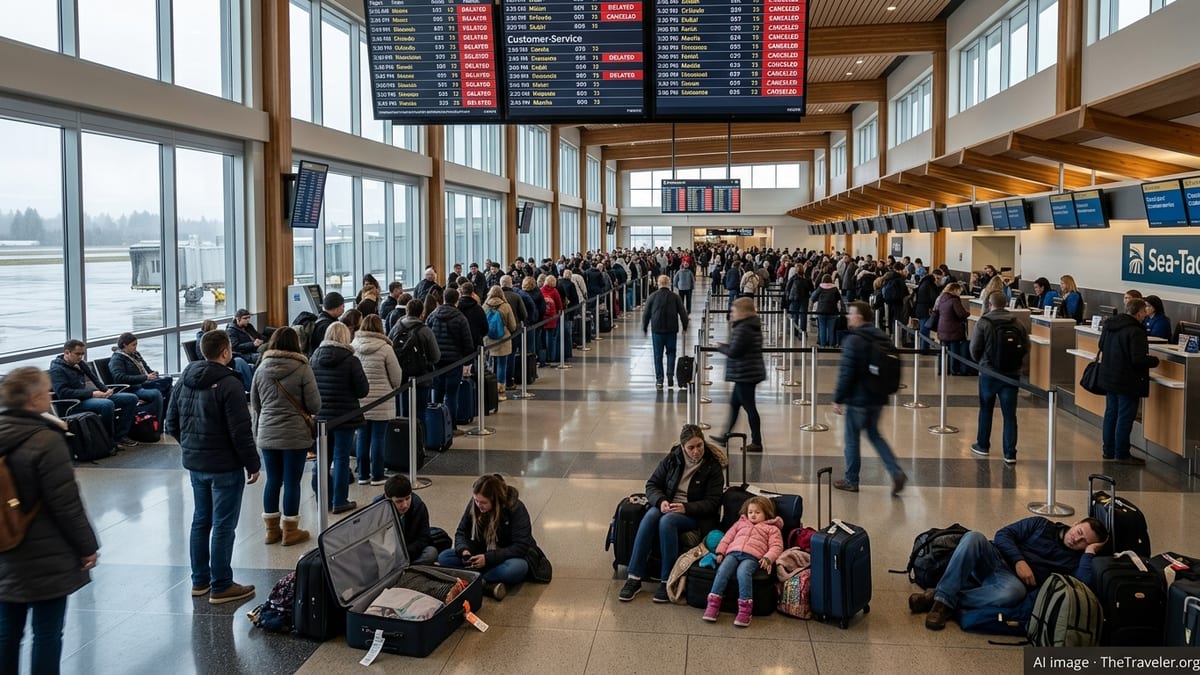
Travelers at Seattle-Tacoma International Airport faced packed terminals, long security lines and mounting frustration this week as a convergence of extreme weather and global airspace restrictions triggered widespread delays and cancellations on key routes to Miami, Orlando, Dubai and Manila.
Get the latest news straight to your inbox!
Storm System Hammers Seattle Operations
Publicly available aviation and weather data indicate that a powerful March storm system brought rare heavy snow and rain to the Seattle area around March 13, severely disrupting operations at Seattle-Tacoma International Airport. Records show that the airport logged unusual snowfall and significant rainfall in a short window, with knock-on effects for runway and ramp conditions. As crews worked to keep surfaces clear, flights stacked up in departure queues, and arriving aircraft circled or diverted.
Reports from passengers describe hours-long waits and last-minute cancellations as the storm’s impacts peaked between March 13 and March 15. Some travelers recounted boarding aircraft only to sit on the tarmac as de-icing supplies and ground-handling capacity were stretched thin. Others described scrambling to rebook itineraries after multiple rolling delays ultimately led to flights being scrubbed late in the day.
Data compiled from flight-tracking platforms for that period show hundreds of delays at Seattle-Tacoma, with disruption concentrated on longer-haul services that require extensive de-icing and careful runway performance calculations. This created a ripple effect that pushed some departures into crew duty-time limits, forcing cancellations even after conditions on the airfield began to improve.
While airports across the Pacific Northwest were affected, Seattle-Tacoma’s role as a major hub magnified the disruption. Once outbound aircraft fell behind schedule, downstream flights, tight connections and aircraft rotations were all impacted, especially on already busy routes linking the Pacific Northwest with Florida and key international gateways.
Florida Flights Snagged in Cascading Delays
The storm-driven slowdown at Seattle-Tacoma quickly translated into a grim picture for travelers booked to Miami and Orlando. Publicly available flight-status records show rolling delays on multiple daily departures to both Florida cities, with some services canceled outright after crews and aircraft were no longer available within regulatory limits.
Passengers attempting to reach Florida reported gate changes, hours of uncertainty and crowded departure areas as airlines tried to consolidate lightly loaded flights and protect longer-haul operations. With spring travel demand already elevated, even a handful of canceled departures left limited rebooking options, pushing some travelers onto red-eye flights or multi-stop routings through other hubs.
The nature of west-to-east long-haul domestic trips meant that disruptions in Seattle often cascaded into missed connections further down the line. Travelers heading to cruises from Miami or theme park vacations near Orlando reported being forced to adjust hotel, car rental and tour plans at short notice, compounding the financial and logistical toll of the airport’s operational turbulence.
On-time performance statistics from recent years show that Miami and Orlando already contend with congestion, weather and seasonal surges. The sudden shock originating in Seattle added another layer of complexity, turning what should have been routine five-to-seven-hour journeys into overnight odysseys or multi-day detours for some passengers.
Middle East Conflict Deepens Dubai Disruptions
Complicating the Seattle-Tacoma turmoil, the ongoing conflict involving Iran and several Gulf states has severely constrained airspace and airport capacity across parts of the Middle East. Publicly available information on the 2026 Iran war details repeated missile and drone activity directed at or near major hubs in the United Arab Emirates, including Dubai International Airport. These incidents have led to temporary closures, infrastructure damage and a broader shutdown of much of the region’s commercial aviation network.
Travel advisories and airline bulletins indicate that Dubai International has been operating at a very limited level in early March, with many flights suspended or repurposed for repatriation and cargo rather than regular passenger services. Airspace closures and route restrictions have forced long detours around the Gulf region, lengthening flight times and absorbing aircraft that would normally serve routine schedules.
For Seattle-based travelers, the impact has been acute on the nonstop link between Seattle-Tacoma and Dubai, a key bridge for itineraries to South Asia, Africa and beyond. Public discussions on traveler forums in recent days describe repeated cancellations of the Dubai–Seattle rotation and uncertainty about which specific dates will see flights operate. Some passengers report that flights previously advertised as available were later removed from status boards or marked as unavailable, with notifications arriving only hours before departure.
The combination of a constrained hub in Dubai and a weather-stressed operation in Seattle has left many would-be passengers in limbo. Even when an individual flight appears scheduled, shifting security conditions in the Gulf and severe congestion in rebooking channels have meant that a confirmed seat offers less certainty than usual.
Manila Connections Upended by Broken Hub
Manila has emerged as one of the most challenging destinations for travelers attempting to connect through Dubai from Seattle. According to published coverage and airline updates collated by travel advisories, only a limited set of flights to and from Dubai have been operating on select dates, and Manila features among those routes in a patchwork of partial service. As schedules are continually revised, many connections that looked viable on paper have proved impossible to complete in practice.
Travelers with Seattle–Dubai–Manila tickets have reported arriving at the airport to find long lines at ticket counters, inconsistent information on screens and mobile apps, and difficulties accessing customer-service channels due to overloaded call centers and chat systems. In some cases, passengers who successfully reached Dubai earlier in the month found themselves stuck for days as onward flights to Manila were repeatedly delayed or canceled.
This situation has been compounded by broader constraints on airspace over parts of the Middle East, which limit the number of safe and efficient routings available for long-haul services linking North America, the Gulf and Southeast Asia. Aircraft and crews that would normally rotate across multiple city pairs are instead being used for ad hoc repatriation flights or longer detours, leaving fewer resources for scheduled runs to Manila.
For travelers originating in Seattle, the combined effect of these pressures has transformed what is ordinarily a single-stop itinerary into a highly uncertain journey. Some have turned to improvised alternatives via other Asian or European hubs, but high demand and limited capacity mean last-minute fares are elevated and seat availability is tight.
Passengers Face Long Lines, Uncertain Timelines
Inside Seattle-Tacoma International Airport, the human impact of the meltdown has been visible in crowded concourses, floor-to-ceiling lines at customer-service desks and packed seating areas near key departure gates. Photos and first-hand accounts shared publicly in recent days depict passengers sleeping on the floor, clustering around scarce power outlets and scanning departure boards that cycle through waves of new delay estimates.
Reports indicate that security screening has at times become a chokepoint as more travelers arrived early in hopes of navigating the uncertainty. While checkpoint wait times varied over the course of the disruption, the sheer number of stranded or rebooked passengers placed sustained pressure on the terminal’s infrastructure, from restrooms and concessions to train links and curbside pick-up zones.
Industry data and historical analyses suggest that once a hub like Seattle-Tacoma absorbs simultaneous shocks from severe weather and global geopolitical instability, full recovery can take days. Crews and aircraft must be repositioned, maintenance schedules reset and disrupted passengers re-accommodated on flights that are already near capacity due to seasonal demand.
For travelers bound for Miami, Orlando, Dubai and Manila, the result has been a uniquely challenging stretch of days in mid-March. With storms in North America and conflict in the Middle East combining to constrict both ends of their journeys, many have been left confronting a hard reality of modern air travel: a single vulnerable link in the global network can swiftly turn a routine itinerary into an airport nightmare.