

More news on this day
SeaPort Airlines, which relaunched last year with crowd-free commuter flights between Seattle’s Boeing Field and Portland, is preparing to bring its stripped-down, business‑friendly model to the Seattle–Spokane corridor with a proposed Boeing Field–Felts Field shuttle that aims to bypass big-airport headaches on both sides of the Cascades.
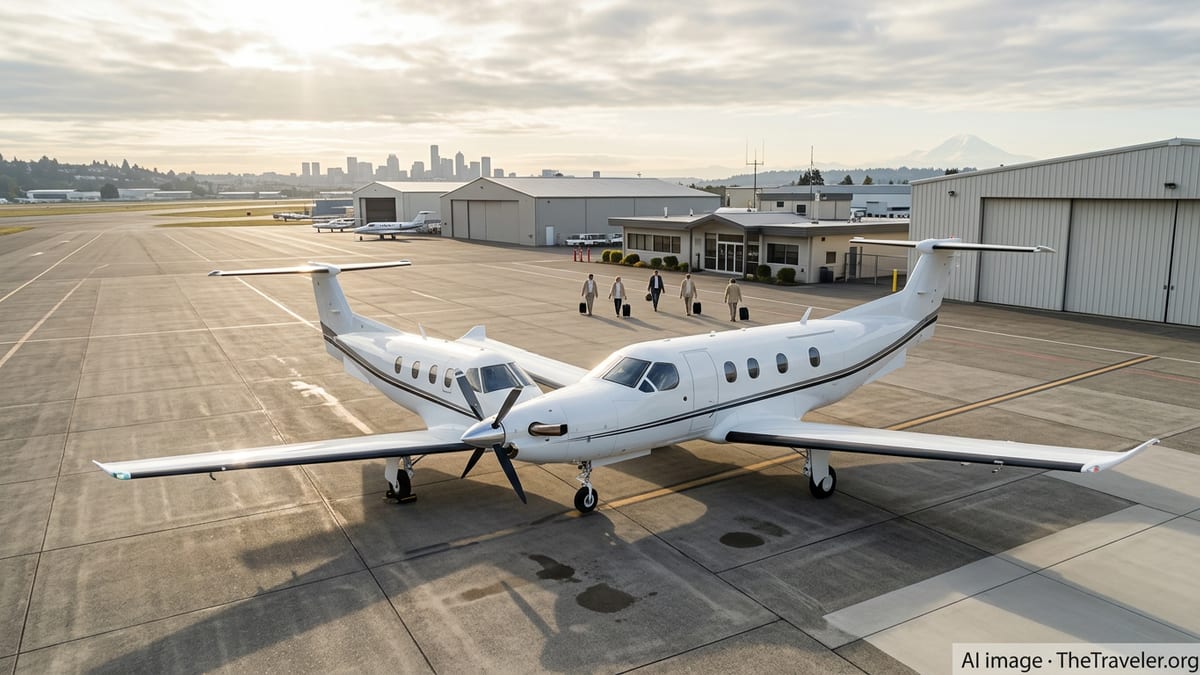
A New Low-Friction Option Between Seattle and Spokane
The planned shuttle would mirror SeaPort’s revived Portland route, which operates from a small terminal at King County International Airport, better known as Boeing Field, rather than Seattle–Tacoma International Airport. By avoiding the region’s busiest commercial hub, SeaPort targets travelers frustrated by congestion, long security lines and parking snarls.
While the company has not formally published a Spokane schedule, industry sources and local aviation officials say SeaPort has been evaluating demand and infrastructure at Spokane’s historic Felts Field, a general aviation airport east of downtown, as the anchor for a high-frequency shuttle. The move would position SeaPort as a niche player on a city pair largely dominated by mainline carriers through Spokane International Airport.
Market analysts note that SeaPort’s strategy depends on convenience rather than sheer capacity. Using nine-seat Pilatus PC-12 turboprops, the airline can operate as a scheduled charter, minimizing airport formalities and offering short, frequent hops aimed squarely at time-sensitive business travelers and high-value leisure passengers.
If finalized, the Boeing Field–Felts Field shuttle would further tighten links between two of the Inland Northwest’s fastest-growing metro areas at a time when both regions are investing heavily in aviation infrastructure, from hangar developments in Spokane to terminal upgrades in Seattle.
Inside the Boeing Field and Felts Field Experience
SeaPort’s appeal in the Pacific Northwest rests largely on its ground experience. At Boeing Field, passengers park just steps from a modest terminal building, check in at a small counter and walk directly to their aircraft. With no conventional security checkpoint and aircraft seating below the federal screening threshold, check-in closes as little as 20 minutes before departure, turning what is often a half-day travel ordeal into a quick, predictable hop.
Felts Field, which dates back to the 1920s, offers a complementary setting on the Spokane side. The airfield today serves corporate aviation, flight schools and private pilots, with low traffic volumes compared with Spokane International. Recent proposals for new hangar space at Felts Field signal growing demand for based aircraft and more intense aviation use, a trend that could dovetail with SeaPort’s shuttle plans by ensuring both apron capacity and supporting services.
Travelers who make the switch from large terminals to these smaller fields often describe the change in terms of friction: less walking, fewer crowds, minimal waiting and parking that feels more like visiting a suburban office than a major airport. For travelers shuttling frequently between Seattle and Spokane for legal, medical, tech or government work, that friction reduction can matter more than onboard amenities.
Onboard, the single-engine Pilatus aircraft trade big-jet features like cabin service and overhead bins for an intimate cabin with quick boarding and deplaning. Flight times between the Seattle and Spokane metro regions are expected to be well under an hour once air traffic and routings are factored in, positioning the shuttle as a faster door-to-door option than driving across the Cascades or connecting through larger hubs.
Competing With Highways and Hub Airports
SeaPort’s Boeing Field–Felts Field concept enters a market already served by major airlines at larger airports, as well as Interstate 90’s busy car and bus routes. But the company is betting that its no-fuss experience can peel off travelers currently torn between slogging through a large terminal and committing to a five-hour drive.
Regional airline watchers point to SeaPort’s performance on the Portland route, where the carrier emphasizes time savings over price. Roundtrip fares have been positioned at a premium to some mainline tickets, but travelers pay for the ability to arrive later, skip security and move quickly between curb and cabin. If a similar model takes hold between Seattle and Spokane, SeaPort would be targeting a slice of the market that values billable hours and schedule control over loyalty points or inflight perks.
The timing also aligns with broader shifts in Pacific Northwest air travel. While Seattle–Tacoma International continues to expand its main terminal, secondary airports such as Boeing Field and Everett’s Paine Field are increasingly promoted as lower-stress alternatives for regional trips. In Spokane, new private hangar projects at Felts Field underscore a parallel trend toward more customized, small-scale aviation solutions close to downtown.
For now, SeaPort’s potential shuttle is unlikely to unseat large carriers on volume. Instead, analysts expect the service, once announced, to operate as a high-frequency niche product that pressures competitors to sharpen schedules, pricing or airport options for short-haul business flyers.
What Travelers Can Expect From the Shuttle Model
If the Boeing Field–Felts Field shuttle launches along the lines of SeaPort’s existing commuter services, travelers can expect several hallmarks: simple booking, small terminals, minimalist boarding procedures and frequent departures designed around business day rhythms. Flights would likely run multiple times daily, with early-morning and late-afternoon peaks catering to same-day round trips.
Because the operation uses small turboprops, amenities are basic. Seating is limited, there is typically no inflight service, and luggage capacity is constrained to hand-carried bags and small checked items. In exchange, passengers gain the ability to arrive much closer to departure time, avoid long queues and spend less time navigating airport infrastructure.
Ground access is another differentiator. Boeing Field sits only a few miles south of downtown Seattle, reachable by rideshare, taxi or short shuttle hops from major business districts. Felts Field is similarly close to central Spokane, reducing transfer times on both ends of the trip and making the shuttle especially attractive for travelers whose final destinations lie near the city cores rather than suburban business parks.
SeaPort has also leaned into a service ethos that emphasizes personal interaction. Smaller passenger loads mean staff can handle special requests, irregular operations and schedule changes on a one-to-one basis, a contrast to the mass-processing feel of large hubs. For travelers who prize a calm, predictable start and finish to their journey, that experience can be as compelling as the raw time savings.