

More news on this day
Regional carrier SeaPort Airlines is betting that travelers are ready to trade long security lines at Seattle-Tacoma International Airport for a quieter, quicker experience at Boeing Field, rolling out a TSA-free screening model and private-terminal perks on its growing network of short-hop flights.
Get the latest news straight to your inbox!
A New Kind of Check-In at Boeing Field
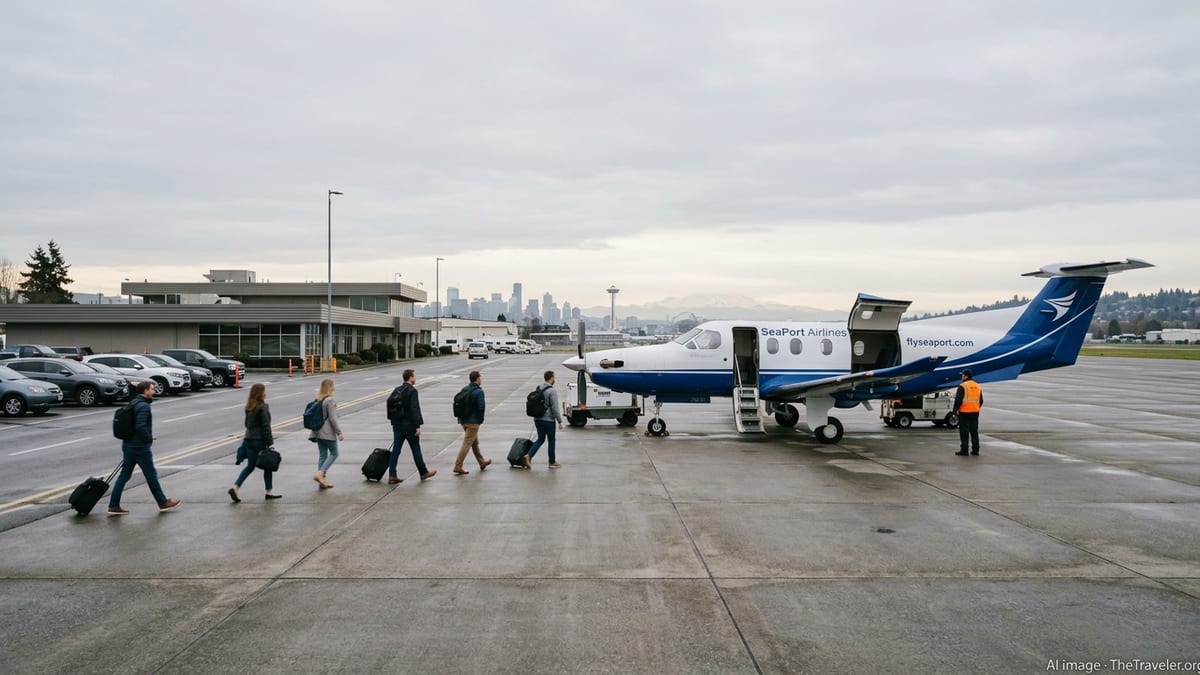
SeaPort Airlines has quietly turned Seattle’s Boeing Field into a testing ground for a different style of commercial flying, one that strips away many of the pain points associated with big hubs. Operating from an executive-style terminal at King County International Airport, the carrier is offering scheduled flights that feel closer to boarding a private aircraft than a traditional airline.
Because SeaPort’s Pilatus PC-12 aircraft seat just nine passengers, the airline qualifies for an alternative, TSA-approved security program typically used by small commercial operators. Instead of lining up at standard Transportation Security Administration checkpoints, passengers are vetted in advance and screened using procedures integrated into the check-in and boarding process.
The result is that most travelers can arrive closer to departure, move through the terminal in minutes and step directly onto the aircraft without the shoe-removal, divestiture bins and serpentine queues that define the experience at nearby Seattle-Tacoma International Airport. For frequent business travelers on the Seattle–Portland and new Seattle–Spokane shuttles, SeaPort is marketing this as time gained back in the workday.
At Boeing Field, the experience begins not at a crowded ticket hall but at a compact lobby shared with corporate and charter operators. Parking is adjacent to the building, and passengers walk only a short distance from car to counter to aircraft, a contrast the airline is eager to highlight as congestion and construction continue at Sea-Tac.
TSA-Approved Vetting Without the Checkpoint Lines
SeaPort’s model relies on a lesser-known aspect of U.S. aviation security rules: airlines operating small aircraft with limited seat counts can use alternative screening programs that focus on vetting passengers before they reach the airport. Names are checked against federal databases and watchlists, and baggage is handled under specific chain-of-custody and inspection procedures.
For customers, the most visible difference is the absence of traditional TSA lanes and equipment. Carry-on items are screened by SeaPort staff under federal oversight, and passengers typically keep their shoes on and laptops in bags. Identification checks remain in place, but the overall flow is designed to be fast and low-friction rather than a chokepoint.
Aviation security experts note that this framework has been in use for years in the commuter and charter sector, but SeaPort is among the few companies bringing it into a branded, scheduled shuttle product between major metropolitan areas. The airline positions the program as “TSA-free” from a customer experience standpoint, while emphasizing that it complies with federal security requirements tailored to its aircraft size and operation.
For SeaPort, the tradeoff is clear: by limiting cabin capacity and flying high-frequency shuttles instead of larger jets, it avoids the infrastructure and staffing demands of full-scale TSA checkpoints while offering a premium-feeling product at fares it says are comparable to mainline airlines bought close to departure.
Boeing Field Steps Forward as a Regional Hub
The TSA-light experience is only one part of SeaPort’s broader Boeing Field play. After restarting operations in 2025 with a dense schedule of flights between Seattle and Portland, the airline this month added service linking Boeing Field with Spokane’s historic Felts Field, positioning itself as a dedicated regional connector for the Pacific Northwest.
The airline now runs up to 16 shuttle flights a day between Boeing Field and Portland International Airport, and eight daily flights on its Boeing Field–Felts Field route, splitting service between morning and evening peaks. By choosing centrally located secondary airports and private or semi-private terminals at both ends, it aims to shrink total door-to-door journey times despite lower cruising speeds than jets at Sea-Tac.
Boeing Field itself is undergoing an image shift in the process. Long known primarily for corporate aviation, cargo carriers and aircraft testing, the airport is now seeing an uptick in scheduled passenger activity focused on short-haul business travel. Local leaders see the SeaPort model as a way to relieve some pressure on Sea-Tac while reviving Boeing Field’s historic role as a passenger gateway.
For now, SeaPort is the only scheduled carrier offering this type of service from Boeing Field, but its leaders have spoken openly about ambitions to add more regional spokes if demand holds, potentially linking Seattle to additional communities in Washington, Oregon and Idaho that value schedule frequency over hub connectivity.
Winning Over Travelers Frustrated With Sea-Tac
The airline’s timing appears deliberate. Sea-Tac has spent the past several years managing record passenger volumes, major terminal construction and evolving TSA procedures, leaving many travelers wary of unpredictable wait times. While the airport has opened new checkpoints and adjusted screening rules to ease the crunch, social media is still filled with stories of long lines and missed flights.
SeaPort’s marketing leans into that frustration. One advertising campaign circulating in the Seattle region shows a skeleton waiting in a crowded terminal line, contrasting it with a quick walk across the ramp at Boeing Field. Online, early customers describe the experience as “show up, check in, walk to the plane,” underscoring the appeal for people who value time savings over frequent-flyer miles or a wide choice of departure times on larger carriers.
Business travelers are among the most coveted converts. For someone commuting regularly between downtown Seattle, Portland’s city center or Spokane’s business districts, avoiding freeway traffic to Sea-Tac, long security lines and remote parking can translate to several hours saved each week. SeaPort is also pitching its smaller aircraft and intimate boarding areas as less stressful environments for occasional flyers who find large hubs overwhelming.
Still, the airline faces an education challenge. Many travelers remain unfamiliar with Boeing Field as a passenger option, and some are wary of propeller aircraft despite their strong safety records in regulated commuter service. SeaPort’s task will be to convince skeptics that a nine-seat turboprop out of a quiet terminal can be as reliable and comfortable as the jets departing Sea-Tac’s crowded gates.
What SeaPort’s Perk Signals for the Future of Short-Haul Travel
SeaPort’s TSA-free perk at Boeing Field arrives as airports and airlines worldwide rethink the role of short-haul flying. With runway and terminal capacity at major hubs stretched thin, smaller airports and alternative terminals are gaining new attention as pressure valves for regional demand.
If the Boeing Field experiment continues to attract travelers, it could validate a playbook in which airlines pair high-frequency turboprop service with streamlined security programs to lure passengers off congested hubs. Other mid-sized cities with underused secondary airports and business-heavy corridors may be watching closely to see whether SeaPort’s model can be replicated.
For travelers in the Pacific Northwest, the immediate impact is tangible: another choice for getting between Seattle, Portland and Spokane that prioritizes ease over airport amenities and loyalty-program perks. For the industry, SeaPort’s approach offers a reminder that not every innovation in air travel depends on new aircraft types or lavish terminal rebuilds; sometimes, the biggest change starts with simply skipping the line.