

More news on this day
Travelers across the United States faced fresh disruption today as Seattle-Tacoma International Airport reported 71 delayed flights and 8 cancellations, affecting major carriers such as Alaska Airlines, Delta Air Lines and United Airlines on routes linking Los Angeles, Denver, San Francisco, Anchorage and several international hubs.
Get the latest news straight to your inbox!
Sea-Tac Flight Disruptions Concentrated Among Major Carriers
Publicly available flight-tracking data for Seattle-Tacoma International Airport on April 7 indicate a compact but disruptive wave of operational issues, with 8 cancellations and 71 delays recorded across domestic and international services. The pattern fits with the broader Easter-period travel strain identified across the US, where delays have significantly outnumbered cancellations.
Alaska Airlines, which maintains a substantial hub presence at Seattle, registered the largest share of schedule changes, with around 30 delayed departures or arrivals and two cancellations attributed to the carrier. Delta Air Lines reported two cancellations and roughly a dozen delays connected to its Seattle operations, while United Airlines recorded a smaller number of affected flights, including one cancellation and several delays.
Icelandair also featured prominently in the cancellation totals, with three Seattle-related flights scrubbed from the schedule, largely concentrated on transatlantic services. Other operators, including American Airlines, Southwest Airlines, Frontier Airlines, Hawaiian Airlines, SkyWest and Korean Air, were primarily affected by delayed departures and arrivals rather than outright cancellations, adding to a day of patchy but persistent disruption for passengers.
Federal aviation status reports for Seattle-Tacoma pointed to ongoing runway construction affecting departures and contributing to departure holds in the 15 to 30 minute range, even as local weather conditions around the airport remained relatively benign. The infrastructure constraints, when layered on top of heavy post-holiday traffic, appear to have amplified the impact of otherwise modest operational challenges.
Knock-on Impacts From Los Angeles To Anchorage
The Seattle disruption quickly rippled through a web of high-traffic routes, particularly along the US West Coast and to key inland hubs. Flights between Seattle and Los Angeles, Denver and San Francisco experienced notable schedule changes, with late departures from the Pacific Northwest cascading into downstream delays as aircraft and crews arrived late for subsequent segments.
Services to and from Anchorage, a critical link in Alaska Airlines’ network, were among those affected as delayed aircraft at Seattle created tighter turnaround windows and pushed departure times later into the day. Publicly available reports from other airports, including Anchorage, show parallel clusters of delays and cancellations, underscoring how localized problems at a major node like Seattle can reverberate across a wider regional system.
Internationally, routes connecting Seattle with Reykjavik and major Asian gateways such as Seoul and Tokyo also registered disruption. Cancellations on Icelandair’s transatlantic services and delays involving long-haul carriers reflected the sensitivity of global operations to schedule slippage at a strategic connecting hub. For travelers booked on multi-leg itineraries, relatively short initial delays departing Seattle often translated into missed connections further along their journeys.
These disruptions unfolded against a national backdrop of elevated holiday travel, with Easter Monday already emerging as one of the busiest and most delay-prone days of the spring period. Nationwide statistics compiled from multiple US airports show thousands of delayed flights and several hundred cancellations, suggesting that Seattle’s difficulties formed part of a wider strain on airline and airport capacity.
Operational Strain Highlights Infrastructure And Capacity Limits
The Seattle figures, while modest in absolute terms compared with larger national totals, highlight the structural pressures on hub airports operating near peak capacity. Sea-Tac has experienced sustained growth in passenger numbers over recent years, fueled by network expansion from Alaska, Delta and international carriers, while construction projects and airfield works continue to reshape parts of the facility.
Even short-lived restrictions on a primary runway or departure corridor can trigger a backlog during busy periods, as departure slots are metered to maintain safe spacing in the air and on the ground. Once a backlog forms, clearing it requires a combination of improved conditions, available spare aircraft and rested flight crews, resources that are often stretched thin on peak travel days.
Industry analyses of recent US disruption patterns show that weather, crew availability, and air traffic control flow management frequently combine to produce high-delay, low-cancellation days. At Seattle on April 7, the relatively low cancellation count compared with delays suggests airlines were prioritizing completion of most flights, even at the cost of late arrivals, rather than removing large numbers of services from the schedule.
The experience at Seattle also mirrors findings from broader studies of US airport punctuality, which point to hub congestion and infrastructure bottlenecks as recurring drivers of delay. While individual events may appear isolated, they collectively underscore longstanding debates about runway capacity, terminal expansion and the resilience of airline schedules built around tight connection windows.
What Travelers Experienced On A Disrupted Travel Day
For passengers, the numerical breakdown of 71 delays and 8 cancellations translated into long waits at gates, missed connections and unplanned overnight stays in Seattle and other cities. Travelers on heavily used corridors such as Seattle to Los Angeles, Denver and San Francisco encountered rolling departure time changes, with aircraft sometimes held on the ground while departure queues cleared.
Those booked on Alaska, Delta and United flights were among the most visibly affected given the carriers’ sizable operations at Seattle-Tacoma and their roles in feeding connecting traffic through the hub. Travelers heading onward to smaller regional destinations or international cities often faced the greatest complications, as a single missed connection could mean long gaps before the next available departure on the same route.
Published coverage of recent US disruptions indicates that some travelers were rebooked on alternative routings through different hubs, occasionally involving additional connections or overnight layovers. Others accepted later same-day departures or shifted travel plans entirely, opting to delay trips until operations normalized.
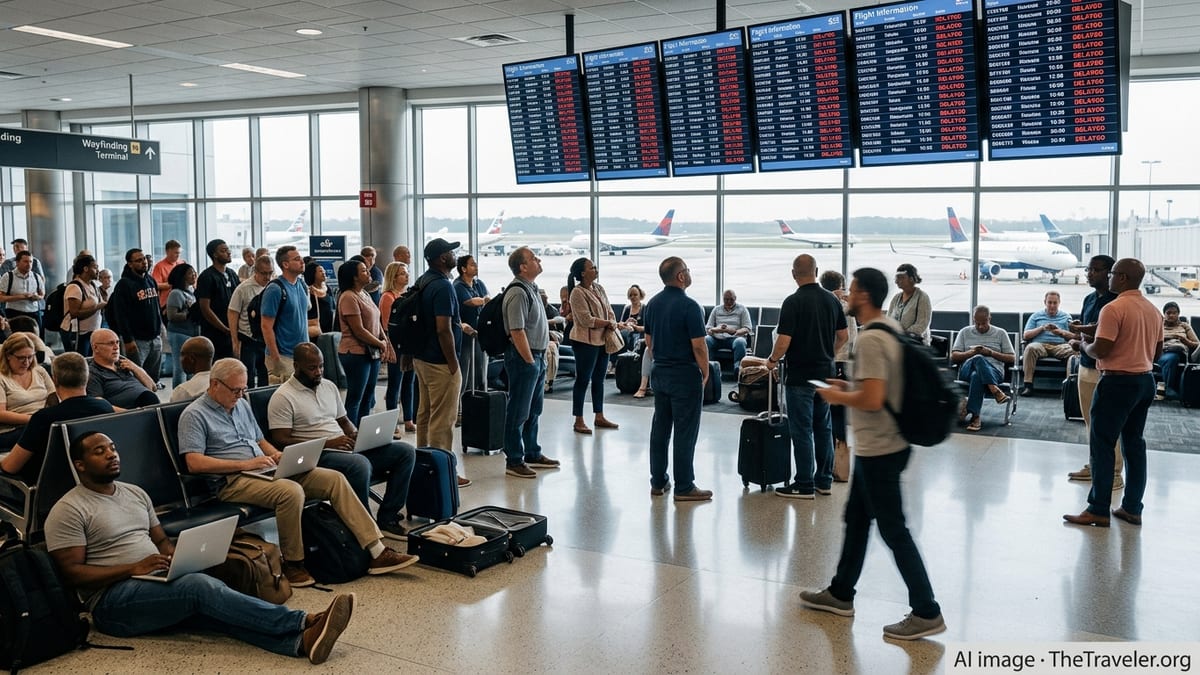
At the terminal, crowded departure halls and busy customer service desks reflected the cumulative effect of dozens of delayed flights. While many services eventually departed, the irregular operations placed added strain on airport amenities, from seating and food outlets to ground transportation, as passengers adjusted plans on short notice.
Guidance For Passengers As Disruptions Continue
Travel analysts note that the pattern seen at Seattle-Tacoma is likely to recur at major US airports throughout the spring and summer as carriers operate dense schedules in a system vulnerable to weather, staffing and infrastructure constraints. The events of April 7 serve as a reminder that even a relatively limited number of cancellations can significantly affect travel plans when combined with widespread delays.
Publicly available advice from airlines and consumer groups emphasizes the importance of monitoring flight status closely on busy travel days, using airline apps and airport information channels to track gate changes, departure holds and rebooking options. Travelers with tight connections through busy hubs such as Seattle, Los Angeles or Denver are often encouraged to allow additional buffer time when possible.
For those already at the airport when irregular operations develop, guidance typically includes staying near the gate for real-time updates, keeping receipts for any out-of-pocket expenses that may later be eligible for reimbursement under airline policies, and being prepared to explore alternative routings if a cancellation occurs. In some cases, same-day changes to less congested routes or off-peak departures can reduce the risk of extended delays.
With spring and summer travel demand building, the Seattle episode reinforces the view that passengers remain exposed to sudden schedule shifts even in generally favorable weather. While airlines and airports continue efforts to improve resilience, the experience at Sea-Tac shows how quickly a complex network can be thrown off balance when infrastructure constraints and high demand converge.