

More news on this day
Nonstop leisure routes connecting Seattle with Puerto Vallarta have been abruptly halted after a surge of cartel-linked violence in Mexico’s Jalisco state disrupted operations at Puerto Vallarta’s international airport and prompted widespread cancellations by U.S. and Canadian carriers.
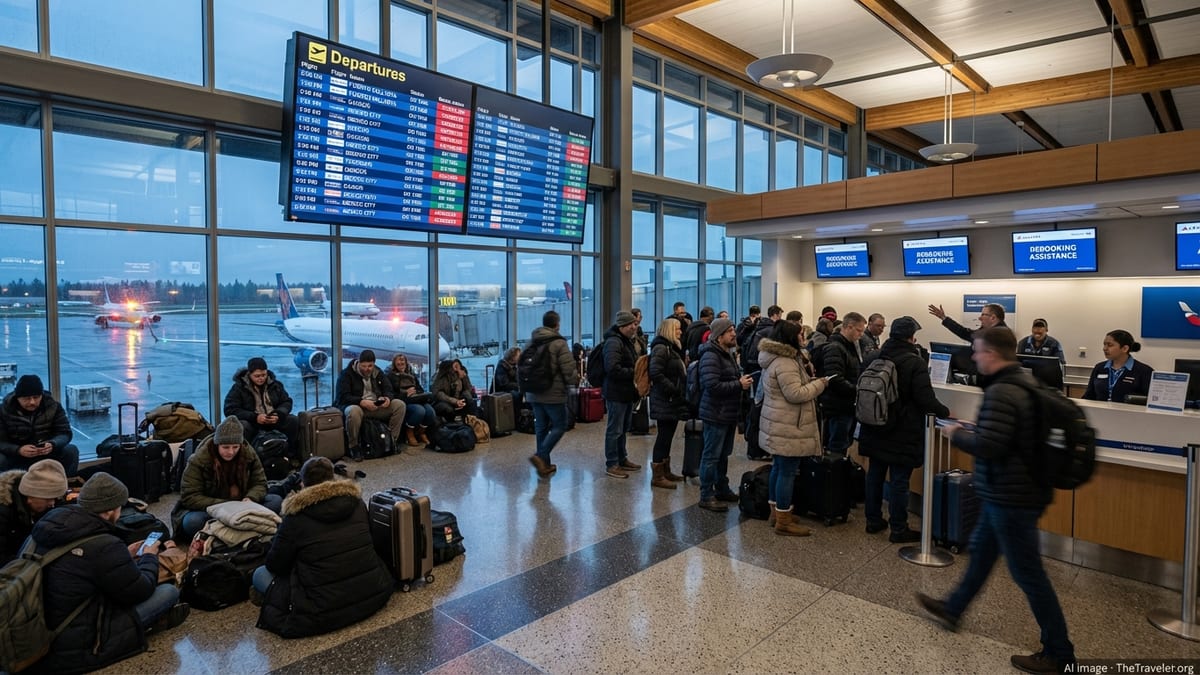
Cartel Violence in Jalisco Triggers Sudden Air Travel Disruptions
Tourism links between the Pacific Northwest and one of Mexico’s most popular beach destinations were thrown into disarray over the weekend as violent unrest rippled across Jalisco, following a federal operation that reportedly killed cartel leader Nemesio Oseguera Cervantes, known as El Mencho. Road blockades, vehicle fires and armed confrontations were reported in several municipalities, creating a fast-moving security crisis that quickly spilled over into the country’s aviation system.
Puerto Vallarta International Airport, a crucial gateway for sun-seeking travelers from the United States and Canada, remained physically open, but airlines sharply curtailed service. On Sunday 22 February, all international flights to the resort city were canceled, according to airport statements, effectively cutting off foreign arrivals for the day even as runways and terminal facilities stayed under heavy protection by the National Guard and Mexican military.
The disruption has been felt acutely in Seattle, where nonstop services to Puerto Vallarta form a key part of the winter and spring leisure schedule. With Mexico-bound flights suspended or severely reduced, hundreds of passengers from the Pacific Northwest found their vacations upended and their return trips uncertain, as carriers moved quickly to prioritize crew and passenger safety over schedule integrity.
Seattle-Based Alaska Airlines Scrambles to Cut Mexico Flying
Seattle-based Alaska Airlines, the dominant carrier at Seattle–Tacoma International Airport, was among the first U.S. airlines to confirm broad cancellations tied directly to the unrest. The airline said on Sunday it had canceled two dozen flights to and from Puerto Vallarta, Guadalajara and Manzanillo, a decision that effectively wiped out its nonstop Mexico offerings from Seattle for the day and disrupted connecting itineraries throughout its network.
In a public statement, Alaska Airlines cited civil unrest near Mexican airports as the primary reason for the cancellations and emphasized that it was working to reaccommodate affected passengers on later dates or alternative routes where possible. The carrier is closely monitoring security developments in Jalisco and has indicated that additional schedule adjustments are likely if authorities extend their shelter in place and security advisories.
For Seattle travelers, the cuts hit at a peak moment for winter getaways. February and March typically see strong demand on routes from the Pacific Northwest to Mexico’s Pacific coast, driven by cruise traffic, spring break trips and long-stay vacationers drawn to Puerto Vallarta’s beaches and resort zones. With Alaska’s schedule pared back, travelers who had counted on nonstop links from Seattle now face rebookings via other U.S. hubs, longer travel times or outright trip cancellations.
Puerto Vallarta Airport Under Guard as Airlines Suspend International Service
Puerto Vallarta International Airport, officially Licenciado Gustavo Díaz Ordaz International Airport, moved quickly to underline that it was not formally closed, even as images of smoke plumes and military vehicles circulated on social media. Airport operators reported that the facility was operating under the protection of National Guard and Defense Ministry personnel, and said that any flight cancellations were being driven by individual airline decisions in response to the evolving security picture.
Despite that assurance, the impact on international traffic was immediate and sweeping. All foreign flights into Puerto Vallarta were canceled on Sunday, and most domestic operations were also pulled from the board. The result was a patchwork of disruptions in which some aircraft remained technically able to land, but carriers opted to divert or ground flights to avoid exposing passengers and crews to potential dangers on airport access roads and in surrounding neighborhoods.
Travelers inside the terminal described long queues at airline counters, intermittent announcements about cancellations and rebookings, and a general air of uncertainty as news of road blockades and clashes filtered in from around the state. Many were advised by consulates and airlines to remain in secure hotel compounds rather than attempt to navigate potentially hazardous routes to and from the airport.
U.S. and Canadian Airlines Pull Back as Security Alerts Intensify
The turbulence in Jalisco quickly grew into a broader aviation disruption affecting carriers across North America. U.S. airlines including American Airlines, United, Delta and Southwest all reported canceling or waiving fees on flights to and from Puerto Vallarta and, in some cases, nearby Guadalajara and Mazatlán, as they reassessed risk levels for crews operating into western Mexico.
Canadian flag carrier Air Canada took the rare step of suspending operations to Puerto Vallarta, citing ongoing security concerns around the airport and the wider region. The airline described the suspension as temporary but indefinite, saying it would resume flights only when minimum safety guarantees could be assured in cooperation with local authorities. The move left many Canadian vacationers stranded in resort areas along Banderas Bay, awaiting word of rescue flights or alternative arrangements.
In tandem with airline decisions, the United States government issued a prominent security alert urging citizens in Jalisco, Tamaulipas, Michoacán, Guerrero and parts of Nuevo León to shelter in place. Officials warned that roadblocks, vehicle fires and criminal activity were affecting both intercity travel and access to key airports, and noted that airline operations in Guadalajara and Puerto Vallarta had already been impacted by the unrest. Canadians received similar warnings from their government to avoid nonessential travel to affected regions.
Seattle Passengers Face Cancellations, Long Waits and Limited Options
At Seattle–Tacoma International Airport, the cascading impact of Mexico cancellations was visible in departure boards filled with red status lines, as well as in the queues at rebooking desks. According to real-time tracking data, Sunday saw dozens of flights delayed or canceled at the airport, with a substantial share linked either directly or indirectly to operations in Mexico.
Passengers scheduled on nonstop Seattle–Puerto Vallarta flights reported receiving overnight messages advising them not to go to the airport until they had confirmed their flight status with their carrier. Many awoke to find their flights canceled outright, with offers of fee waivers and future travel credits but few immediate alternatives, given the scale of cuts across multiple airlines and hubs.
Families and groups traveling for cruises or group vacations faced particularly complex challenges, as tightly coordinated itineraries unraveled with little warning. Travel agents in the Seattle area spent the day trying to salvage trips by rerouting clients through less affected Mexican cities or rescheduling travel to later dates, but the combination of limited seats, heightened security checks and traveler anxiety made quick solutions scarce.
Tourism Hotspot Grapples With Security Shock During High Season
The timing of the unrest could hardly be worse for Puerto Vallarta and the surrounding Riviera Nayarit corridor, which rely heavily on winter and early spring arrivals from the United States and Canada. This period typically sees high hotel occupancy, crowded beaches and a robust schedule of nonstop flights from cities like Seattle, Vancouver, Calgary, Los Angeles and Dallas, all funneling visitors into the region’s resorts, rental properties and cruise terminals.
With airport access compromised and flight cancellations stacking up, local tourism operators are bracing for a wave of short-term revenue losses and potentially longer-lasting reputational damage. Many businesses have enacted in-house security measures and are urging guests to remain within resort grounds until authorities declare the situation stabilized, a message that runs counter to the free-roaming, open-air experiences that have long been part of Puerto Vallarta’s appeal.
Tourism analysts note that the resort city has weathered previous episodes of regional violence without permanent damage to its international profile, but caution that the current crisis stems from a high-profile cartel leader’s killing, a factor that could keep security forces and rival groups in confrontation for days or weeks. The degree to which airlines and foreign governments maintain restrictions will likely influence how quickly demand from markets such as Seattle and western Canada recovers.
Travel Advisories, Waivers and What Passengers Should Expect Next
As of Monday 23 February, airlines and government agencies continue to advise travelers with plans to visit Puerto Vallarta, Guadalajara or other affected areas in western Mexico to monitor official updates and remain in close contact with their carriers. Many airlines have issued travel waivers allowing customers to change dates or destinations without penalty if their itineraries touch the impacted airports over the coming days.
Seattle area passengers are being urged to check their flight status repeatedly rather than assuming previous confirmations still stand, as schedules remain fluid and real-time security assessments can prompt additional cancellations with little notice. Travel insurance policies that cover civil unrest and trip interruptions may offer some financial protection, though coverage typically depends on the timing of purchase and specific policy language.
Airport officials and carriers alike stress that safety will override commercial considerations as they evaluate when to restore Seattle–Puerto Vallarta nonstop flights and other routes into Jalisco. For now, the combination of military operations, road disruptions and government shelter in place orders has created conditions in which normal tourist traffic cannot be guaranteed safe passage, underscoring the fragile intersection between international leisure travel and Mexico’s ongoing battle against organized crime.