

More news on this day
US air travelers connecting through Seattle-Tacoma International Airport are facing significant disruption after a late-winter storm and resulting ground delays triggered 137 flight delays and 10 cancellations across multiple airlines, including Delta Air Lines, Alaska Airlines and Icelandair.
Get the latest news straight to your inbox!
Weather System and Ground Delays Snarl Seattle Operations
The disruption comes as the Pacific Northwest absorbs the effects of a powerful March weather system that brought rare lowland snow, heavy rain and challenging conditions across western Washington. Publicly available weather data show that Seattle and surrounding areas experienced an unusual combination of snow and record daily precipitation in mid-March, contributing to knock-on effects across road and air transport.
At Seattle-Tacoma International Airport, operational data and traveler reports indicate that a ground delay program was put in place as conditions deteriorated. Ground delay programs typically require departing flights to hold at their origin airports or accept extended departure slots in order to manage reduced arrival capacity, a measure that can quickly cascade into systemwide delays once aircraft and crew are displaced.
While overall safety margins remained intact, the combination of reduced arrival rates, active runway and taxiway de-icing, and crew duty-time limits meant that some flights could no longer operate as scheduled. This dynamic is reflected in the tally of 137 delayed services and 10 outright cancellations affecting a mix of domestic and international routes linked to Seattle.
Major Carriers See Knock-on Disruptions Across Their Networks
Delta Air Lines, Alaska Airlines and Icelandair are among the most visible carriers at Seattle-Tacoma International Airport and were particularly exposed to the ripple effects of the storm-related slowdown. Publicly accessible flight-tracking data for the affected period show multiple Delta and Alaska departures accumulating rolling delays as aircraft waited for slots, de-icing, or replacement crews.
For Alaska Airlines, which maintains a major hub operation in Seattle, even a short period of constrained airport capacity can reverberate throughout its network. Operational statistics released in recent months highlight generally strong on-time performance for the carrier, but the events in Seattle underscore how quickly weather and airspace constraints can override otherwise robust scheduling.
Icelandair and other international operators using Seattle as a transatlantic and transpacific gateway also faced schedule pressures. Long-haul services are especially vulnerable when departure windows close or crew duty rules are reached, as rescheduling often requires complex aircraft swaps and re-crewing that can stretch into the following day’s schedule.
Travelers Confront Long Lines, Rebooking Challenges and Missed Connections
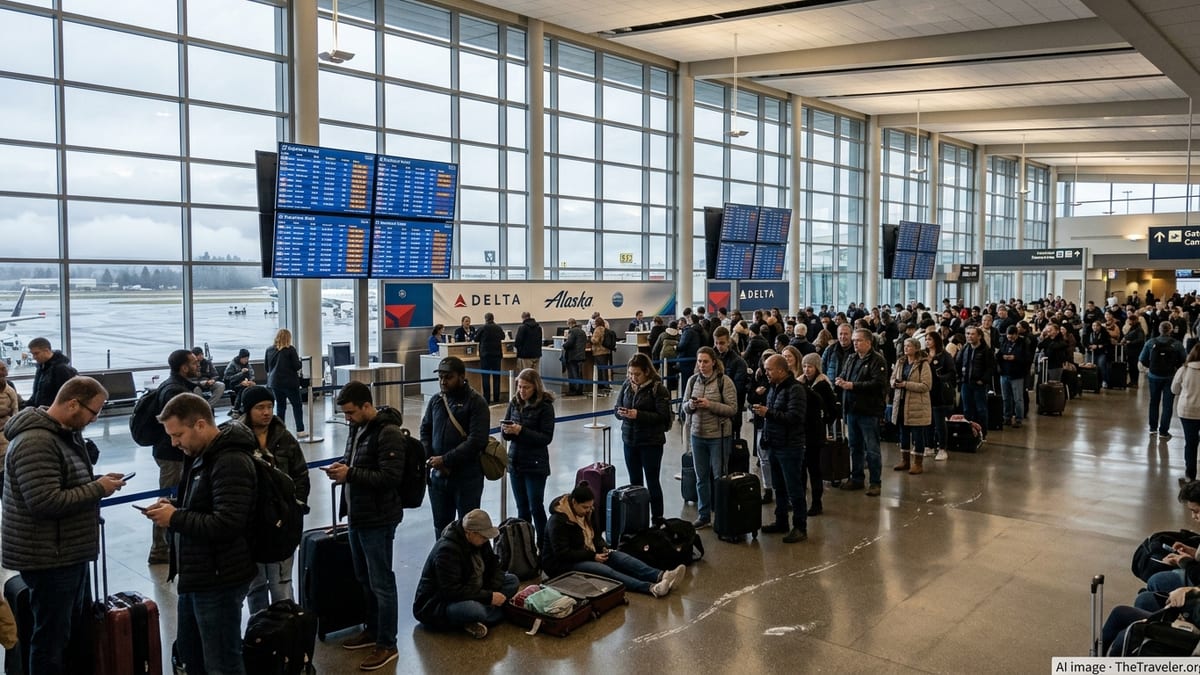
Passenger accounts shared publicly during the disruption describe long waits at check-in counters and customer service desks, with some travelers spending many hours in the terminal while monitoring repeated gate changes and rolling departure estimates. According to these reports, customer service channels for at least one major carrier were heavily backlogged as call centers fielded extended hold times.
For many travelers, missed connections became a primary concern. With Delta and Alaska both using Seattle as a key connecting node for domestic routes and for flights to Alaska, Hawaii and international destinations, delays on a single leg frequently translated into overnight stays or multi-stop rebookings. Some itineraries that were originally planned as straightforward nonstops were converted into journeys of 20 hours or more as carriers worked within limited seat availability.
Social media posts and discussion threads from the affected days highlight the strain on airport services during peak disruption periods. Travelers described crowded gate areas, difficulty accessing updated information, and uncertainty over whether to wait for delayed flights or seek alternative routings. These accounts align with historical patterns seen during previous large-scale weather disruptions at major hubs.
Operational Strain Highlights Ongoing Vulnerability to Extreme Weather
The Seattle delays and cancellations add to a growing body of data showing how sensitive modern airline operations remain to disruptive weather, even outside traditional peak winter months. Recent federal Air Travel Consumer Reports and on-time performance analyses for major US carriers note that extreme weather remains a leading cause of delay, often accounting for a significant share of monthly disruptions.
In practice, conditions such as freezing temperatures combined with moisture can slow airport throughput as ground crews carry out de-icing on multiple aircraft and manage slick ramp surfaces. When coupled with constrained runway use and visibility challenges, the effective capacity of an airport can drop sharply, creating bottlenecks that propagate throughout airline networks.
Airline industry observers point to events like the Seattle disruption as a reminder that, despite technology improvements and stronger scheduling discipline, weather can still overwhelm even well-performing carriers. Published performance tables routinely show Delta and Alaska near the top of North American rankings, yet both were significantly affected by the Seattle slowdown, indicating that hub location and regional climate remain critical factors.
What Passengers Can Expect in the Coming Days
With the primary storm system now moving away from the Pacific Northwest, operations at Seattle-Tacoma International Airport are expected to stabilize gradually, though backlogs may linger as airlines reposition aircraft and crews. Flight data patterns after previous severe-weather events suggest that residual delays can continue for 24 to 48 hours as carriers work through compressed schedules.
Travelers with upcoming itineraries involving Seattle are being advised, through carrier alerts and airport messaging, to check flight status frequently and allow extra time at the airport. Same-day rebooking options may remain limited on popular routes until aircraft rotations fully normalize and spare seat inventory improves.
Industry analysts note that the disruption may contribute modestly to monthly delay and cancellation statistics for the carriers most involved, but that the broader reputational impact will likely depend on how quickly operations return to normal and how effectively passengers feel they were supported during the interruption. For now, the episode serves as another example of how a single regional weather system can ripple across the wider US air travel network, with Seattle at its center.