

More news on this day
Passengers moving through Seattle-Tacoma International Airport on April 7 faced mounting frustration as 79 flights were disrupted, contributing to a broader wave of delays and cancellations across the United States air travel network.
Get the latest news straight to your inbox!
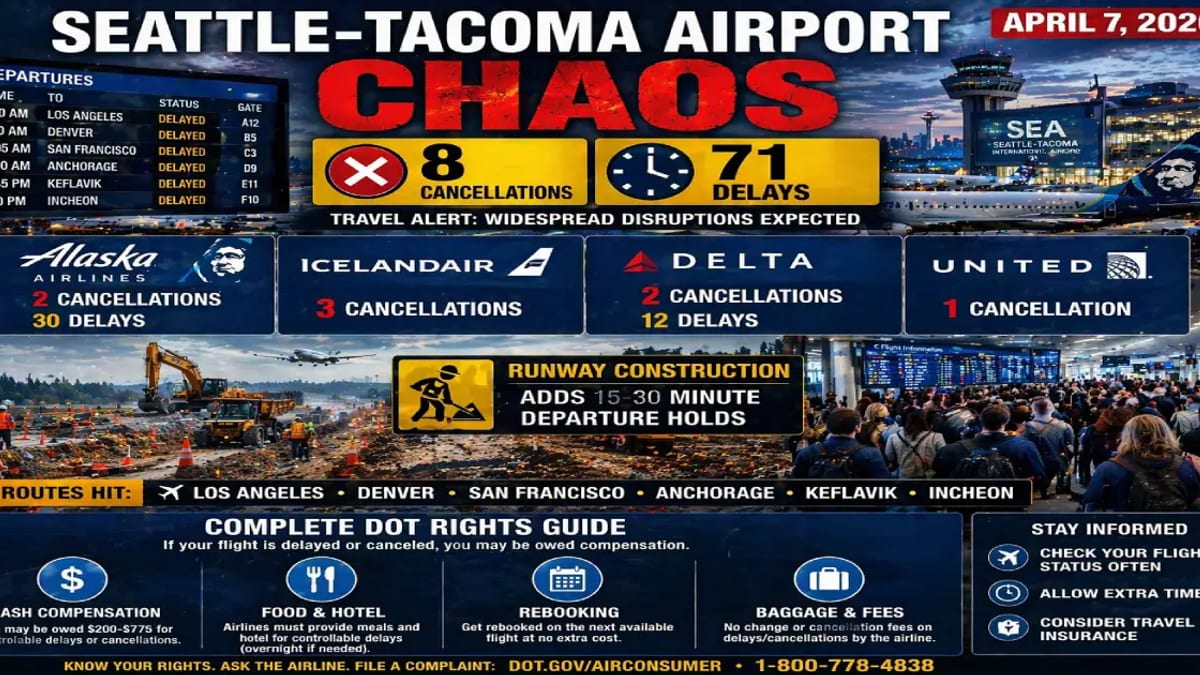
Dozens of Flights Delayed and Canceled at SEA
Publicly available flight tracking data for April 7 indicates that Seattle-Tacoma International Airport recorded 79 operational disruptions, including 71 delayed departures and arrivals and 8 flight cancellations. The disturbances affected a mix of domestic and limited international services, with routes linking Seattle to key hubs such as Los Angeles, Denver, San Francisco and Anchorage among those impacted.
Several major carriers with large footprints at Seattle, including Alaska Airlines and Delta Air Lines, experienced schedule pressures as the day progressed. Other national operators such as United Airlines and Southwest Airlines were also listed among the affected airlines, pointing to a network-wide strain rather than an isolated airline problem at the airport.
While Seattle did not see the worst numbers in the country, the 79 disrupted flights were significant for a single hub and were enough to produce visible crowding in concourses, longer-than-usual gate holds and a rise in missed connections for travelers attempting to link through SEA to the rest of the United States.
SEA Disruptions Tied to Nationwide Logistical Strain
The problems at Seattle-Tacoma unfolded against a backdrop of widespread aviation disruption in the United States on April 7. Industry monitoring platforms reported more than 4,000 delayed flights and over 200 cancellations across major American hubs, including Atlanta, New York, Chicago, Los Angeles, Orlando and Houston, in addition to Seattle.
This broader pattern suggests that the difficulties at SEA were shaped not only by local conditions but also by knock-on effects from congested airports elsewhere. When major hubs experience rolling delays, aircraft and flight crews can be left out of position, reducing schedule flexibility and amplifying even minor issues as the day wears on.
Observers of airline operations note that, in such circumstances, a relatively modest number of initial delays can cascade into a much larger wave of disruptions. For Seattle, the result on April 7 was an above-average level of irregular operations even though airport-specific weather and infrastructure conditions remained generally stable.
Weather and Operational Factors Behind the Chaos
Weather data for the Seattle area late on April 6 and into April 7 showed relatively benign local conditions, with cool temperatures and scattered clouds, and no indication of major storms or low-visibility events over the airfield. This contrasts with recent North American disruptions that have been explicitly linked to severe winter weather or intense storm systems affecting airport capacity.
Instead, analysts looking at the April 7 picture highlight a combination of system-level stressors. These may include residual effects from earlier storms in other regions, tight aircraft utilization, and constraints in available flight crews after a demanding late-winter and early-spring travel period. In such an environment, even minor schedule adjustments can have an outsized impact on airports that serve as important regional hubs, such as Seattle-Tacoma.
Historic performance data also show that SEA is vulnerable to disruption when national networks are under stress. Studies of U.S. airport reliability in recent years have repeatedly placed Seattle among the large airports with relatively high shares of weather-related and knock-on delays, reflecting both its role in the national network and its exposure to complex operating conditions.
Impact on Passengers and Key Routes
The 71 delays and 8 cancellations at Seattle-Tacoma translated into hours of uncertainty for passengers who had planned to travel on April 7. Travelers on routes to and from West Coast cities such as Los Angeles and San Francisco, as well as to inland hubs including Denver, reported extended gate holds, multiple rolling departure times and tighter-than-expected connection windows.
Disruptions at SEA also posed challenges for long-haul and transcontinental travelers making use of Seattle as a connecting point. Even when long-distance flights operated close to schedule, passengers arriving late from feeder services risked missing onward departures, and some were forced to rebook onto later flights or overnight in the region.
Airport wayfinding information and airline communication channels directed affected passengers toward rebooking options, same-day standby lists and customer service desks, but the concentration of irregular operations over a single day made queues and waiting times longer than usual. For many travelers, the experience added an extra layer of stress to an already busy spring travel period.
What Travelers Should Watch for After April 7
Although April 7 marked a particularly visible day of disruption at Seattle-Tacoma, analysts caution that the broader system pressures behind the 79 irregular operations may not resolve immediately. Airline schedules remain tightly wound in the wake of recent winter-weather events and ongoing demand for domestic travel, leaving limited slack in aircraft and crew rotations.
Travelers planning to pass through SEA in the coming days are advised, based on patterns observed across the national network, to monitor their flight status frequently, build extra buffer time into connections and be prepared for potential last-minute gate changes. Travel-insurance products that specifically cover delays and missed connections may also offer some financial protection when disruption ripples through multiple hubs at once.
For Seattle-Tacoma, the April 7 episode underscores how quickly a mid-sized wave of delays and cancellations can create a perception of chaos within a single airport, especially when it coincides with nationwide aviation strain. As airlines and airports navigate the rest of the spring travel season, operational resilience at critical nodes like SEA will remain a key point of focus for the industry and passengers alike.