

I expected my Alaska cruise to be beautiful. I did not expect to feel my heart pound in my throat as our ship edged through Endicott Arm toward Dawes Glacier, surrounded by ice, silence and the low rumble of something ancient shifting in the distance. That morning turned a pleasant vacation into the most dramatic travel moment I have ever experienced at sea.
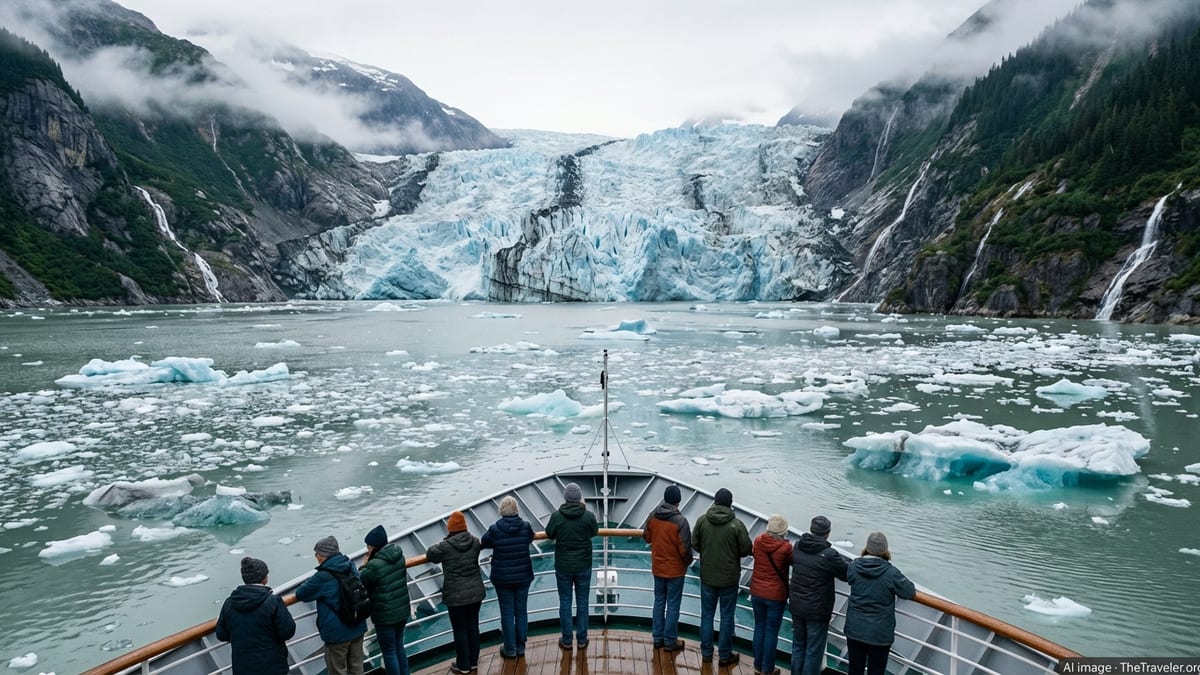
Entering Endicott Arm: From Open Ocean to Ice-Filled Fjord
The day we sailed into Endicott Arm began quietly. I woke before sunrise to a thin strip of pink light on the horizon and the faint scrape of ice against the hull. Overnight, we had left the relatively open waters of Stephens Passage and slipped into a narrow fjord carved by glaciers over thousands of years. By the time I stepped onto the balcony, the scale of the place had already changed everything I thought I knew about “scenic cruising.”
Endicott Arm does not feel like a typical cruise destination. It is a deep, winding corridor framed by sheer granite cliffs that rise sharply from the water, streaked with waterfalls and veils of mist. There are no docks, no towns, no clusters of fishing boats. Access is entirely by water, and vessel traffic is limited to protect wildlife and the fragile shoreline. It feels remote and uncurated, as if you have slipped backstage into Alaska’s working landscape of ice and rock rather than a stage set designed for tourists.
As we pushed deeper into the fjord, the water itself became a sign that we were entering another world. What had been open, steel-colored sea gradually thickened with floating ice: first scattered shards, then small chunks, then whole rafts of brash ice that our ship nudged aside, leaving a broken trail in its wake. Somewhere ahead, beyond a bend in the fjord, lay Dawes Glacier, the tidewater glacier that feeds this icy river of fragments.
On deck, passengers who had been chatting noisily fell quiet. Most of us simply stood along the rail, hands wrapped around hot coffee cups, breath steaming in the cold air, listening to the subdued thrum of the engines and the occasional hollow knock of ice bumping along the hull. The drama was building long before we saw the glacier itself.
First Sight of Dawes Glacier: A Wall of Ice and Silence
The captain’s announcement came just after breakfast: we were approaching the turning basin, the final, widening bowl of the fjord where large ships stop a few miles short of the ice face. I hurried outside, joining the line of guests pressed against the forward rail. There was a hush that felt almost reverent as the ship rounded a final rocky shoulder and the glacier came fully into view.
Dawes Glacier did not look static or frozen in time. It looked alive. The face of the glacier towered above the water like an immense, fractured wall, its surface a mosaic of textures and colors: chalk white snow, deep turquoise crevasses, and vertical black stripes where rock and sediment had been ground into the ice. In some sections the ice appeared almost luminous, glowing from within whenever a rare shaft of sunlight slid between the clouds.
At this point the ship slowed and the engines dialed back so far that the fjord grew almost eerily quiet. Without the buffer of engine noise, other sounds emerged: the faint crackle of ice shifting in the water, the distant rush of waterfalls on the cliffs, and every so often a sharp echo from deep inside the glacier itself. You could feel the cold more strongly here, as if the massive ice field at the head of the fjord were exhaling across the bay.
The captain explained over the loudspeaker that we were looking at the seaward end of a much larger river of ice that originates in the Stikine Icefield, one of the great ice complexes of the coastal mountains. We were only seeing the last dramatic chapter of a long glacial story, but from our vantage point it was hard to imagine anything beyond that towering wall of ice and the milky, slate-colored water filled with bergs and growlers.
When the Glacier Moved: Experiencing a Calving Event
Everyone hopes to witness a calving event at a tidewater glacier, but there is no guarantee. Calving, the moment when a chunk of ice shears off the face and crashes into the sea, is unpredictable. It can happen several times in an hour or not at all while visitors are present. On our day at Dawes, the glacier decided to perform.
The first sign was sound, not motion. A low, rolling crack echoed across the water like distant thunder bouncing off canyon walls. Conversations on deck stopped mid-sentence as every head turned toward the center of the glacier’s face. For a few seconds nothing seemed to change, and then a tall column of ice separated from the wall in agonizing slow motion, tilting outward as if in defiance before finally surrendering to gravity.
What followed was chaos in miniature. The ice shattered as it hit the water, sending up a plume of spray and smaller chunks that ricocheted across the surface. A ring of waves rolled outward, pushing through the floating ice and causing bergy bits to bob and twist. The sound was not a single crash but a layered symphony of cracking, splintering and roaring water that seemed to vibrate in my chest.
All around me, cameras clicked and phones filmed, but the experience did not feel like a performance staged for an audience. It felt like we had been granted a brief, visceral glimpse of the energy that quietly shapes these landscapes day after day. When the water finally calmed and the glacier’s face settled into a new, slightly altered outline, an odd stillness followed. People spoke in low voices, as if they had just witnessed something sacred or fragile. In that moment, I understood why so many travelers describe tidewater glaciers as emotional experiences rather than simple sightseeing stops.
Life on the Ice: Wildlife Encounters in Endicott Arm
As dramatic as the glacier itself was, the approach through Endicott Arm offered its own subtler thrills. The ice-choked waterway is a vital habitat for harbor seals, which haul out onto the floating ice to rest, give birth and nurse their pups in relative safety from predators. Regulations require cruise ships and smaller boats to maintain careful distances from seal concentrations, but even from afar it was possible to see their sleek shapes draped across the floes like gray commas on a white page.
Naturalists on board pointed out how easily the seals blended into the mottled surface of the ice, and explained that this nursery area is one of the reasons vessel numbers and routes are so tightly managed in the fjord. In early summer, when pupping is at its peak, sections of Endicott Arm may be off-limits or transited with extra caution, and captains frequently adjust plans to accommodate wildlife conditions. That morning, watching mothers carefully shift position to shield their pups from wind and spray, those protective rules felt less like restrictions and more like common sense.
Above the waterline, the cliffs provided a different sort of spectacle. Bald eagles circled high on thermals, occasionally swooping down to perch in solitary spruce trees that somehow clung to cracks in the rock. A few passengers spotted mountain goats on distant ledges, their white coats nearly indistinguishable from lingering snow patches. In the water beyond the ice, the lucky among us caught the blows of humpback whales and the slick dorsal fins of porpoises, drawn to the nutrient-rich currents that swirl at the mouths of fjords like Endicott Arm.
The wildlife sightings lent the entire scene a sense of scale. Dawes Glacier is not an isolated monument, but part of a living ecosystem where everything from plankton to whales depends, in some way, on the cycle of freezing, melting and mixing that glaciers drive. Watching a seal pup slide clumsily off a piece of ice into the water, I realized that the drama unfolding around us was not only visual; it was ecological, too.
Big Ship, Small Boat: Choosing How Close to Get
Most large cruise ships can approach Dawes Glacier only to the point where ice density and maneuvering room remain within strict safety margins. From there, they spin slowly in the basin, giving guests panoramic views from every side of the vessel. On its own, that experience is remarkable. However, many lines also offer optional small-boat excursions that leave directly from the ship and travel deeper into the ice, sometimes getting significantly closer to the glacier face when conditions allow.
On my sailing, I chose to stay aboard the main ship and experience the glacier from elevated decks and my balcony, but fellow passengers who booked the small-boat tour returned with vivid stories. They described weaving through fields of ice, sometimes close enough to see the complex textures and bubbles trapped within individual chunks. Naturalists on the smaller craft pointed out the terminology of ice types, from brash to “growlers” and “bergy bits,” and explained how color can reveal age and density. Clear, blue ice, they learned, often signals older, more compacted glacial material.
Those travelers also felt the power of the glacier in a different way. Lower to the water, they experienced swells from calving events more directly, and the sound reached them without the slight buffer of a large ship’s bulk. Some excursions combine glacier viewing with extended wildlife watching or additional narration about glaciology, climate and local history. In many cases, the small-boat journeys do not return to the cruise ship but instead continue on to a port like Juneau, where guests reunite with the vessel later in the day.
Whether you choose to remain on the main ship or venture out on a smaller craft, it is worth understanding that conditions can change quickly. Heavy ice can prevent a large vessel from reaching the turning basin, and in those cases, passengers on small-boat tours may be the only ones who see the glacier at all. Flexibility is essential in Alaska; you travel on nature’s schedule, not your own.
Preparing for the Most Dramatic Morning of Your Cruise
Looking back, part of what made my time at Dawes Glacier so intense was how thoroughly it engaged every sense. The visual impact is obvious, but the experience also has a distinct soundscape, temperature and even a faint smell of salt and clean, mineral-rich air. To appreciate it fully, a little preparation goes a long way.
First, dress as if you will be standing still outside for a long time, because you probably will. Even in midsummer, the air near a tidewater glacier can feel sharply colder than in nearby ports. Layering is key: a base layer that wicks moisture, a warm mid-layer like fleece or wool, and a windproof, preferably waterproof outer shell. A hat, gloves and warm socks are not overkill, especially if your ship arrives at the glacier early in the morning when overnight chill still lingers.
Second, plan ahead for photography. A zoom lens or binoculars will help you appreciate details in the ice face and spot distant wildlife, but do not underestimate the value of simply pausing to look with your eyes rather than through a viewfinder. Many visitors find that the strongest memories from glacier viewing are sound and emotion, neither of which translate perfectly to still images or video clips.
Finally, manage your expectations with an open mind. You might experience bright sun, moody drizzle, or low clouds hanging in the fjord. Ice conditions might allow the captain to approach very close, or they might force a more distant vantage point. Calving might be explosive and frequent, or the glacier might remain relatively quiet. Each combination of weather, light and activity tells a slightly different story. The drama comes as much from the unpredictability as from the scenery itself.
Understanding a Changing Landscape
Standing in front of Dawes Glacier, it is tempting to see the ice as timeless. In reality, the fjords and glaciers of Southeast Alaska are part of a landscape in motion, shaped by long-term climate patterns, short-term weather and complex local conditions. Many tidewater glaciers in the region have retreated over the past century, pulling back from the sea or thinning as air and ocean temperatures gradually increase.
In Endicott Arm, this change is visible in subtle ways, especially if you compare recent photos with older images taken from similar vantage points. Some sections of shoreline that were once buried under ice now support young vegetation, creating a patchwork of bare rock, pioneer plants and older forest. New waterfalls appear as meltwater finds different paths down the cliffs, and the pattern of icebergs in the fjord can shift from season to season.
Cruise lines and expedition operators increasingly weave this reality into their onboard interpretation. Naturalists talk not only about glacial mechanics and wildlife but also about the ways local communities and scientists monitor glaciers like Dawes. While most visitors will not leave with hard data or scientific expertise, they often depart with a heightened awareness of how sensitive these systems are, and how quickly they can respond to broader environmental forces.
For me, that morning at the glacier left a lingering sense of both privilege and responsibility. It felt like a gift to witness such raw beauty, but also a reminder that these frozen giants are not permanent fixtures. They are chapters in an ongoing story of change, and our presence as travelers is now part of that narrative.
The Takeaway
When I think back on my Alaska cruise, I remember charming ports, lively evenings on deck, and the understated luxury of watching forested islands slip past my balcony. Yet all of those memories orbit around a single axis: the hours we spent in Endicott Arm, slowly pivoting in front of Dawes Glacier while ice cracked, waterfalls roared and harbor seals dozed on floating platforms of snow and blue glass.
There was nothing manufactured about that experience. No scripted show, no curated soundtrack, no guarantee of dramatic calving or cooperative wildlife. The drama came from the scale of the landscape and the sense that we had stepped briefly into a world that carries on whether or not a ship full of visitors is watching.
If you are considering an Alaska cruise and see “Endicott Arm and Dawes Glacier” listed in the itinerary, treat it not as just another scenic highlight but as the emotional center of your voyage. Dress warmly, wake up early, claim a spot on deck and let yourself be quiet enough to really absorb what you are seeing. With luck, you will feel the deep, rolling thunder of the glacier in your chest and carry that memory long after the ship has turned back toward open water.
FAQ
Q1. How close do cruise ships usually get to Dawes Glacier?
Cruise ships typically stop a couple of miles short of the glacier face, at the last safe point where they can turn around in the ice-filled basin.
Q2. Is a small-boat excursion to Dawes Glacier worth it?
Many travelers consider the small-boat tours worthwhile because they can often navigate closer to the ice and offer more detailed commentary, though conditions always dictate how near they can safely approach.
Q3. What time of year is best for seeing Dawes Glacier?
The main cruise season to Endicott Arm runs from late spring through early fall, with late May through August often providing a good balance of daylight, wildlife activity and relatively accessible ice conditions.
Q4. Can bad weather or heavy ice prevent ships from reaching the glacier?
Yes. Low visibility, strong currents or dense ice can limit how far a ship can safely proceed, and in some cases vessels may not reach a direct viewing position in front of the glacier.
Q5. Will I definitely see the glacier calve?
No. Calving is natural and unpredictable. Some visitors see dramatic icefalls while others experience a quieter glacier with only occasional rumbles and smaller breaks.
Q6. What should I wear for glacier viewing in Endicott Arm?
Layered clothing, a warm hat, gloves and a windproof outer shell are recommended, as the air near the glacier can feel significantly colder than in nearby ports.
Q7. Is Dawes Glacier suitable for travelers with limited mobility?
Viewing from a large cruise ship is generally accessible, with elevators and indoor lounges offering good sightlines, while small-boat tours may involve steps or narrow walkways that are more challenging.
Q8. Are there restrooms or facilities near Dawes Glacier?
There are no shore-based facilities in Endicott Arm. All amenities, including restrooms, warmth and food, are on board your ship or excursion vessel.
Q9. How long do ships usually spend in front of Dawes Glacier?
Most ships spend roughly one to two hours maneuvering in the basin, rotating slowly so passengers on all sides have extended time to view and photograph the glacier.
Q10. Can I visit Dawes Glacier without taking a large cruise?
Yes. A number of small-ship cruises, expedition vessels and local tour operators based in Southeast Alaska offer itineraries that include Endicott Arm and Dawes Glacier, often with a more intimate scale.