

More news on this day
Australia’s flag carrier is facing renewed heat in Parliament after a Senate committee condemned Qantas for pressing ahead with plans to shut regional crew bases in Canberra, Hobart and Mildura, a move critics say puts profits before people and weakens already fragile regional aviation.
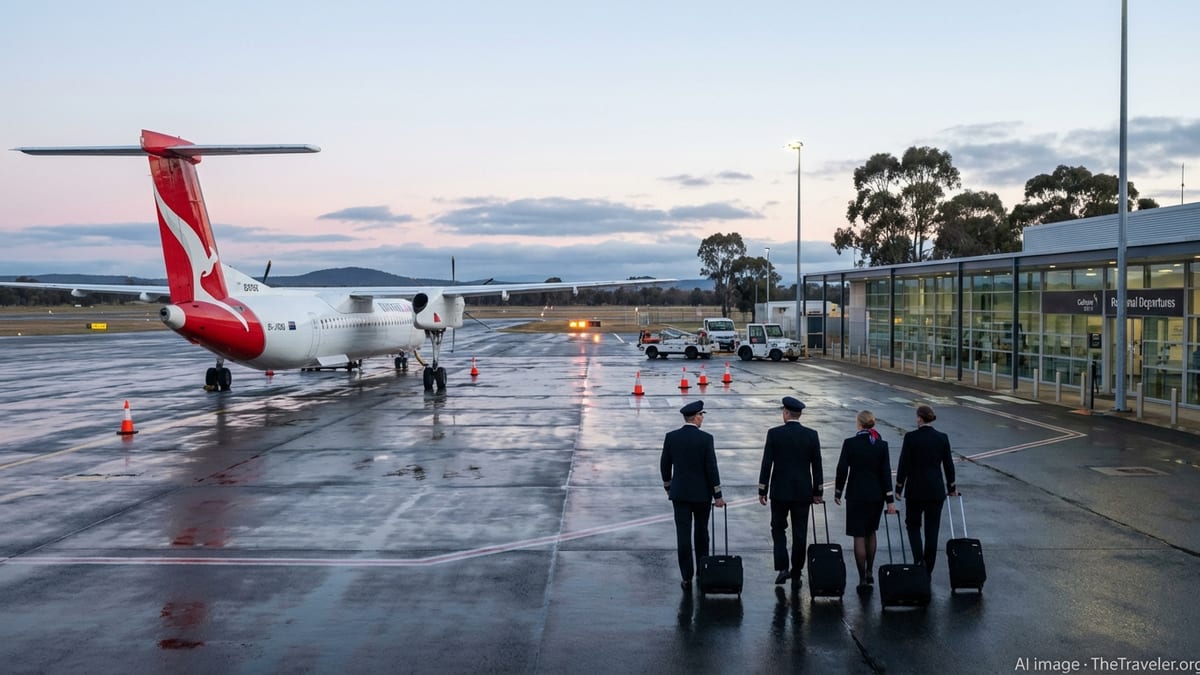
Senate Report Condemns Qantas Over Regional Closures
An Australian Senate committee on rural and regional affairs has delivered a scathing assessment of Qantas’s decision to close its regional staff bases at Canberra, Hobart and Mildura airports, finding the airline failed to properly consult affected workers or communities and had not adequately weighed the broader public interest. The report, tabled in Parliament this week, concludes that the closures, due to take effect by April next year, will strip high-skill aviation jobs from the regions and concentrate even more of Qantas’s operations in the major capitals.
The committee framed the decision as part of a pattern of behaviour from Qantas, citing the airline’s recent record penalties for unlawfully outsourcing ground handling jobs during the pandemic period. It said the process leading up to the October 2025 announcement of the shutdowns suggested lessons from that episode had not been learned, with staff and regional leaders again left to react to decisions that appeared effectively predetermined.
While Qantas insists the move is an operational reshuffle that does not affect flight schedules to the three airports, the Senate report argues that the impact on regional Australia goes beyond timetables. By removing based pilots and cabin crew from Canberra, Hobart and Mildura, it warns, the airline risks eroding community confidence in air services and accelerating the drift of skilled workers and their families to the big cities.
Canberra, Hobart and Mildura Bases to Shut by April
QantasLink first signalled in September 2025 that it was reviewing its so called base footprint, examining whether the smaller crew bases in Canberra, Hobart and Mildura should be consolidated into larger hubs. Less than a month later, on 1 October, the airline confirmed that all three would be closed, with operations to be absorbed into Sydney, Melbourne and Brisbane. Around 70 pilots and cabin crew currently based across the three locations will be affected.
Under the plan, crews will no longer sign on or reside at these regional airports. Instead, they will commute from the major city bases to operate flights in and out of Canberra, Hobart and Mildura. Qantas says the changes are designed to improve reliability by concentrating more staff where most flights depart and arrive, allowing it to respond faster to disruptions and reduce the risk of cancellations.
The airline has stressed that there will be no reduction in services to any of the three destinations as a direct result of the closures. In Canberra’s case, Qantas notes it operates more than 200 flights a week in conjunction with its low cost arm and is investing in new Airbus A220 jets on routes to Melbourne and Sydney. In Mildura, QantasLink points to a fleet renewal that will increase the number of seats to and from the city, while in Hobart it underlines ongoing employment at its contact centre.
Despite those assurances, the Senate committee’s findings, together with strong political and union opposition, have thrown fresh attention on how the restructuring will reshape life for workers and the role of the airline in regional capitals and communities.
Workers Face Commuting, Relocation and Family Strain
At the heart of the row is the future for the roughly 70 pilots and cabin crew who built their lives around the Canberra, Hobart and Mildura bases. Qantas has promised that there will be no job losses, offering affected staff positions in Sydney, Melbourne or Brisbane as well as a support package that includes confirmed flights, a commuting allowance and some rostering flexibility for at least two years after the closures.
For many employees, however, the prospect of commuting long distances or uprooting families to expensive capital city housing markets is deeply unsettling. Evidence given to the Senate inquiry by impacted crew, some of it in closed session, detailed how staff had bought homes in regional centres after being encouraged to relocate from other bases, only to be told a year or two later that their jobs would effectively move again. One pilot described investing in a house and renovations on the understanding that there was no plan to shut the base, only to learn in 2025 that the operation would be wound up.
Union officials say these stories highlight the personal cost of what they characterise as a corporate decision driven by efficiency metrics. The Transport Workers Union argues that staff are being forced to choose between their careers and their communities, with commuting arrangements that may be workable on paper but, in practice, mean missed school events, disrupted family life and financial strain. The Senate report echoes those concerns, warning that many affected workers are likely to leave their current communities permanently.
Qantas counters that fly in fly out commuting is common in aviation and that it is doing what it can to help staff who want to remain living in Canberra, Hobart or Mildura. The airline has pointed out that some crew already travel to start their shifts in larger ports and that relocation assistance will be available to those who decide moving is the better long term option. Even so, the committee found that the support on offer, including an allowance of several hundred dollars a fortnight, does not fully reflect the upheaval involved.
Regional Communities Warn of Economic and Social Fallout
Local leaders in all three affected regions have expressed alarm at the closures, saying they run counter to long standing efforts to decentralise high value jobs and strengthen regional economies. In Mildura, community representatives and politicians have described the decision as a slap in the face for a remote city that relies heavily on air links for business, health and education. They argue that losing a base, even with flights intact, sends a damaging signal about the region’s importance to the national carrier.
Canberra, despite being the national capital, is also grappling with the prospect of losing dozens of aviation roles. Around 30 QantasLink staff are based there, and union representatives have warned that their removal will diminish the city’s status as an aviation hub and reduce opportunities for local pilots and cabin crew. Some local legislators have questioned how the closure fits with Qantas’s public narrative about investing in the Canberra market, including new aircraft deployments and a growing route network.
In Hobart, where QantasLink employs about 30 crew at the base, concern has focused partly on Tasmania’s broader challenge in retaining skilled workers. State political leaders have said they do not want to see Tasmanian based staff forced interstate simply to keep their jobs. While acknowledging that airlines must manage their operations efficiently, they argue that regional capitals like Hobart need more, not fewer, career pathways in high skill sectors if they are to grow their economies and support population targets.
The Senate report took a similar view, concluding that the loss of highly skilled roles from Canberra, Hobart and Mildura would have ripple effects beyond the aviation sector. It warned that fewer professional jobs could lead to families relocating, children leaving local schools and reduced spending in local businesses, undermining regional development strategies that rely heavily on stable, well paid employment.
Reliability Claims Questioned Amid Broader Aviation Turbulence
Qantas has repeatedly framed the consolidation of its regional bases as an essential step to improve reliability after several difficult years marked by flight disruptions, staffing shortages and intense public scrutiny. By basing more crew at its busiest ports, it argues, the airline can more easily swap staff and aircraft between routes, reduce knock on delays and offer customers a more dependable experience.
The Senate committee was not convinced by this argument. Its report notes that having staff based in regional centres can in fact provide a buffer when flights are delayed or aircraft rotations change, because additional crew are already on hand. It also questions whether the airline provided clear evidence that shutting the three bases will deliver measurable reliability gains, as distinct from cost savings and scheduling flexibility in the main hubs.
The debate is playing out against a backdrop of wider instability in regional aviation. The collapse of low cost carrier Bonza and the administration of rival regional airline Rex have already shaken confidence in smaller communities that rely on air travel for essential connections. Critics of Qantas’s move argue that, in this environment, withdrawing regional bases sends precisely the wrong message and leaves governments and passengers with fewer levers to ensure service continuity.
QantasLink maintains that its growing fleet, including new A220 jets and upgraded turboprops, will increase capacity for regional travellers and that base consolidation should be seen as part of a long term renewal strategy rather than a retreat. Nonetheless, the scrutiny from the Senate and the chorus of concern from regional leaders indicate that many remain unconvinced that reliability and customer service are the main drivers.
Political Pressure Mounts for Qantas to Reconsider
Following the release of the Senate report, political pressure on Qantas has intensified from across the spectrum. Regional MPs, senators from government and opposition parties, and independents have all urged the airline to revisit its decision, arguing that the national carrier has a responsibility that goes beyond pure commercial calculation. Some have pointed to the history of government support for Qantas, both direct and indirect, as grounds for expecting a higher standard of engagement with regional communities.
Senior ministers have publicly called on the airline to recognise the social and economic value of keeping regional bases open, or at least to expand negotiations with unions and local stakeholders to find alternatives. Suggestions floated include maintaining a smaller presence in each city, staging the changes over a longer time frame, or bolstering other forms of investment in the affected airports to offset the loss of crew bases.
The committee itself recommended the establishment of a more formal framework for consultation between airlines, unions, airports and governments when major operational changes are contemplated. It argued that decisions such as base closures should not be sprung on workers and communities with little warning, but instead be subject to transparent processes that weigh national and regional interests alongside corporate objectives.
For Qantas, the political fallout comes at a sensitive time as it works to repair its brand after a bruising period of legal battles, customer complaints and leadership changes. How the airline responds to the Senate’s condemnation and to community concerns over the regional base shutdowns is likely to be seen as a test of whether it is serious about rebuilding trust.
Qantas Response and the Road Ahead for Regional Travel
Qantas has said it will carefully review the Senate committee’s findings and continue to engage with the inquiry and with affected stakeholders. In public statements, the airline has reiterated that no jobs are being cut, that affected staff have accepted roles in other locations and that its commitment to Canberra, Hobart and Mildura remains strong. It points to continuing investment in aircraft, engineering facilities and customer service initiatives in these markets as evidence that the closures are operational changes rather than a withdrawal.
Even so, the report ensures the issue will not fade quickly. Regional mayors, business groups and tourism operators are using the findings to renew calls for a stronger national strategy for regional aviation that looks beyond the fortunes of any single carrier. Some argue that the federal government should consider new incentives for airlines that maintain significant regional employment footprints, while others want more direct public investment in air services or alternative transport infrastructure such as upgraded rail links.
For travellers passing through Canberra, Hobart and Mildura airports, little may appear to change when the bases finally shut and crews begin commuting from interstate. Flights will still arrive and depart, the familiar red tail will still be on the tarmac, and new aircraft may even offer more seats. But behind the scenes, the network that keeps those services running will be less rooted in the communities they serve.
As the Senate’s condemnation makes clear, the question now facing policymakers, Qantas and regional Australia is not only how many flights operate, but who benefits from them and where the jobs that support them are based. The outcome of that debate will shape the future of air travel for millions of Australians living far from the country’s largest cities.