

I went to East Africa thinking the answer would be simple: go wherever the Great Migration looks most dramatic, tick off the Big Five, fly home smug and satisfied. After spending time in both Tanzania’s Serengeti (Option A) and Kenya’s Masai Mara (Option B), I learned very quickly that “which safari is better” is annoyingly subjective.
Both gave me big, goosebump wildlife moments. Both also frustrated me in ways I did not expect, from cost creep to crowds to opaque booking rules. If you are trying to choose between them, the real decision is less about which park is “best” and more about which compromises you are willing to live with.
What I Thought I Wanted vs What Actually Mattered
Before I went, I thought the Great Migration itself would be the deciding factor. Of course I wanted those cinematic scenes: a torrent of wildebeest charging into a crocodile-filled river on a dusty afternoon, lions lurking in the grass, the whole thing backlit for my camera. Every article I read framed Serengeti vs Masai Mara around that moment, so I framed my expectations the same way.
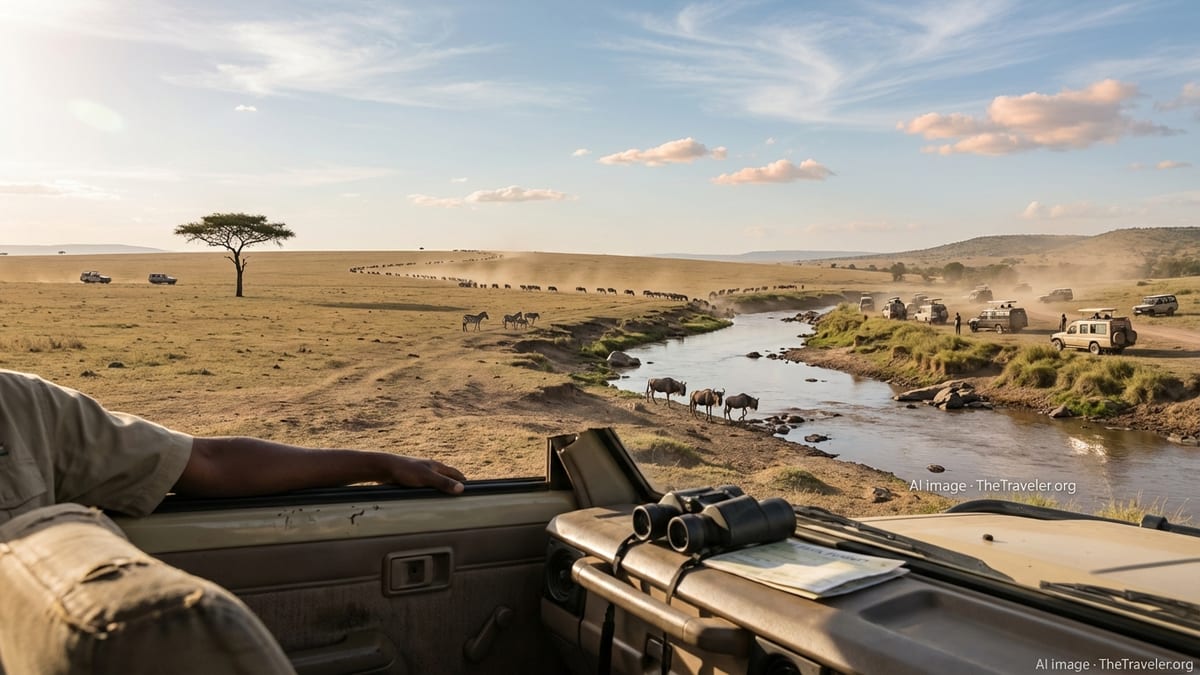
On the ground, I realized the migration is not a neat package you can just book. It is a moving, weather-dependent loop that can arrive late or early, stall for weeks, or play out mostly at night. In the Serengeti, I chased the herds over several days, watching them pour over ridges in long, snaking lines, but the famous river crossings were brief and far away. In the Masai Mara, I timed my trip for the supposed peak, yet several days went by without so much as a single dramatic crossing. The herds were there, but the “BBC documentary” moment did not line up with my schedule.
What ended up mattering more to me was how each place felt day to day. In the Serengeti, the scale is almost absurd. Driving for an hour and seeing only grass, sky, and the occasional lone acacia made the wildlife encounters feel earned and wild. In the Masai Mara, the density of animals felt higher, but so did the density of vehicles. A cheetah sighting could pull in twenty Land Cruisers within minutes, all jostling for the same angle. If I had to choose again based purely on atmosphere, I would pick the Serengeti’s sense of space over the Mara’s intensity.
The Real Difference in Cost and Value
On paper, there is a clear cost difference right now, and it favors the Serengeti. Serengeti National Park charges international visitors a daily conservation fee of roughly 70 to 75 US dollars per adult for a 24 hour period, depending on which part of the park you are in and the time of year. That is not cheap, but it is still in the realm of reasonable for a flagship national park of this scale. Once you are inside, that fee covers full daytime use for a full day, not a split ticket clock.
In the Masai Mara, the numbers are different and, frankly, a shock when you see them in context. The Narok County Government has introduced a 12 hour ticket system, and from July through December, nonresident adults now pay 200 US dollars per day for entry into the main reserve, valid from 6 a.m. to 6 p.m. If you wanted to stay overnight and treat that as a 24 hour window, you are effectively at 400 dollars per person for the privilege of being inside the reserve across two calendar days. Even in the so-called green season (January through June), nonresident adults still pay about 100 dollars per daytime entry under the same 12 hour validity.
I did not fully internalize what “12 hours” meant until I was standing at the gate watching the attendant carefully stamp our entry time. Because the fee is attached to calendar day use, not rolling 24 hours, every reentry on a new day is another 100 or 200 dollars. It completely changes the feeling of value. In the Serengeti, I felt there was some slack in the system: if we lingered over breakfast and entered the park at 9 a.m., we still had a full day until 9 a.m. the next morning. In the Mara, leaving the reserve for lunch at a camp outside the boundary and wanting to go back in later that afternoon simply was not worth the additional fee.
Value is not just about fees, though, and this is where Masai Mara fights back a bit. On the days when everything lines up, you do get a huge amount of action per game drive, simply because the area is smaller and the herds are concentrated along the river during migration months. I had single morning drives there that delivered a leopard, a cheetah successfully hunting, two lion prides, and dozens of vultures at a carcass. In the Serengeti, the same variety would often be spread across two or three quieter drives. If you can afford the high entry fees and are focused on photographic “hits,” Masai Mara can feel outrageously productive. If your budget is tight, the Serengeti gives you more hours of wilderness per dollar.
Location and Logistics in Practice
The most stressful decision moment for me came before I even left home: base in Kenya and drive to the Mara, or commit to Tanzania and handle the Serengeti’s longer access routes. Getting to Masai Mara from Nairobi is relatively straightforward. You can drive in five to six hours on a mix of solid tarmac and increasingly potholed roads, or you can take a 45 minute light aircraft flight with one of the local airlines straight to an airstrip near your camp. I opted to fly in to save time, and that felt like the right call. The check-in was basic, the plane was small but safe, and I was game driving within an hour of landing.
The Serengeti demanded a different mindset. Most visitors route through Kilimanjaro or Arusha, then either drive via the Ngorongoro highlands or fly to one of the park’s several airstrips. The drive in can easily take six to eight hours depending on where in the Serengeti you are staying, with sections of rough gravel that get muddy after rain. I chose to drive in from Karatu as part of a longer northern Tanzania circuit, and the day ate up far more time and energy than I expected. We spent long stretches crawling along in a cloud of dust behind trucks, then dealing with park gate formalities that moved at their own pace.
Once inside, the logistical contrast sharpened. In the Masai Mara, everything is relatively close together. The main reserve is compact, and even the adjacent conservancies that many lodges use are only a short drive away. Moving from one habitat to another is usually a matter of minutes, not hours. In the Serengeti, distances are the defining feature. Getting from central Seronera to the northern Kogatende area where the Mara River crossings happen can consume the better part of a day. The advantage is that you experience a real sense of journeying across an ecosystem; the downside is that misjudging your timing can mean driving long distances with little to see.
If your trip is short, Masai Mara’s accessibility is a real advantage. I did a three-night Mara stay that felt full and satisfying because travel time was so light. My four nights in the Serengeti felt barely adequate, and if I am honest, I shortchanged some areas by trying to cover too much. Next time, I would still include the Serengeti, but I would stop pretending I can see the entire park in under a week.
Comfort, Noise, and Sleep Quality
When I pictured safari nights, I imagined silence punctuated only by distant hyena whoops and the rustle of grass. Reality differed between the two options in ways I only noticed once I tried to sleep. In the Serengeti, because camps are relatively spread out and the park’s zoning is strict, I mostly got that quiet wilderness feel. Nights in my tented camp near Seronera were dark, cool, and surprisingly peaceful. The noisiest thing was the generator cutting in for a few hours in the evening, and even that was muted and predictable.
In the Masai Mara, the density of camps and lodges around the reserve edges really changed the soundscape. One night, in a camp just outside the Talek Gate, I fell asleep to a soundtrack of distant music from a larger lodge, occasional vehicle engines, and the barking of dogs from nearby villages, all competing with the night sounds from the reserve itself. It was not unbearable, but it was not the deep wilderness isolation I had imagined. When I later moved into a conservancy with tighter development limits and a low vehicle cap, the difference in noise and light pollution was immediate and welcome.
Comfort itself is not lacking in either place as long as your budget can handle midrange or better properties. Both the Serengeti and the Masai Mara now have extremely high-end camps that feel more like boutique hotels with canvas walls. But there are texture differences. In the Serengeti, the architectural style felt more restrained and practical to me, partly because the park rules force semi-permanent or seasonal tented structures in many areas. In the Mara, I saw more evidence of full-scale, permanent constructions creeping into the reserve, including a very controversial luxury camp built right inside the protected area. The comfort level is high, but it comes with a creeping sense of overdevelopment.
Sleep quality also comes down to vehicle routines. In the Mara during peak season, you can expect pre-dawn wake-up calls and a convoy of vehicles rumbling out as soon as the gate opens, because everyone wants to maximize that expensive 12 hour ticket. That urgency is contagious; I felt compelled to wake up even when I was exhausted, simply because the entry fee made a late start feel wasteful. In the Serengeti, I still woke early for good game viewing, but I never felt pressured by a ticking ticket window. It is a subtle difference, but it changed how rested I felt over a week.
Food, Amenities, and What’s Actually Included
I went in assuming “all-inclusive” meant roughly the same thing in both destinations. It does not. My second major decision moment was choosing whether to book fully inclusive tented camps in both parks or piece together cheaper accommodation with separate park fees, game drives, and drinks. I ultimately split the difference: a midrange semi-inclusive camp in the Serengeti where soft drinks were included but alcohol was extra, and a fully inclusive conservancy camp in the Mara where even laundry and most drinks were covered.
In the Serengeti, the food was generally hearty and unpretentious. Buffets leaned on stews, grilled meats, vegetables, and starches that could survive the long supply chain from Arusha or beyond. Fresh salads appeared but not in great variety, which makes sense given the logistics. Breakfasts were generous, and packed bush breakfasts after early drives were often a highlight. I did have one camp where the menu read fancier than it tasted, but the baseline was consistent: you will not go hungry, even if you will not necessarily be wowed.
The Mara offered a slightly more refined food experience overall, but also more variation. Camps closer to Nairobi seemed to invest more in presentation, with three-course dinners and better coffee, but I also hit one lodge where the buffet felt stretched thin and repetitive, clearly trying to cut costs to compensate for higher park and operating fees. The most honest advice I can offer is to read recent reviews carefully and not assume that a higher room rate automatically means better food. The real sweet spot, for me, was the smaller, owner-run camp in a conservancy where the chef adjusted meals based on what guests actually liked on the first night.
Amenities are where expectations need to be checked hardest. Even at high price points, both Serengeti and Masai Mara camps are constrained by distance and infrastructure. Wi-Fi, when it exists, is patchy and usually limited to common areas. Hot water often relies on solar heating or scheduled generator hours. In the Serengeti, I had one afternoon where there simply was not enough power to run fans during a particularly hot spell, and the tent turned into a sauna. In the Mara, a sudden storm knocked out electricity for part of the evening and left us eating dinner by headlamp. None of this ruined the trip, but anyone expecting seamless city-style service deep in the bush will be frustrated.
Crowds, Atmosphere, and Who You’ll Be Surrounded By
Crowding is the single biggest experiential difference that caught me off guard, and it leans in favor of the Serengeti. In central Serengeti, you will absolutely share sightings with other vehicles, especially for cats near the main roads. I still found that most guides behaved with some restraint, keeping a respectful distance and rotating positions. Crucially, there is simply more room to spread out. We had full mornings where we saw no more than two or three other vehicles, especially once we left the main loops.
The Masai Mara during migration season can feel like a wildlife theme park in certain hot spots. The first time our guide called in a leopard, I counted more than twenty vehicles converging on the sighting within ten minutes. At the Mara River, scenes of dozens of jeeps clustered along the banks waiting for a crossing were common. Guides radio each other constantly, which is great for your chances of seeing rare behavior but not so great for atmosphere. Park rules theoretically limit the number of vehicles at a single sighting, but enforcement is uneven. I had at least two moments in the Mara when I felt we, as tourists, were collectively harassing the animals.
There is a partial solution: the community conservancies surrounding the main reserve in Kenya. Staying in one of these, with a cap on vehicles and stricter guiding standards, gave me a very different Mara experience. We still entered the main reserve for a day to see the river, paying the full entry fee, but most of our drives stayed in the conservancy, where vehicle numbers were controlled and off-road driving was managed more carefully. This hybrid approach is more expensive upfront but, for me, it salvaged the Mara from being written off entirely as too crowded.
In terms of who you will be surrounded by, both destinations now draw a global crowd. That said, I noticed more short-break visitors and mixed tour groups in the Mara, often combining a safari with a few Nairobi days and a beach extension. In the Serengeti, I encountered more travelers on longer, multi-park circuits through Tanzania, which may explain why people seemed slightly more relaxed about “ticking off” specific sightings. If you prefer a quieter, slower-burn atmosphere and do not mind longer drives, Option A will likely feel more aligned with you than Option B.
Booking Reality, Rules, and Seasonal Gotchas
The third big decision moment for me came when choosing when to go and how far ahead to book. I originally aimed for early August to straddle good odds for river crossings in both regions. In the Serengeti, that meant targeting the northern sector around Kogatende, where the herds usually start hitting the rivers from July through October, with some variability based on rain. In the Masai Mara, the received wisdom is mid-July through September for the best chance of crossings. Recent seasons, though, have seen first sustained crossings sometimes not kicking off until early August, and lingering into late September or even October if grazing lasts.
In practice, this variability means you are always rolling the dice. Camps in prime locations in both the northern Serengeti and within or adjacent to the Masai Mara reserve can book out many months ahead for August and early September. I booked six months in advance and still had limited choices in the most coveted areas. If you are the sort of traveler who prefers to keep things flexible or decide late, you will either pay more or end up in less optimal locations. This is particularly painful in the Mara, where being forced to stay outside the reserve because your first choices are full means paying the same high entry fees but spending more time each day commuting to the gates.
The other booking trap is the way park rules and fees change. Before this trip, I had not appreciated how recently Masai Mara’s charging structure had shifted to the 12 hour model, nor how sharply peak season prices now diverge from the Serengeti. Planning purely off older guidebooks or outdated online reviews would give you the wrong cost expectations. I had one awkward conversation with a fellow traveler who had budgeted for older Mara rates and was visibly angry after realizing the actual bill for their family of four would be several hundred dollars higher than expected over three days.
Seasonal gotchas extend beyond prices. In the Serengeti, the green season from about March to May can bring heavy rains and muddy tracks, which some guides quietly dread. Roads become challenging, and some remote camps close. On the other hand, it is the time for calving in the southern Serengeti from roughly December through March, which offers incredible predator action and fewer crowds at lower prices. In the Mara, heavy rain can also flood crossings and make certain roads temporarily impassable, but because the area is smaller, operators tend to adapt quickly. You trade a higher chance of vehicle backups at key sightings for shorter overall drive times.
The Moments That Changed My Mind
There were three points in this trip where my mental ranking of Serengeti vs Masai Mara shifted decisively, at least for a while. The first was during a long, quiet afternoon drive in the central Serengeti. We had seen very little for an hour and I was starting to wonder if we had driven into the wrong valley. Then, almost imperceptibly, dots on the horizon resolved into a line of wildebeest stretching from one side of the sky to the other. It was not a river crossing, not even particularly dramatic, just an endless, steady movement of animals. I remember thinking: nothing about this is efficient, but everything about it feels wild. In that moment, Option A firmly took the lead.
The second turning point happened a week later in the Masai Mara. We were parked by the river with a cluster of other vehicles, watching a confused group of wildebeest approaching and retreating from the bank over and over. The sun was high, the light harsh, and I was reaching the limit of my patience for waiting and exhaust fumes. Then, almost without warning, the lead animals committed, and the crossing erupted. It was chaos and noise and dust, with crocodiles lunging and calves calling out when separated. Vehicles jostled for position, some getting too close for my liking, but for about ten minutes I could not look away. The sheer focus of the action in such a tight corridor made it feel like everything I had been chasing since Tanzania had finally converged. For that brief window, Option B was winning.
The third moment was less dramatic but more telling. Back in camp that evening in the Mara, I overheard staff discussing the latest disputes over new lodge developments inside the reserve. There was mention of high nightly rates that dwarfed my own trip budget, and concern about how additional construction might affect the migration corridors. It drove home that the Mara is under intense development pressure, with upmarket camps charging thousands per night and still pushing for more prime locations. The Serengeti is not free from tourism impact, but the development felt more contained and regulated to me. That conversation nudged my long-term preference back toward the Serengeti as the place that might still feel wild in ten or twenty years.
If I could rewind the trip, I would still do both parks, but I would allocate more nights to the Serengeti and fewer to the Mara, and I would prioritize a conservancy stay over nights inside or directly on the edge of the main reserve. I would also be more ruthless about my expectations for the migration, treating any river crossing as a bonus instead of an entitlement.
Who Each Option Is Best For
After living through both experiences, I do not think there is a single winner, but there are definite matches for different types of travelers. If you are on a tight budget or simply want your money to buy you more actual time in the field, the Serengeti (Option A) is currently the stronger choice. Park fees, while significant, are more manageable and give you a full 24 hours of validity. Distances are long, but if you are willing to commit at least five or six nights across a couple of regions, you will get a layered, spacious safari that is harder to replicate elsewhere.
Option A also suits people who care deeply about a sense of remoteness and who have the patience for quiet spells between sightings. The rewards are often in the cumulative texture: a lone cheetah on a termite mound at sunrise, hyenas trotting home along the road at dawn, a thunderstorm rolling across the plains in the late afternoon. If you need constant action and a packed highlight reel to feel satisfied, the Serengeti can frustrate you. If you are content to let the slow parts be part of the experience, it can be extraordinary.
Masai Mara (Option B) is, at this point, more of a high-intensity safari. The smaller size, the concentration of animals in and around the river during the migration season, and the very efficient guiding networks make it easier to rack up big sightings quickly. If you only have three or four nights for safari and want to maximize your chances of seeing cats and potentially a river crossing without covering huge distances, the Mara is compelling despite its cost. Families with limited time, photographers looking for dense action, and travelers starting from Nairobi will find it a practical and powerful option.
The caveat is that you must go in with eyes open about fees, crowds, and development. If your budget allows, staying in a well-run conservancy and treating the main reserve as a day trip for the river makes a huge difference in atmosphere. If your budget does not stretch that far and you are staying outside the reserve, you will need to make peace with long gate queues, strict 12 hour ticket timings, and busy sightings. For some, the sheer density of wildlife will outweigh those compromises. For others, it will feel like too high a price, financially and experientially.
The Takeaway
Having actually bounced along the tracks of both the Serengeti and the Masai Mara, I no longer think of the question as “which is better” but “which tradeoff suits you.” The Serengeti (Option A) gives you space, slightly saner fees, and a feeling of old-school wilderness that is getting rarer every year. It demands more time, more patience, and a willingness to accept that the most famous migration scenes may stay just out of reach. The Masai Mara (Option B) offers compressed drama and efficient sightings in a more accessible package, at the cost of higher prices, heavier vehicle traffic, and a noticeable push toward high-end development inside a finite landscape.
If you are planning your first safari and can only choose one, my honest recommendation is this: choose the Serengeti if you value atmosphere, room to breathe, and a slower, more contemplative safari where you measure success in days, not individual sightings. Choose the Masai Mara if your time is short, your budget can absorb the higher park fees, and you want to maximize your odds of intense, dramatic wildlife encounters, ideally with a conservancy stay to buffer the crowds. Both are still worth it under the right conditions, but neither is the uncomplicated dream most brochures suggest. For me, the wildness of the Serengeti wins by a small but significant margin, and if I am lucky enough to return, that is where I will spend most of my time.
FAQ
Q1. Is the Serengeti or Masai Mara cheaper for park fees right now?
For international visitors, the Serengeti is generally cheaper in terms of park fees because its daily conservation fee for adults is around the low 70 dollar range for a 24 hour period. The Masai Mara now charges nonresident adults 100 dollars per 12 hour day in the low season and 200 dollars per 12 hour day in the high migration season, so your effective daily cost there is significantly higher.
Q2. Which destination is easier to reach for a short trip?
Masai Mara is easier for a short trip, especially if you are starting in Nairobi. You can fly there in about 45 minutes or drive in roughly five to six hours. Reaching the Serengeti typically involves routing through Kilimanjaro or Arusha, then either a long drive via Ngorongoro or a further light-aircraft flight into the park, which eats more time.
Q3. Where are my chances better for seeing Great Migration river crossings?
Both the northern Serengeti and the Masai Mara can deliver Mara River crossings between about July and October, depending on rainfall and grass conditions. The northern Serengeti often sees crossings earlier in that window, while the Mara tends to peak from early August through September, with some variation year to year. Neither option can guarantee a crossing, so you should treat it as a bonus rather than the sole reason to go.
Q4. Which park feels less crowded at wildlife sightings?
The Serengeti usually feels less crowded because it is much larger and vehicles spread out more across different areas. You will still share popular sightings with other vehicles, but it is rare to see the kind of twenty-plus car clusters that can form around big cats or river crossings in the Masai Mara during peak season.
Q5. Is it worth paying extra to stay in a conservancy near the Masai Mara?
In my experience, yes, if your budget allows. Conservancies bordering the Mara generally limit vehicle numbers and often have stricter guiding rules, which leads to quieter sightings and a more relaxed atmosphere. You can still pay the main reserve fee for a day trip to the river, but your everyday drives will feel much less hectic.
Q6. How many nights should I spend in each place?
If you visit only the Serengeti, I would aim for at least four to six nights split between two areas to balance travel time and game viewing. For the Masai Mara alone, three to four nights can give you a satisfying taste, especially if you are focused on the migration. If you try to do both in one trip, I would personally spend more nights in the Serengeti and a slightly shorter, high-impact stay in the Mara.
Q7. Will I have reliable internet and power in camps?
Do not count on fully reliable internet or city-style power in either destination. Many camps in both parks rely on generators and solar, which can mean limited hours of electricity and slow or intermittent Wi-Fi, usually confined to common areas. It is improving over time, but if constant connectivity is essential, safari in either location will be frustrating.
Q8. Which destination is better for a family with kids?
Masai Mara’s easier access and shorter drive times between sightings can be an advantage with children who have limited patience for long bumpy drives. However, the very high entry fees per person add up quickly for families. The Serengeti involves more travel logistics but can feel calmer and more spacious for kids who enjoy being out in nature for longer stretches.
Q9. Are there ethical concerns about overdevelopment in either park?
Both areas face pressure from tourism, but it feels more acute in the Masai Mara right now, where high-end lodges and camps continue to push for locations inside or right on the edge of the reserve. Controversies over new luxury camps and their impact on migration routes have become a real issue. The Serengeti is not immune to impact, but development there currently appears more tightly regulated and dispersed.
Q10. If I can only choose one for a once-in-a-lifetime safari, which should it be?
If you have to choose, I would lean toward the Serengeti for a once-in-a-lifetime safari, primarily because of its scale, slightly better value on park fees, and stronger sense of wilderness. If your time is very limited and you are focused on high-intensity game viewing with a decent chance of seeing the migration in a small area, the Masai Mara could still make more sense, especially combined with a good conservancy stay.