

More news on this day
Authorities in the United States, Italy and Russia are scrambling to piece together how a convicted serial stowaway once again slipped onto an international flight, this time boarding a United Airlines service from Newark to Milan without a ticket or passport before being discovered mid‑Atlantic.
Repeat Breach on Transatlantic Route Raises Alarm
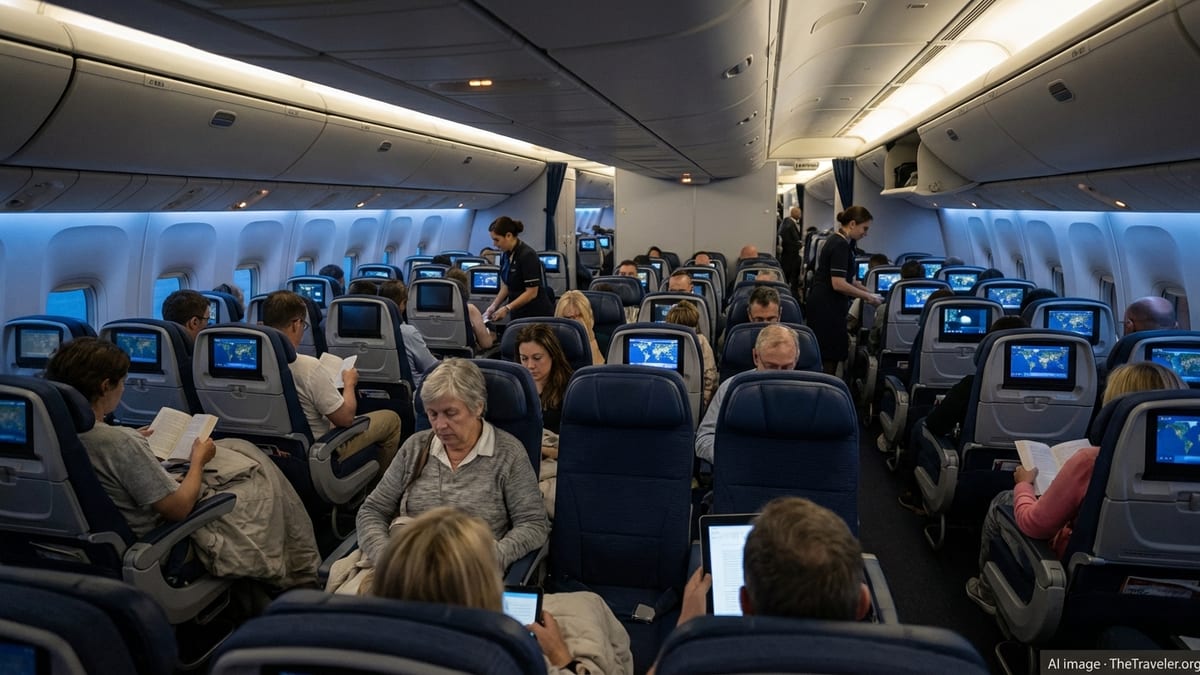
United Airlines crew on a Newark Liberty to Milan Malpensa flight were confronted with an unwelcome surprise this week when they discovered an unmanifested passenger seated among a cluster of empty economy seats. The woman, identified by law enforcement sources as Russian national and U.S. resident Svetlana Dali, had no boarding pass or travel documents, yet had successfully cleared airport controls and joined the overnight service to northern Italy.
According to investigators and airline officials, the discovery was made only after the aircraft had already crossed a significant portion of the Atlantic. With the flight too far along to safely divert back to New Jersey, the captain continued to Milan, where Italian police met the aircraft at the gate and took the suspect into custody. Passengers remained largely unaware of the unfolding drama until after landing, when they were delayed during disembarkation as authorities boarded the jet.
United has confirmed it is reviewing security camera footage and gate procedures at Newark’s Terminal C in cooperation with airport authorities. While the airline has not disclosed operational details, people familiar with the matter say initial checks suggest the stowaway may have blended into the boarding flow of legitimate passengers, echoing tactics used in a previous incident involving the same woman.
The episode has rattled frequent flyers and travel industry analysts, who say it exposes lingering vulnerabilities in airport and airline protocols that rely heavily on layered but human‑dependent checks at multiple points from curbside to cabin door.
United States Investigators Probe Security Lapses
In the United States, the incident has triggered an intensive review by multiple agencies, including the FBI’s Newark office, the Transportation Security Administration and the Port Authority of New York and New Jersey, which operates Newark Liberty International Airport. Officials are seeking to determine precisely where the woman bypassed required document checks and how she entered the sterile area without valid credentials.
Investigators are focusing on several pressure points in the journey from landside concourse to aircraft door, from initial identity verification at the security checkpoint to boarding‑pass scans at the gate and secondary checks carried out by airline staff. Previous court records show that in a 2024 case, the same stowaway was able to walk through a New York boarding gate by merging with a group of ticketed passengers, never being asked to present a pass before stepping onto the jet bridge.
The repeat breach is particularly sensitive because Dali was already under federal supervision following her conviction on an earlier stowaway charge linked to a New York–Paris flight. Her supervised release terms barred her from leaving her judicial district without authorization and required mental health evaluation and treatment. U.S. prosecutors are now weighing additional charges that could include violating probation, new stowaway counts and security‑related offenses tied to the Newark incident.
For U.S. aviation officials, the case is likely to revive questions about whether existing watchlists, behavior‑detection programs and random gate screenings are robust enough to identify non‑traditional security risks, such as repeat offenders who target gaps in human attention rather than relying on forged documents or weapons.
Italian Authorities Balance Security and Legal Complexities
On the Italian side, police at Milan Malpensa quickly moved to detain the stowaway on arrival, transferring her from the aircraft to an airport holding facility for questioning. Under Italian procedures, foreign nationals who enter the country irregularly on commercial flights can face administrative immigration measures as well as possible criminal charges, even when the underlying violation originated abroad.
Officials in Milan are working closely with U.S. counterparts to clarify whether the woman will be prosecuted in Italy, deported, or transferred back to the United States under existing bilateral agreements. Given that the aircraft was U.S.‑operated and departed American soil, legal experts note that primary jurisdiction for any new criminal case is likely to rest with U.S. federal courts, but Italian prosecutors must still process the irregular arrival and any offenses committed on Italian territory.
In the meantime, Italian aviation authorities are examining their own response procedures for in‑flight security irregularities. While the flight departed Newark, Italy’s civil aviation regulator and airport operator are expected to review how information about the stowaway was relayed during the descent and turn‑around, how the aircraft was isolated on arrival, and whether any additional passenger screening measures are warranted for transatlantic services flagged by foreign authorities while en route.
The incident also comes as Italian airports, including Milan Malpensa, are handling steadily rising transatlantic traffic from the United States, heightening scrutiny of how well ground teams are prepared for complex, security‑tinged disruptions that originate thousands of miles away.
Russia Monitors Case of Citizen at Center of Stowaway Saga
With the woman identified as a Russian citizen who had been living legally in the United States, Moscow has been drawn into a case that is as diplomatically delicate as it is unusual. Russian consular officials are expected to seek access to her while she remains in Italian custody, in line with standard practice when nationals are detained abroad.
Although there has been no public statement from Russia’s foreign ministry specifically addressing the latest Newark–Milan episode, earlier legal filings in the Paris case referenced her background and previous work history in Russia. The new arrest places Moscow in the position of monitoring proceedings in two Western jurisdictions at once, while also managing any consular responsibilities tied to her mental health and legal representation.
Diplomatic observers note that aircraft stowaway cases rarely become major flashpoints in international relations, but they can add friction to already complex consular workloads, especially when an individual reoffends across multiple borders. In this instance, Russian, U.S. and Italian officials must coordinate not only on legal status and travel documents, but also on potential repatriation or long‑term residency questions once the criminal and immigration processes run their course.
For the traveler caught in the middle, the immediate consequence is a maze of overlapping legal systems, each with its own view of culpability, mental competency and public safety priorities.
Broader Questions for Global Aviation Security and Travelers
Beyond the headline‑grabbing narrative of a serial stowaway, the Newark–Milan case raises wider concerns for airlines and travelers about the resilience of aviation security in an era of high passenger volumes and staffing strains. Security systems are designed with redundancies, yet this incident suggests that determined individuals who study airport routines can still exploit moments of inattention at crowded gates or checkpoints.
For passengers, the episode may be unsettling, but experts stress that stowaway incidents of this type remain extremely rare compared with the tens of thousands of flights operating daily between North America and Europe. Still, frequent flyers are likely to notice subtle changes in gate procedures on transatlantic routes, such as more rigorous boarding‑pass scans, additional identification checks and closer monitoring of empty seats during taxi and climb‑out.
Industry analysts say regulators in Washington, Rome and other capitals could use the case as a catalyst to revisit how technology is deployed at the last point of contact before boarding. Options range from biometric verification to improved integration between airline reservation systems and security databases, all aimed at ensuring that every person on board matches a verified booking and identity. Such changes, however, must be balanced against privacy concerns and the need to keep boarding flows smooth.
For now, the woman at the center of the saga waits in custody in Italy as three nations debate her legal fate. In airports from Newark to Milan, meanwhile, her unlikely journey is already prompting uncomfortable questions about what it really takes to get on a plane in the 21st century.