

More news on this day
Japan’s opulent Seven Stars in Kyushu luxury sleeper train is emerging as a coveted experience for both domestic and international travelers, reflecting a broader shift toward immersive, slow travel across the country’s southernmost main island.
Get the latest news straight to your inbox!
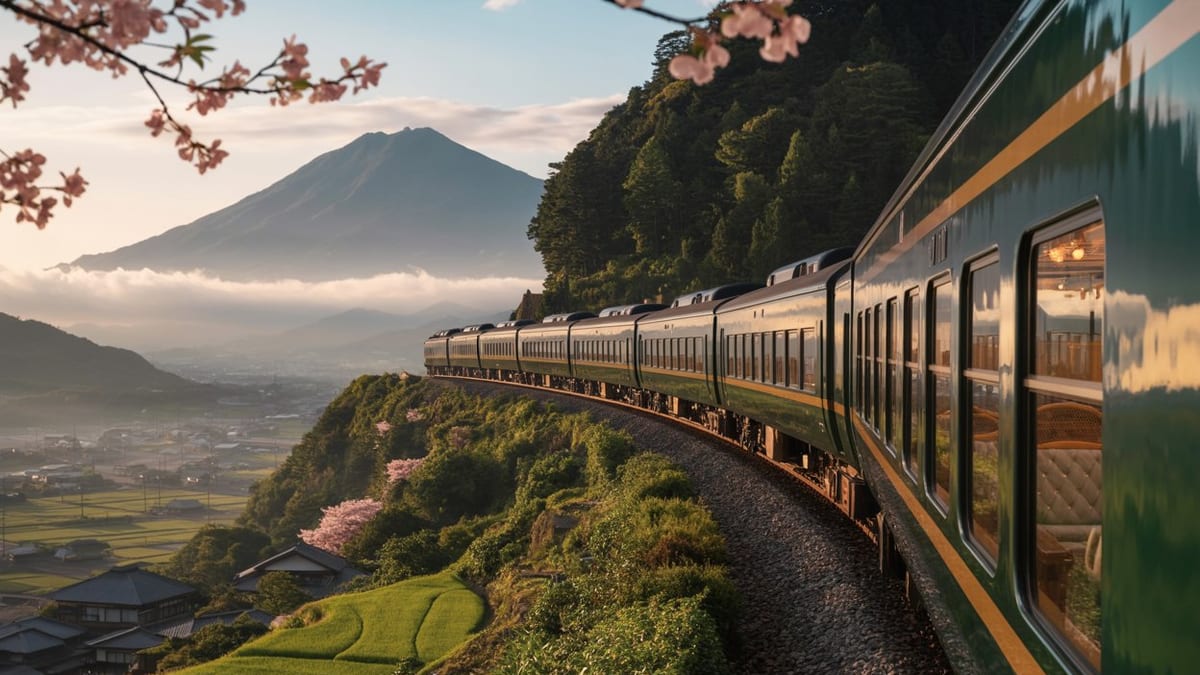
Image by Travel And Tour World
A Boutique Train Riding a Global Luxury Rail Boom
Launched in 2013 as Japan’s first true luxury sleeper train, the Seven Stars in Kyushu was conceived as a rolling showcase of the island’s landscapes, crafts, cuisine and onsen culture. With just seven carriages and 12 suites, the train operates more like an intimate cruise than a conventional rail service, trading speed for multi-day itineraries that loop through Kyushu’s volcanic interiors, coastal plains and hot spring towns.
Travel industry coverage indicates that global demand for upscale rail journeys is rising, and the Seven Stars has become a key Japanese example of this trend. International roundups of high-end trains routinely list the Kyushu service alongside storied names such as the Venice Simplon-Orient-Express, citing its small capacity and curated excursions as drivers of appeal. The train’s limited berths and infrequent departures have also contributed to a perception of scarcity that attracts affluent travelers looking for once-in-a-lifetime experiences.
Reports from specialist tour operators suggest that the Seven Stars increasingly draws a mix of Japanese guests and visitors from North America, Europe and other parts of Asia. Packages that bundle suites on the train with pre- and post-journey stays in Fukuoka, Nagasaki or Kagoshima are marketed as a way to access Kyushu’s lesser-known destinations without navigating complex regional rail timetables. This has positioned the train as both a gateway for first-time visitors and a deeper dive for repeat travelers who have already visited Japan’s major cities.
As international tourism to Japan rebounds, the Kyushu Railway Company and partner agencies appear to be leveraging the train’s exclusivity to tap into a niche segment of high-spend visitors. Publicly available information from reservation services and rail pass documentation underscores that the Seven Stars sits outside standard discount pass schemes, reinforcing its status as a premium, stand-alone product within Japan’s rail ecosystem.
Refined Routes and Elevated Hardware on Kyushu’s Rails
The Seven Stars operates a series of seasonal itineraries, typically ranging from two days and one night to four days and three nights, that circle Kyushu and stop at a rotating set of onsen towns, castle cities and coastal communities. Information published by the Kyushu Tourism Organization notes that routes span all seven prefectures, highlighting themes such as nature, history, food and traditional craftsmanship.
In 2022, the train underwent a significant refurbishment that further sharpened its luxury positioning. According to promotional materials, the renovation added and refreshed shared spaces including a salon, tea room, boutique and bar, while updating cabin interiors with new finishes by regional artisans. The restructuring of public areas is designed to facilitate more interaction between guests and staff, with a focus on curated dining and lounge experiences while the train traverses Kyushu’s interior.
The rolling stock itself has become a visual symbol for high-end Japanese rail. Photography circulated in media coverage shows deep burgundy carriages with panoramic windows, wood-paneled interiors and brass details that contrast sharply with the minimalist design of the country’s shinkansen. The train is hauled by a dedicated locomotive on JR Kyushu’s network, emphasizing the service’s status as a self-contained rail cruise rather than a standard sleeper operating on regular timetables.
Recent operational notices on the official Seven Stars site outline periodic suspensions, route adjustments and new journey announcements through 2026, reflecting the complexity of running a cruise-style product on shared infrastructure. Applications for future seasons are opened in defined windows several months in advance, signaling to prospective travelers that planning needs to begin early, particularly for the longer itineraries that combine on-board nights with stays at ryokan and resort properties en route.
From Lottery Applications to Global Distribution
One of the defining characteristics of the Seven Stars experience has been its application-based booking system. For many departures, would-be passengers submit entry forms and are selected by lottery, a process that was originally aimed at managing intense domestic demand when the service debuted. Travel trade documents and third-party operator descriptions indicate that this framework remains in place for a substantial portion of the schedule, especially for peak seasons.
At the same time, JR Kyushu has gradually opened select departures to charter arrangements with domestic and overseas travel companies. Materials prepared for agents describe how certain dates are sold exclusively as full-train charters, allowing tour operators to package the journey with international flights, city tours and pre- or post-cruise hotel stays. This hybrid approach enables the railway to maintain its lottery system for individual Japanese applicants while also guaranteeing blocks of inventory for foreign markets.
Several specialist rail and luxury travel firms now promote Seven Stars departures into 2026, often highlighting specific themed routes, such as itineraries that include volcanic landscapes, Unzen hot spring stays or private stargazing options at scenic mountain passes. These offerings are pitched not only to rail enthusiasts but also to travelers who might otherwise gravitate toward luxury cruises or boutique countryside resorts.
The structure of bookings underscores how far the train sits from ordinary rail products. Publicly available FAQs for JR Kyushu’s online reservation systems and regional rail passes specify that discount passes cannot be used on the Seven Stars, and seats are not sold through the everyday ticketing channels used for limited express trains. For travel planners and tourists, this means the train must be treated as a separate, all-inclusive trip rather than an add-on to a standard Kyushu rail itinerary.
Showcasing Kyushu’s Regional Revival and Cool Japan Appeal
Beyond its onboard amenities, the Seven Stars has become a symbol of regional regeneration and cultural branding for Kyushu. The train’s name references the island’s seven prefectures and seven thematic pillars, including nature, history, onsen, food and what marketing materials describe as “humanity” and “trains.” Excursions off the train frequently focus on small communities, artisans and local gastronomy, positioning the service as a high-profile conduit between visitors and rural economies.
Recent recognition has further cemented the train’s status in Japan’s broader tourism strategy. In September 2025, JR Kyushu announced that the Seven Stars received a Cool Japan Award for 2025, an accolade aimed at highlighting attractions with strong international appeal. A company notice stated that the award was tied to efforts to promote inbound tourism and support local economies, signaling official interest in leveraging the train’s visibility beyond Japan.
Travel promotion materials describe how guests disembark for guided visits to towns known for ceramics, preserved samurai districts and coastal shrines, before rejoining the train for multi-course dinners that spotlight Kyushu-sourced ingredients. By combining these stops with high-profile branding abroad, the service effectively turns each departure into a moving showcase for craftspeople, farmers and hot spring operators who might otherwise struggle to reach international audiences.
Regional tourism organizations have increasingly framed the Seven Stars as a flagship experience that complements more accessible sightseeing trains and rail passes across Kyushu. In this narrative, the luxury sleeper functions as a top-tier product that draws global attention, encouraging travelers to explore other design-focused trains and local routes that are easier to book and more affordable, thereby spreading the benefits of rising visitor numbers more widely across the island.
Slow Travel, High Prices and Rising Expectations
While exact fare structures vary by itinerary and season, listings from tour operators and rail specialists consistently place the Seven Stars among the most expensive train journeys in Asia. Multi-day packages that include suite accommodation, dining and excursions are typically priced at a level comparable to high-end ocean cruises or extended stays in five-star urban hotels. The cost, combined with limited availability, has led some commentators to characterize the journey as a bucket-list item rather than a repeatable holiday.
Despite the high entry point, demand appears resilient. Media reports and operator notes emphasize that departures often fill quickly once application periods open, with waiting lists common for peak cherry blossom and autumn foliage seasons. The refurbishment in 2022 and the continual tweaking of routes suggest that JR Kyushu is acutely aware that luxury travelers expect both physical comfort and evolving storytelling, particularly as comparative products emerge elsewhere in Japan and across Asia.
Observers of global rail trends point out that the Seven Stars embodies a broader movement in which trains serve as destinations in their own right rather than mere transport between cities. For time-poor but spending-ready visitors flying into Fukuoka or connecting from Tokyo, a three- or four-day rail cruise offers a curated immersion into Kyushu that might otherwise take weeks of independent travel to replicate.
As Japan looks to balance record visitor numbers with regional revitalization and sustainable tourism practices, the Seven Stars in Kyushu is likely to remain a closely watched case study. Its ability to draw both Japanese and overseas guests onto longer, slower itineraries across a single island illustrates how luxury rail can function as both a revenue generator and a cultural ambassador within an increasingly competitive global travel market.