

More news on this day
Thousands of motorists faced gridlock in Cambridgeshire after a serious disruption on the A1 near Alconbury left long stretches of the key north south route barely moving, triggering knock on delays across the region’s commuter network.
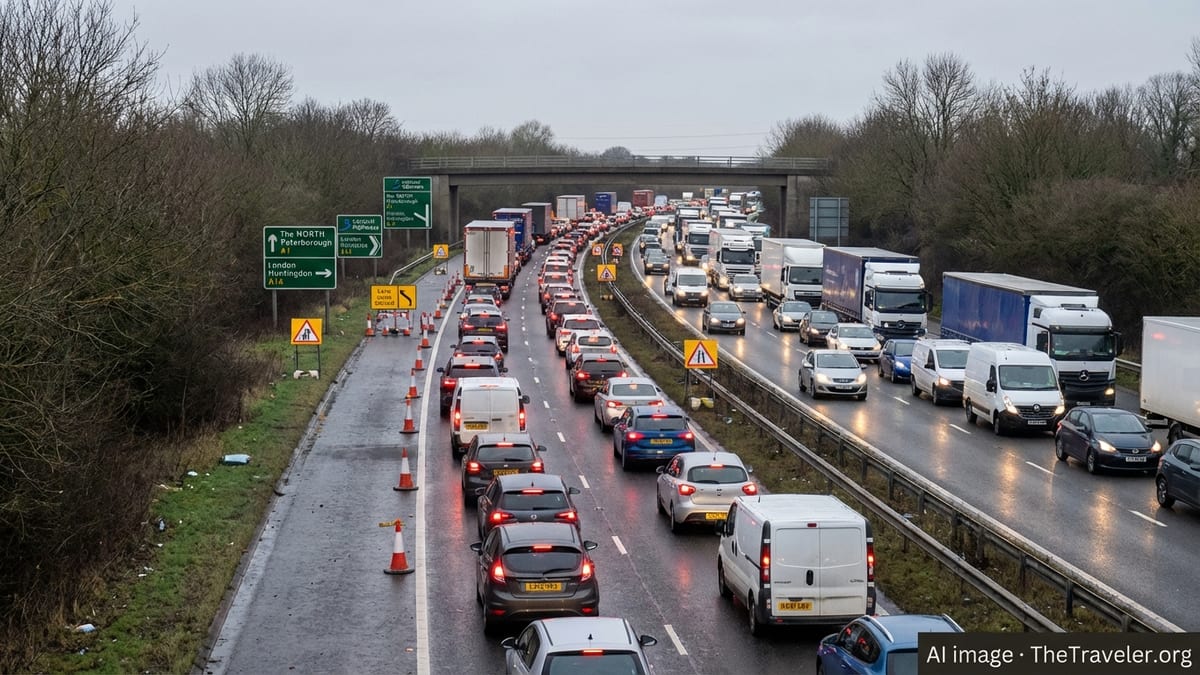
Major Artery Brought to a Crawl Near Alconbury
Morning peak traffic on the A1 around Alconbury slowed to a crawl as lane closures and emergency works forced vehicles into narrow running lanes and lengthy contraflows. Drivers reported standstill conditions for several miles in both directions, with journey times between Peterborough, Huntingdon and St Neots stretching well beyond normal rush hour peaks.
The disruption struck on one of the busiest stretches of trunk road in eastern England, where the A1, A1(M) and local access roads converge close to Alconbury and the rapidly expanding Alconbury Weald development. Long distance freight heading between London, the Midlands and the North was caught alongside commuter traffic, amplifying the scale of the delays.
National and local traffic monitoring services recorded speeds dropping to single figures at key pinch points, while slip roads onto the A1 backed up towards village junctions. Some motorists abandoned satellite navigation guidance entirely, turning off onto local lanes in an attempt to escape the congestion.
Lane Closures, Diversions and Ongoing Works
The severe delays were compounded by existing traffic management in the area, where a series of temporary orders and works have already been constraining capacity. A temporary prohibition of through traffic on the B1043 over the A1 between the eastern and western roundabouts at Alconbury has been in place to facilitate bridge maintenance, diverting local movements onto alternative routes and increasing pressure on the main carriageway.
At the same time, wider construction programmes on the regional network, including improvements linked to the A428 and connections towards the A421 and A14, have introduced overnight and weekend closures, reduced speed limits and narrowed lanes. While scheduled closures are typically advertised in advance, unplanned incidents during these work periods can quickly push the network beyond its limits, as drivers vie for limited road space.
On the A1 itself, a combination of coned off sections, reduced speed limits and intermittent closures of entry and exit slips disrupted the usual rhythm of traffic joining and leaving the mainline. HGV drivers travelling under tight delivery windows found themselves held for extended periods, while coach operators reported difficulty maintaining timetables for early morning services into Cambridge and London.
Local Villages Bear the Brunt of Diverted Traffic
As congestion intensified on the A1 near Alconbury, satnav systems began directing frustrated motorists through a web of local roads including Alconbury Hill, Alconbury Weston, Vinegar Hill and the Great North Road. These routes, formally identified in diversion orders as suitable alternatives for certain closures, quickly became overloaded once large numbers of additional drivers sought to use them simultaneously.
Residents in Alconbury, Alconbury Weston and nearby hamlets reported continuous streams of heavy lorries and commuter traffic passing within metres of front doors. Narrow bends, parked cars and school run activity combined to create tense encounters between local users and diverted through traffic, with some villagers taking to social media to warn others away from shortcutting through the area.
Local authorities have previously worked with National Highways to agree formal diversion corridors designed to keep most traffic on major A roads. However, when delays stretch well beyond official expectations, drivers often ignore signed routes in favour of what navigation apps suggest in real time, pushing vehicles down minor roads never built for sustained heavy volumes.
Commuters, Freight and Businesses Count the Cost
For regular commuters between towns such as Huntingdon, St Neots, Peterborough and the logistics parks around Alconbury Weald, the morning’s disruption meant missed meetings, delayed shift changes and rearranged childcare. With many workers now splitting time between home and office, days that require a physical presence can be particularly sensitive to long unplanned delays.
Freight operators reported drivers reaching legal driving time limits while still trapped in queues, forcing unplanned rest breaks and missed onward connections. On corridors like the A1, where haulage firms already face tight margins and rising fuel and maintenance costs, every additional hour stuck in congestion adds directly to operating expenses.
Recent surveys of road users along other busy sections of the A1 have highlighted widespread concerns about congestion, accident risk and poor surface conditions, with a significant proportion of respondents saying they actively avoid the route where possible. For businesses relying on just in time deliveries and regional distribution hubs, unpredictable disruption near Alconbury reinforces perceptions that this key north south spine lacks the resilience expected of a strategic route.
Safety Concerns on a Stressed Strategic Route
The A1 has long been regarded by campaigners, motoring organisations and regional leaders as a route where capacity constraints and inconsistent standards increase collision risks, particularly where dual carriageway sections narrow abruptly, junction designs are outdated or temporary roadworks alter familiar layouts. Recent years have seen repeated calls for further dualling, better junction treatments and reviews of speed limits along single carriageway stretches.
In the Alconbury area, where the A1 interfaces with the A14 corridor and local routes serving expanding housing and employment sites, any prolonged disruption can quickly lead to risky driver behaviour. Reports from motorists during the latest delays described vehicles attempting late lane changes near closed off slip roads, HGVs queuing on hard shoulders and impatient drivers seeking to weave between queues at low speed.
Local councillors and road safety advocates have previously highlighted that when major works and maintenance coincide with peak traffic, the buffer that normally absorbs minor incidents disappears. Even a modest breakdown or shunt in lane can then trigger rapid deterioration from slow moving traffic to gridlock, lengthening the time emergency responders need to reach the scene and clear obstructions.
Regional Growth Colliding With Infrastructure Limits
The corridor around Alconbury is at the centre of one of Cambridgeshire’s most ambitious growth areas, with the new community at Alconbury Weald steadily expanding and new road connections, including a southern link road to Huntingdon and the A141, progressing in phases. These schemes are intended to take pressure off older junctions, create more direct access to employment zones and redistribute traffic that currently must funnel through a small number of constrained pinch points.
However, construction itself inevitably generates temporary disruption, with plant movements, lane closures and new tie ins to existing carriageways all requiring carefully planned traffic management. While planners stress that the long term effect will be a more resilient network, drivers caught in the latest delays near Alconbury experienced the short term reality of building major infrastructure in a corridor that is already heavily used.
Local business groups have broadly welcomed investment in the area’s road network but continue to warn that phasing and coordination are crucial. With works also occurring on parallel east west routes such as the A428 and A421 at various points, any lack of alignment between projects can leave drivers facing consecutive pinch points, multiplying the impact of each individual closure or restriction.
Authorities Urge Drivers to Check Before Travelling
Transport authorities and police units responsible for the Alconbury stretch of the A1 repeatedly urge drivers to check live travel information before setting off, particularly when journeys cannot easily be rescheduled. On days when scheduled works coincide with poor weather or earlier incidents, congestion can build far earlier than usual and remain well beyond the morning peak period.
Official guidance typically advises allowing additional time, sticking to signed diversion routes and avoiding sudden manoeuvres in and out of queues. Motorists are reminded not to use hard shoulders unless directed by police or traffic officers, and to leave clear access for emergency vehicles even when traffic is barely moving. Patience and adherence to lower temporary speed limits are emphasised as key to keeping traffic flowing and reducing the risk of secondary collisions.
Commuters in the region are increasingly turning to flexible working arrangements to absorb the risk that days like this present. Some employers have put in place policies that allow staff delayed by major incidents on trunk roads to work remotely at short notice, while transport planners argue that sustained investment in rail and bus alternatives is needed to reduce dependence on the A1 for everyday travel.
Longer Term Questions Over A1 Reliability
The latest disruption near Alconbury is likely to sharpen questions over the long term reliability of the A1 as one of Britain’s most important road corridors. While sections in Cambridgeshire and further south have benefitted from capacity enhancements in recent years, drivers and regional leaders argue that the route remains a patchwork of standards that struggles to cope with modern volumes of commuter and freight traffic.
Data from recent years has shown hundreds of full and partial closures across various stretches of the A1 due to collisions, breakdowns and weather related incidents, often resulting in lengthy diversions and unplanned overnight disruption. Each new major incident reinforces calls from councils, business groups and safety campaigners for a more comprehensive approach to upgrading the route, rather than piecemeal fixes focused on individual black spots.
For now, motorists using the corridor around Alconbury must contend with a period in which essential works, growing local development and everyday traffic all interact on infrastructure originally designed for far lower volumes. As the latest severe delays show, when any part of that system falters, the consequences can ripple quickly from one end of the region to the other, turning a routine commute into an arduous, hours long ordeal.