

More news on this day
Powerful super-cell thunderstorms over Central Texas have violently disrupted operations at Austin-Bergstrom International Airport, triggering widespread delays and cancellations across several major airlines and adding fresh strain to an already fragile U.S. air travel system.
Get the latest news straight to your inbox!
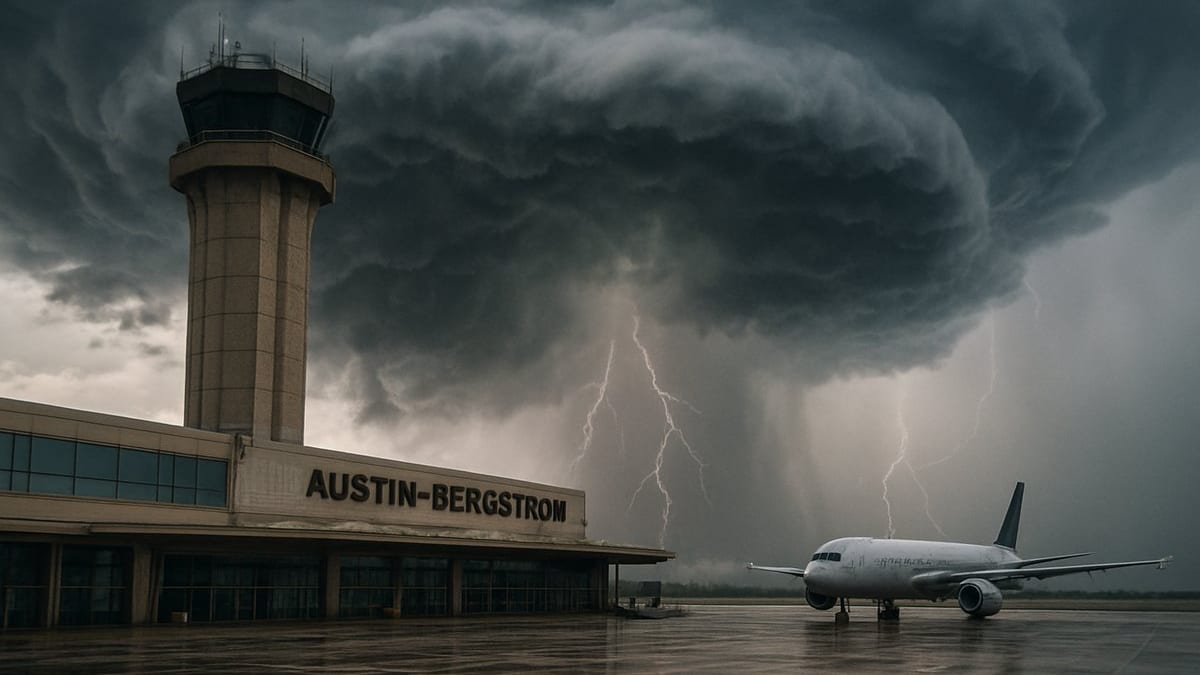
Super-Cells Sweep Central Texas and Close In on AUS
Publicly available radar and forecast data for early April show a volatile storm complex parked over Central Texas, with repeated bands of intense thunderstorms, lightning and localized flooding affecting the Austin area. Meteorological summaries for the first week of April describe a multi-day severe weather episode across the region, with a risk profile that includes damaging winds, hail and reduced visibility, all of which sharply constrain airport operations.
Federal aviation status updates list Austin-Bergstrom as experiencing significant weather impacts, with periods of ground delay programs and flow restrictions as storms move directly across arrival and departure corridors. These conditions limit the number of aircraft controllers can safely move per hour, forcing airlines to stack holding patterns, slow turnarounds on the ground and repeatedly retime departures.
The disruption has arrived just as Austin-Bergstrom is adjusting to a major operational change: the permanent closure of its South Terminal on March 31 and the consolidation of all commercial traffic into the main Barbara Jordan Terminal from April 1. Airport information notes that this transition concentrates all carriers on a single set of gates and taxiways, increasing the sensitivity of the airport’s schedule to any weather-related slowdown.
Regional transport bulletins indicate that the same super-storm system has also produced hazardous driving conditions around Austin, further complicating passenger access to the airport and slowing the movement of ground crews and support staff during peak disruption periods.
Mega-Airlines Hit as Ripple Effects Spread Nationwide
Industry tracking data compiled for early April show that flight disruption is not limited to Austin, but that Austin-Bergstrom has become a key pressure point on the wider network. Nationwide tallies for April 3 report hundreds of cancellations and several thousand delays, with activity at Austin and other Texas hubs featuring prominently among the most affected locations.
Reports from aviation analytics firms and travel outlets indicate that large network carriers such as American Airlines, United Airlines and Delta Air Lines, along with major low-cost operators including Southwest and Frontier, have all logged substantial delays and targeted cancellations linked in part to the Central Texas storms. When a line of severe weather repeatedly crosses a busy corridor like Austin, those carriers often preemptively thin schedules or hold aircraft away from the worst conditions to avoid diversions and stranded jets.
Travel-industry coverage describing performance across the first days of April points to a familiar pattern: afternoon and evening banks into and out of Texas hubs are particularly vulnerable, as earlier storm-related delays cascade into missed connections and crew time-limit issues later in the day. Austin, which has rapidly grown into a significant spoke for several airlines and a focus city for others, appears in these reports as both a source and a victim of those knock-on effects.
Network diagrams published in recent airline and airport briefings underscore how a snarled Austin rotation can reverberate into cities as far apart as Chicago, Los Angeles, Orlando and New York, as aircraft and crew that were due to position through Central Texas instead sit on the ground waiting for a safe weather window.
Inside the Passenger Experience at a Choked Airport
Social media posts and traveler forums from the past several days depict crowded concourses, long security lines and snaking customer service queues at Austin-Bergstrom as storms pulse across the region. Flyers recount last-minute cancellations, rolling departure estimates and gate changes as airlines try to reshuffle limited takeoff and landing slots around the most intense weather cells.
Information shared by local travelers suggests that some carriers have leaned more heavily on proactive cancellations from Austin than others, trimming schedules early in the day to preserve aircraft and crew where possible. In many cases, passengers report same-day rebookings through alternative hubs in Dallas, Houston or Phoenix, while others describe overnight stays and multi-leg routings that turn a short hop into a cross-country odyssey.
Published guidance from consumer advocates emphasizes that when storms are the primary cause of disruption, U.S. regulations do not require airlines to provide hotel vouchers or meal compensation. However, many passengers at Austin-Bergstrom report being offered travel credits, waived change fees or standby options on earlier flights once weather conditions improve, reflecting the voluntary customer service commitments that major airlines have publicized since previous high-profile meltdowns.
Airport-facing updates indicate that staff have been working to manage crowding by redirecting travelers between checkpoints and encouraging the use of mobile boarding passes, but reports also describe intermittent congestion around baggage claim as delayed inbound flights arrive in quick succession once ground stops lift.
Storm Season, Structural Strain and the Broader Aviation Picture
Context from national aviation coverage suggests that the chaos in Austin is part of a wider pattern in 2026, as U.S. airlines confront the intersection of strong passenger demand, staffing challenges and increasingly volatile weather. Analyses released in recent weeks describe a system still adjusting to earlier winter storms, February airspace restrictions in parts of Texas and New Mexico, and a series of severe-weather outbreaks in March that already stretched crew and fleet resources.
Sector reports on carrier performance highlight that when multiple hubs are buffeted in quick succession, buffers built into schedules and staffing can erode rapidly. Airlines then have less resilience when a fresh wave of storms, such as the current Central Texas super-cells, sweeps into a busy region like Austin. From that perspective, the latest disruption at Austin-Bergstrom is both a local weather story and a symptom of a national network under sustained pressure.
Climate and catastrophe summaries for early 2026 describe an active pattern of severe convective storms across the central United States, including several early-spring events that produced high winds, large hail and flooding. Experts cited in those publications note that such episodes complicate planning for both airports and airlines, because the timing and intensity of storms can change rapidly even within a single day.
For travelers, the result is a heightened sense of fragility in air itineraries that touch weather-prone regions. The Central Texas storms now choking operations at Austin-Bergstrom illustrate how a single regional outbreak can upend flight plans for passengers scattered across the country, and how quickly a modern mega-airline network can seize up when one of its key nodes is battered by the sky.