

More news on this day
Hundreds of travellers across Brazil have faced missed connections and overnight airport stays after a wave of delays and cancellations hit São Paulo’s Congonhas and Guarulhos airports, as well as Porto Alegre’s Salgado Filho, disrupting operations for LATAM, GOL, Azul, VOEPASS and other carriers.
Get the latest news straight to your inbox!
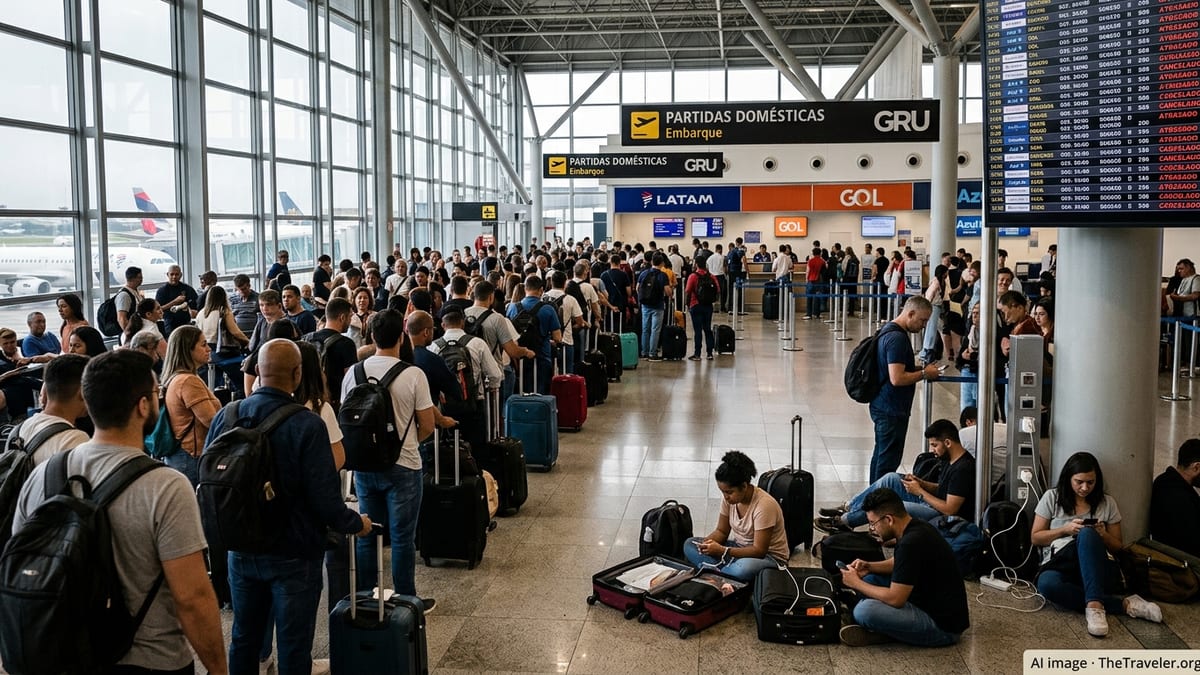
Widespread Disruptions at São Paulo and Porto Alegre Hubs
Recent operational data and local media coverage indicate that a combined total of 76 delayed flights and 23 cancellations have rippled through São Paulo-Congonhas, São Paulo-Guarulhos and Porto Alegre’s Salgado Filho airports, leaving passengers facing long waits, missed connections and unexpected diversions. The disruptions have primarily affected Brazil’s largest domestic carriers, including LATAM, GOL and Azul, with regional operator VOEPASS and several smaller airlines also seeing knock-on schedule problems.
The impact has been felt most acutely on heavily trafficked domestic routes linking São Paulo with cities in the south and northeast, where tight turnarounds and high load factors leave airlines with limited room to recover when weather or air traffic management constraints occur. Publicly available information from Brazil’s air navigation and airport monitoring platforms shows elevated levels of departure and arrival delays at both Congonhas and Guarulhos over the affected period, along with clusters of cancellations at peak times when runway and airspace capacity are under the greatest pressure.
At Porto Alegre’s Salgado Filho, the situation has been compounded by ongoing capacity constraints in Brazil’s southern corridor, where seasonal weather patterns can quickly disrupt carefully balanced schedules. Travellers on routes connecting Porto Alegre to São Paulo, Campinas and Brasília have reported missed onward connections and extended waits for rebooking as airlines struggled to absorb displaced passengers into already busy services.
Weather, Airspace Congestion and Knock-on Operational Challenges
Reporting from Brazilian aviation outlets points to a mix of adverse weather around São Paulo, temporary flow restrictions in the country’s busiest airspace, and aircraft rotation challenges as key contributors to the latest wave of disruption. When storms or low visibility affect Guarulhos and Congonhas, controllers often impose tighter separation and holding patterns, reducing the number of arrivals and departures that can be safely handled each hour. That quickly cascades across domestic networks, especially for carriers that rely on São Paulo as a central hub.
Operational statistics published by Brazil’s air traffic management authorities show that routes linking Congonhas and Guarulhos to major domestic destinations are particularly sensitive to such constraints, with on-time performance dipping whenever there are strong seasonal weather systems or infrastructure works near runways and taxiways. As aircraft and crews arrive late into São Paulo, subsequent departures are pushed back, and airlines face difficult choices about which services to delay and which to cancel outright in order to restore some stability to the timetable.
The situation in Porto Alegre has also been influenced by localized weather and capacity issues. When Salgado Filho temporarily restricts operations due to reduced visibility or heavy rainfall, aircraft may be held at origin airports or rerouted to alternates, triggering further delays as airlines reposition planes and crews. Those adjustments can take hours to ripple through the system, leaving stranded travellers uncertain about when they will continue their journeys.
LATAM, GOL, Azul and VOEPASS Routes Under Strain
Network maps and schedule data illustrate how closely Brazil’s major airlines are intertwined with São Paulo’s two main airports, making them particularly vulnerable when either Congonhas or Guarulhos experiences disruption. LATAM concentrates a large share of its domestic and international operations at Guarulhos, while GOL and Azul rely heavily on shuttle-style services that feed São Paulo from regional capitals such as Porto Alegre, Curitiba and Belo Horizonte. VOEPASS, though smaller, operates regional links that connect with these larger carriers through codeshare and interline arrangements.
When departures from Congonhas or Guarulhos run late, travellers on connecting itineraries frequently find themselves misaligned with onward flights, especially where they must change airports within the São Paulo metropolitan area. Recent traveller accounts shared on public forums describe cases where flights from Porto Alegre to Guarulhos diverted to Campinas due to weather, adding several hours to journeys and causing passengers to miss long-haul departures. Others report that tight domestic-to-international connections at Guarulhos became unworkable once initial legs on LATAM, GOL or Azul departed even slightly behind schedule.
The situation is especially challenging for travellers relying on regional links operated by VOEPASS and other smaller airlines, which often run with lower frequencies. When a single rotation is significantly delayed or cancelled, re-accommodating passengers can require rerouting via multiple hubs or overnight stays, particularly when alternative departures are already close to full at busy times of year.
Stranded Travellers Face Long Queues and Costly Workarounds
Accounts posted by passengers on Brazilian and international travel forums describe crowded check-in halls, long queues at airline service desks and difficulty accessing timely information about new departure times. Travellers report spending several hours in terminals at Congonhas, Guarulhos and Salgado Filho while awaiting rebooking, with some opting to purchase last-minute tickets on competing carriers or arrange intercity transfers by bus or rideshare to salvage their travel plans.
Those with separate tickets or complex self-connected itineraries have been particularly exposed. Publicly shared experiences include examples of travellers arriving late into Guarulhos on domestic flights only to miss independently booked onward services, with limited support available beyond standard change fees and fare differences. Others recount paying out of pocket for hotel nights near the airports when evening cancellations left no feasible same-day alternatives to reach their final destinations.
For international visitors unfamiliar with Brazil’s airport geography, the interplay between São Paulo’s two principal airports is an added complication. Several recent posts highlight confusion when disrupted itineraries were rebooked into the “wrong” São Paulo airport for onward connections, requiring passengers to traverse the city’s congested highways at their own expense and risk missing further flights.
What Travellers Can Expect in the Coming Days
Operational bulletins and recent performance trends suggest that airlines are gradually working through the backlog created by the cluster of delays and cancellations. However, with São Paulo and Porto Alegre both entering periods of seasonally unstable weather and high demand, travellers can expect schedules to remain sensitive to further disruptions in the short term.
Consumer advocates and travel commentators in Brazil are advising passengers to build longer connection windows at São Paulo’s airports, particularly when combining domestic and international segments, and to avoid tight cross-airport transfers between Congonhas and Guarulhos where possible. Flexible ticket options, including same-day flight changes and protected connections on a single booking reference, are being highlighted as valuable safeguards when operational reliability is under pressure.
Publicly available guidance from aviation authorities also continues to stress the importance of monitoring flight status closely through airline channels on the day of travel, arriving early for departures out of Congonhas, Guarulhos and Salgado Filho, and preparing for possible last-minute gate changes or reassignments. While the immediate wave of disruption is expected to ease, Brazil’s busiest air corridors remain prone to sudden bottlenecks, and travellers passing through São Paulo and Porto Alegre are being urged to plan with extra caution.