

More news on this day
Southwest Florida International Airport, a crucial gateway for winter snowbirds and spring break visitors, is experiencing severe disruption as a convergence of bad weather, network congestion, and seasonal demand turns routine departures into a test of patience.
Get the latest news straight to your inbox!
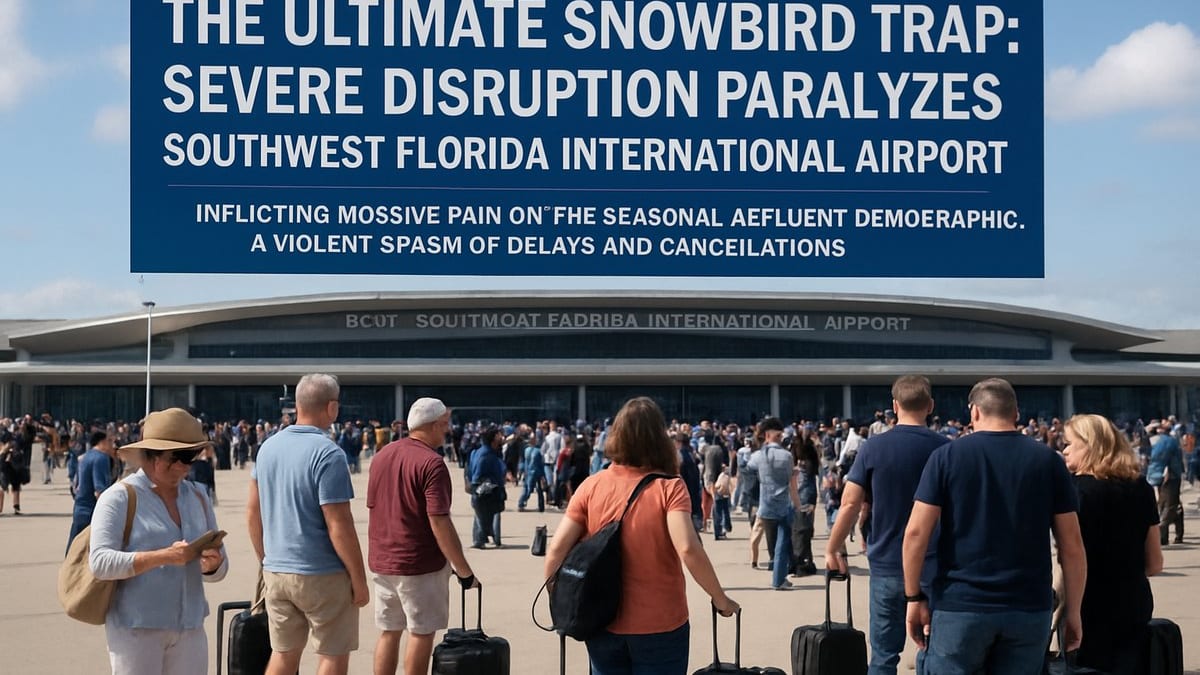
Peak Season Meets a Fragile National Network
The disruption at Southwest Florida International Airport, known by its code RSW, comes at the height of the winter and early spring travel season, when snowbirds from northern states traditionally flood into Lee County and surrounding Gulf Coast communities. Planning documents for the airport show that March represents its true peak month, with April remaining among the busiest periods for departures and arrivals.
Nationally, the U.S. aviation system has been under strain through late March and early April 2026, with multiple large weather events triggering thousands of delays and hundreds of cancellations across major hubs. Reports indicate that severe thunderstorms, regional flooding, and lingering winter systems have repeatedly forced airlines to slow or halt operations, clogging schedules at airports from Chicago and Boston to Miami and San Francisco.
Those upstream problems are now rippling into Fort Myers. When flights into RSW are delayed or cancelled at origin airports, aircraft and crews arrive late or not at all, compressing departure banks and forcing passengers into crowded gate areas and long rebooking lines. For many travelers who chose Southwest Florida precisely to escape northern snow and ice, the resulting tarmac waits and rolling delays have become an unwelcome reminder that disruption can follow them south.
Publicly available performance data and industry coverage suggest that U.S. carriers are attempting to operate many flights rather than canceling outright, leading to a higher proportion of long delays. For passengers at RSW, that often translates to hours spent in the terminal, watching departure boards shuffle as crews and aircraft struggle to reconnect with their scheduled rotations.
Ground Delays, Cancellations and Hours in the Terminal
Travel reporting over the past two weeks shows significant spikes in delays and cancellations across Florida, including at airports serving Palm Beach and Miami. While some hubs have borne the brunt of storms and system chokepoints, secondary airports have not been spared from the knock-on effects. RSW’s role as a heavily seasonal facility makes it particularly vulnerable when the broader network falters, because a large share of its flights operate in tight waves timed to leisure travel patterns.
Passengers departing Fort Myers in recent days have faced a familiar set of obstacles: long check in lines as early morning cancellations push travelers into later departures, security queues that swell unpredictably, and gate holds while crews wait for weather or air traffic clearance along crowded routes. Online wait time trackers that normally describe RSW as a relatively efficient airport during off peak hours have flagged the need for extra buffer during the January through April period, when snowbird demand surges.
Unlike larger hubs with multiple runways and extensive spare capacity, RSW has limited room to recover when several flights are delayed at once. A bank of late arriving aircraft can quickly overwhelm available gates, forcing carriers to stagger boarding or keep planes parked on remote stands. Each additional delay further compresses the evening schedule, heightening the risk that late night departures will miss crew duty time windows and be scrubbed entirely.
For travelers attempting to connect onward from Fort Myers, the impact can be even more severe. Missed connections at distant hubs often mean overnight stays and lost vacation or work days, particularly on popular snowbird routes where remaining seats sell out quickly. Reports from national travel outlets emphasize that many passengers across the country are finding rebooking options limited, with some being pushed several days into the future during the heaviest disruption periods.
TSA Bottlenecks and Security Concerns Add to the Squeeze
The current disruption is unfolding against a backdrop of wider pressure on the U.S. aviation workforce and federal security apparatus. Recent local coverage has highlighted the deployment of additional immigration enforcement personnel at RSW, underscoring the airport’s role as a point of entry as well as a domestic gateway. At the same time, national debate continues over staffing levels, pay and morale across the transportation security and air traffic control systems.
Security wait time services that aggregate public data for RSW show that lines can swing from relatively short to unexpectedly long during peak afternoon and early evening periods. During the busy winter and early spring months, these tools advise passengers to arrive well ahead of the standard two hour domestic guideline, particularly on Fridays and Mondays when snowbirds and vacationers are most likely to be flying.
Layered on top of weather related flight delays, even modest slowdowns at security become another point of friction. A passenger who planned around a normal thirty minute checkpoint experience can suddenly find that an extra twenty minutes in line is the difference between making a delayed flight or arriving just as the boarding door closes. As more travelers build in larger margins of error, the terminal fills earlier in the day, putting additional strain on concessions, seating and restroom capacity.
Publicly available airport master plan documents and regional tourism reports make clear that local planners anticipated strong growth in traffic for the 2025 to 2026 period, driven largely by leisure visitors. However, the current wave of national disruption suggests that infrastructure and staffing improvements have not fully kept pace with the demands of a hyper seasonal market that relies heavily on a stressed national aviation network.
Snowbirds Caught Between Climate and Capacity
Southwest Florida’s appeal to snowbirds has long rested on a simple promise: predictable warmth, easy beach access, and a relatively straightforward flight from northern cities. In recent years, however, that promise has come under pressure as both climate volatility and aviation capacity constraints reshape the travel experience. Historic winter storms and severe thunderstorms have repeatedly snarled air traffic along east coast and Midwest corridors that feed into RSW’s schedule.
Climate related extremes are increasingly cited in travel analyses as a background factor contributing to more frequent and longer disruptions. Even when Southwest Florida itself is sunny and calm, storms over connecting hubs can force large scale rerouting, ground stops and crew reassignments. For a seasonal airport where nearly a quarter of annual operations can be concentrated into just a few months, these shocks arrive precisely when the system is least able to absorb them.
The result is a sense among many regular visitors that reaching winter homes along the Gulf Coast has become more uncertain, even as ticket prices and ancillary fees rise. Commenters in travel forums and snowbird communities describe building in extra days at the start and end of trips to hedge against disruption, treating flight schedules as aspirational rather than fixed.
For local tourism businesses, these patterns are a mixed blessing. Extended stays can mean more spending in hotels, restaurants and rental properties, but last minute cancellations or shortened visits hurt revenue and complicate staffing. Regional marketing reports continue to position RSW as the dominant gateway for overnight visitors to the Fort Myers area, yet the airport’s dependence on a fragile national system leaves it exposed whenever weather or operational issues flare elsewhere.
What Travelers Can Do Right Now
With the current disruption wave still unfolding across the United States, travel experts and airline tracking services are emphasizing preparation and flexibility for anyone flying through RSW in the coming days. Common recommendations include booking the earliest possible departure of the day, when aircraft and crews are more likely to be in position, and avoiding tight connections that leave little margin for delay.
Monitoring flight status frequently through airline apps and airport information boards has become an essential habit rather than an optional precaution. When cascading delays build through the afternoon and evening, carriers may introduce rolling schedule changes, swap aircraft types or consolidate lightly booked flights. Passengers who act quickly often secure the few remaining seats on alternate departures.
Another key piece of advice is to allow significantly more time at the airport than in previous years, particularly during the January to April high season. For RSW, that may mean arriving at least two and a half to three hours before departure, especially on peak travel days when both security and check in counters are under strain. Travelers with checked baggage should factor in additional time to navigate parking, shuttle transfers and terminal congestion.
As the 2025 to 2026 snowbird season enters its final stretch, Southwest Florida International Airport remains both an indispensable link and a potential choke point. Until the broader national aviation system stabilizes, those chasing the winter sun to Fort Myers may find that the most challenging part of their trip is not the weather at home, but the gauntlet of delays and disruptions waiting at the airport that serves as their lifeline to the Gulf Coast.