

More news on this day
Travelers across the United States faced extensive disruption as flight operations at Nashville International Airport experienced significant delays and cancellations, with reports indicating around 300 delayed departures and arrivals and roughly 100 flights canceled, affecting connections to Chicago, New York, Los Angeles and other major hubs.
Get the latest news straight to your inbox!
Weather System and Operational Strains Converge on Nashville
Publicly available information indicates that the latest disruption at Nashville International Airport coincides with a powerful late-winter storm system sweeping across large parts of the United States. Recent meteorological analyses describe a far-reaching storm complex bringing heavy snow, severe thunderstorms and high winds to multiple regions, conditions that typically force airports to slow operations, space out takeoffs and landings and, in some cases, temporarily suspend ground handling for safety.
In Nashville, these weather impacts combined with routine operational pressures such as aircraft repositioning and crew scheduling limits. When one or two early morning departures are held or diverted, subsequent flights can quickly stack up, creating a cascade of delays through the rest of the day. As a regional connecting point for the Southeast and Midwest, Nashville’s reduced capacity reverberates along many domestic routes, particularly those linking to large coastal gateways.
While Nashville International Airport has not reported a full closure, data from airline trackers and schedule monitoring services show a pattern of rolling ground delays and route adjustments. Runway operations have been intermittently constrained, leading carriers to prioritize certain departures and divert or cancel others, especially flights into already weather-affected regions.
Industry analysis suggests that this type of mixed weather and operational event now ranks among the more disruptive days for Nashville’s air traffic in recent seasons, though still short of the most extreme nationwide shutdowns associated with historic blizzards or system-wide technology outages.
Chicago, New York and Los Angeles Among Worst-Hit Destinations
The disruption at Nashville International Airport has been particularly visible on routes serving major hubs including Chicago, New York and Los Angeles. Flight tracking data show a high concentration of delays on services connecting Nashville with Chicago’s O’Hare and Midway airports, where already busy traffic flows and concurrent weather issues compounded schedule problems.
Flights to New York-area airports, including John F. Kennedy, LaGuardia and Newark, were frequently flagged for extended departure holds as airlines adjusted to wind and congestion constraints in the Northeast. Passengers reported rolling gate changes and revised departure times, with some aircraft held on the ground in Nashville while air traffic management programs limited arrivals on the East Coast.
On routes to the West Coast, services between Nashville and Los Angeles also experienced knock-on effects. Aircraft scheduled to operate longer-haul segments were sometimes delayed arriving from earlier legs in the network, resulting in late turnarounds and shortened connection windows. For travelers attempting same-day transfers through Nashville, this produced missed onward flights and, in many cases, unplanned overnight stays.
Other U.S. cities with strong connectivity to Nashville, such as Dallas, Atlanta, Denver and Orlando, also saw scattered delays as carriers rebalanced aircraft and crew resources. Although many of these disruptions were limited to one or two hours, the cumulative effect across dozens of flights significantly reduced reliability for passengers relying on tightly timed connections.
Multiple Airlines Affected, With Southwest, American and Delta Prominent
The scale of the disruption at Nashville reflects the involvement of several major U.S. carriers. Publicly available schedule data show Southwest Airlines, American Airlines and Delta Air Lines among the most affected operators, alongside smaller impacts reported for other domestic carriers serving the airport.
Southwest, which maintains a strong presence in Nashville with a dense schedule of point-to-point routes, experienced a series of delayed departures and arrivals as aircraft cycled through weather-affected cities. Because the airline’s model depends on rapid turnarounds at intermediate airports, delays on one leg can quickly propagate across the network, affecting flights far beyond the immediate storm zone.
American Airlines and Delta Air Lines, both heavily reliant on hub-and-spoke operations, saw significant effects on passengers connecting through major hubs such as Dallas–Fort Worth, Charlotte, Atlanta and Detroit. According to published coverage of recent nationwide weather disruptions, these carriers have been working to normalize schedules after repeated winter storm impacts, and the latest Nashville-related delays added another layer of complexity for their operations teams.
Other airlines with smaller schedules at Nashville, including budget and regional carriers, also reported individual cancellations and schedule changes. While their overall numbers were lower, the impact on travelers could be just as disruptive, particularly in cases where limited daily frequencies meant that a single cancellation removed the only non-stop option on a route for that day.
Passenger Experience: Long Lines, Missed Connections and Limited Options
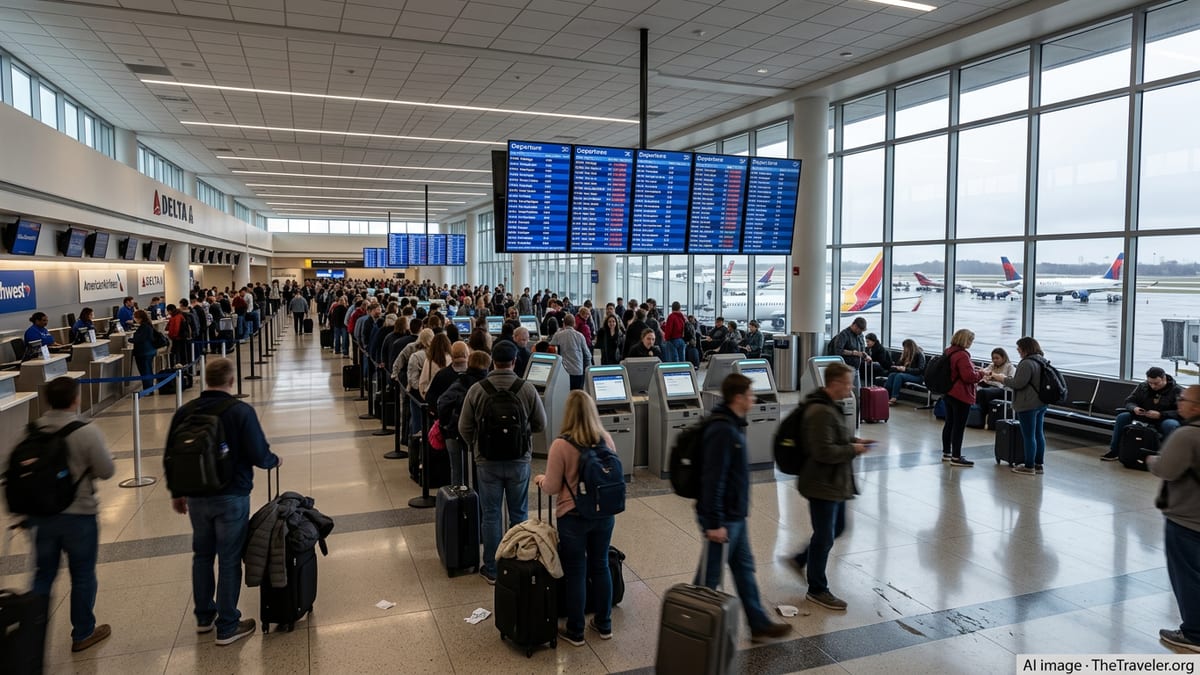
For passengers, the most immediate effects of the Nashville disruption were long queues at check-in counters and customer service desks, crowded gate areas and uncertainty about departure times. Social media posts and user-generated travel reports described travelers waiting for rolling updates on their flights while monitoring airline apps and departure boards that shifted throughout the day.
Missed connections were a recurring theme, especially for those routing through Nashville on the way to Chicago, New York or Los Angeles. With around 100 cancellations reported alongside roughly 300 delayed flights, many travelers found themselves rebooked onto later departures or routed through alternative hubs, sometimes adding many hours to their journeys.
Rebooking proved challenging on certain popular routes where remaining seats filled quickly. In some cases, passengers were offered flights on the following day or itineraries involving additional stops. Reports indicate that hotel availability near the airport tightened in the evening as stranded travelers sought last-minute accommodation, a familiar pattern during large-scale disruptions.
Families and business travelers alike faced uncertainty over important commitments at their destinations, from events and meetings to connecting international flights. Travel insurance providers and credit card travel protection benefits are expected to see increased claims from this event, particularly for those whose trips were significantly curtailed or whose expenses rose due to unplanned overnight stays and additional ground transport.
What Travelers Can Do During Ongoing Irregular Operations
With schedules still stabilizing following the Nashville disruptions, travel experts recommend that passengers keep a close eye on airline communications and remain flexible about routing. Public guidance from consumer advocates emphasizes confirming flight status frequently on the day of travel, arriving at the airport earlier than usual and preparing for potential schedule changes, especially when transiting weather-impacted regions.
For those yet to depart, monitoring alternative options to or from nearby airports, such as Louisville, Memphis or Atlanta, may provide backup plans if operations at Nashville deteriorate again. In some cases, airlines will allow same-day changes to nearby airports at reduced fees or no additional cost during formally declared irregular operations, although specific policies vary by carrier and fare type.
Passengers dealing with significant delays or cancellations are encouraged by travel rights organizations to keep records of boarding passes, receipts and written notifications, as these documents may be useful when seeking refunds, vouchers or other forms of redress. U.S. Department of Transportation guidance outlines the circumstances under which travelers may be entitled to a refund when flights are canceled or schedules are substantially changed.
As airlines work through the backlog of displaced passengers and reposition aircraft and crews, residual delays may continue for at least one to two operational days beyond the initial disruption. Travelers with imminent plans involving Nashville or flights routing through affected hubs are advised to build extra cushion time into itineraries and to consider nonstop options where possible to reduce the risk of missed connections.