

More news on this day
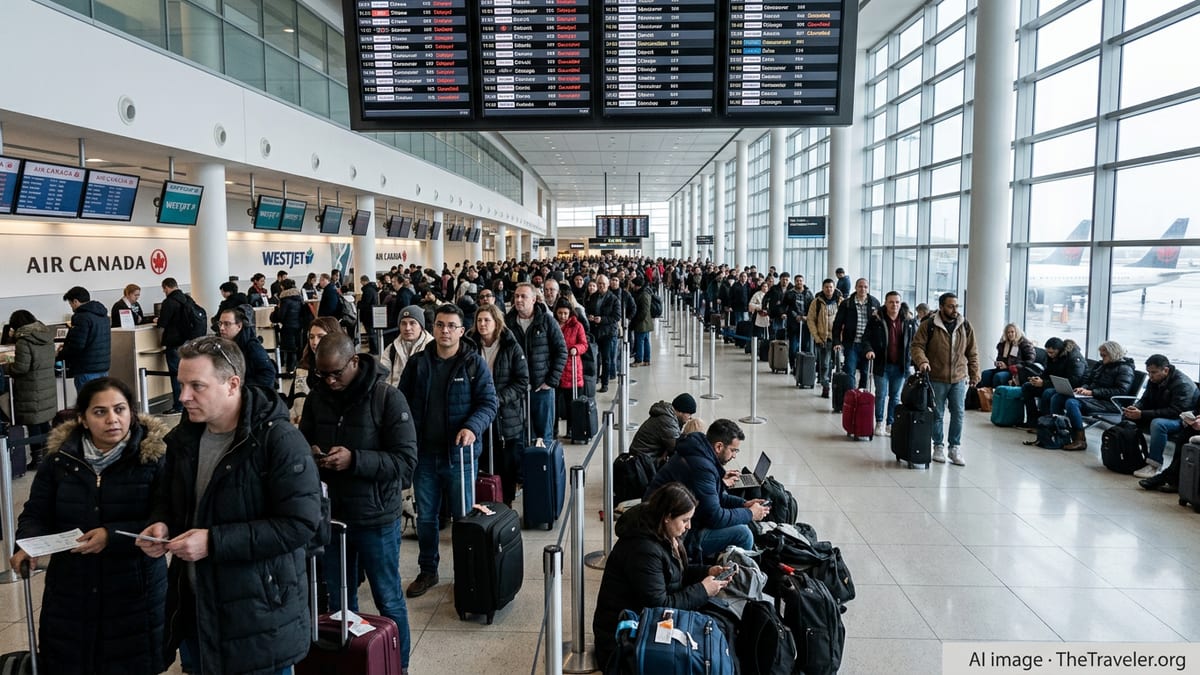
Hundreds of passengers faced cascading travel chaos on March 12 as Toronto Pearson International Airport recorded roughly 320 flight delays and 40 cancellations, triggering knock-on disruptions for Air Canada, Jazz Aviation, Porter Airlines and other carriers on routes linking Montreal, Vancouver, Ottawa, New York and several major U.S. cities.
Get the latest news straight to your inbox!
Ripple Effects Across Canada’s Busiest Air Hub
Toronto Pearson, Canada’s largest and busiest international gateway, once again became the focal point of nationwide disruption as airlines struggled to keep operations moving in the face of mounting delays. Flight-tracking data and airport operations reports on March 12 pointed to a sharp spike in schedule changes, with departures and arrivals pushed back by up to several hours and dozens of services scrubbed entirely.
The surge in disruption comes on the heels of a difficult winter and early spring for Canadian aviation, with Pearson repeatedly ranking among the world’s most affected airports during weather and operational events. Recent storms and operational bottlenecks have exposed how quickly a slowdown at Toronto can cascade through the broader network, snarling domestic links and transborder services alike.
On Tuesday, long queues formed at check in, security and airline service counters as passengers tried to rebook missed connections or secure hotel and meal vouchers. Terminal departure boards displayed a patchwork of revised departure times, rolling delays and cancellations that stretched from early morning into the evening peak.
Ground-handling capacity, aircraft rotations and tight crew schedules all contributed to the mounting delays. With aircraft and crews arriving late into Toronto from earlier flights, subsequent departures were forced into a domino pattern of knock-on disruptions that proved difficult to unwind throughout the day.
Air Canada, Jazz and Porter Bear the Brunt
Flag carrier Air Canada and its regional partner Jazz Aviation were among the hardest hit, reflecting their dominant presence at Pearson and dense schedules linking Toronto with cities across Canada and the United States. A mix of mainline and regional services faced extended ground holds, gate changes and, in some cases, outright cancellations when aircraft or crews could not be positioned in time.
Porter Airlines, which operates a growing network from both Toronto Pearson and Billy Bishop Toronto City Airport, also reported significant disruption. Short-haul flights to and from Ottawa, Montreal and select U.S. destinations experienced rolling delays, leaving passengers facing repeated schedule changes before some flights were eventually cancelled.
The strain extended beyond these three carriers to include WestJet and several international and U.S. airlines that rely on Pearson as a key Canadian gateway. With limited spare capacity available to absorb sudden schedule shifts, airlines had little room to reroute passengers quickly, resulting in congested rebooking lines and long waits to speak with customer-service agents.
Airlines reiterated that passengers should rely on official mobile apps and direct flight-status tools rather than airport screens alone, noting that gate assignments and departure times could change with little notice as operations teams attempted to rebuild the schedule in real time.
Montreal, Vancouver, Ottawa and U.S. Gateways Also Affected
The operational turbulence at Toronto Pearson rippled swiftly through other major Canadian airports. Montreal–Trudeau, Vancouver International and Ottawa International all reported clusters of delayed arrivals and departures tied to aircraft originating in or heading for Toronto, underscoring how a single congested hub can snarl an entire network.
In Montreal, passengers on morning and midday flights to Toronto, Western Canada and the United States faced rolling departure times as airlines waited for inbound aircraft and crews. Some connections to Atlantic Canada were held to protect transfer passengers from late-arriving Toronto services, while others were forced to depart without all connecting travelers on board.
Vancouver and Ottawa saw similar patterns, with delayed inbound flights from Toronto creating a shortage of aircraft for subsequent legs. In some cases, aircraft and crews arrived too late to operate later sectors within mandatory duty-time limits, prompting last-minute cancellations and forcing airlines to consolidate lightly booked flights where possible.
Across the border, U.S. gateways such as New York, Chicago, Washington and Boston reported traffic impact as Canadian carriers struggled to keep transborder schedules intact. Northbound passengers from these cities contended with long ground holds while flights awaited improved flow rates into Toronto’s congested airspace and clearance from Canadian air traffic control.
Passengers Confront Long Waits, Missed Connections and Compensation Questions
For travelers, the operational challenges translated into practical headaches: missed connections, extended tarmac waits, overnight holds and uncertainty about when they would reach their final destination. Families returning from school breaks, business travelers heading to key meetings and visitors with tightly timed itineraries all reported multi-hour delays and, in some cases, unplanned overnight stays.
Lines built quickly at airline service counters as passengers sought rebooking options, hotel accommodation and meal vouchers. With call centers and online chat channels also inundated, many reported waiting hours to speak with an agent. Some travelers opted to abandon air plans entirely on shorter routes, turning to rail or rental cars for last legs between cities such as Toronto, Ottawa and Montreal.
The latest wave of disruption has renewed attention on passenger rights and compensation, particularly under Canada’s Air Passenger Protection Regulations. Eligibility depends on the cause of each delay or cancellation and whether it is deemed within an airline’s control. Consumer advocates urged passengers to keep boarding passes, receipts and written notifications from carriers so they can submit claims once they reach their destination.
Travel agents and frequent travelers also emphasized the importance of building longer connection windows through Toronto during peak winter and early spring months, noting that tightly timed transfers are particularly vulnerable when Pearson experiences weather or operational slowdowns.
Operational Strain Highlights Systemic Vulnerabilities
Industry analysts say the latest disruptions at Toronto Pearson reinforce structural vulnerabilities that have emerged over several recent weather and operational events. A combination of tightly wound schedules, limited spare aircraft and crews, and infrastructure stretched near capacity at peak times means there is little margin for error when conditions deteriorate.
Recent cold snaps, snowfalls and low-visibility events across Southern Ontario and Quebec have underscored how sensitive airport operations can be to even modest shifts in weather, especially when combined with ground-handling constraints and air traffic control flow restrictions. Once delays accumulate early in the day, they often persist well into the evening, affecting travelers far from the original point of disruption.
Airlines and airport authorities have pledged to review their response plans, including staffing levels, deicing capacity, and contingency protocols for tarmac holds and mass rebookings. Technology investments, such as more proactive passenger-notification systems and dynamic re-routing tools, are also being evaluated as carriers search for ways to recover more quickly from shock events.
For now, though, travelers passing through Toronto Pearson and its key partner airports are being advised to monitor flight status closely, allow extra time for connections, and prepare for the possibility of schedule changes as airlines work to restore normal operations in the days ahead.