

More news on this day
Thousands of passengers across China are facing widespread flight delays and cancellations this week as powerful storms and knock-on operational issues disrupt schedules at major hubs including Guangzhou, Shanghai, Beijing and Shenzhen.
Get the latest news straight to your inbox!
Storm Systems Batter Southern China’s Aviation Heartland
Recent severe weather in southern China has emerged as a key trigger for the current wave of disruption at major airports. Publicly available aviation data and travel industry reports indicate that Guangzhou Baiyun International Airport has experienced some of the country’s highest delay and cancellation rates in recent days, with delay rates reported near 90 percent during the worst of the storms.
Meteorological reports describe intense convective systems bringing heavy rain, strong winds and hail across Guangdong Province and the wider Pearl River Delta. These conditions have periodically made safe takeoffs and landings difficult, forcing ground holds and approach diversions at Guangzhou and nearby airports. As one of China’s primary domestic and international hubs, any reduction in capacity at Guangzhou rapidly tightens the aviation network.
The storms have coincided with a period of elevated spring travel demand, magnifying their impact. Airlines operating dense schedules through southern China’s hubs have had little slack to recover, so individual weather-related delays have cascaded into missed connections and crew time-limit constraints. This has left aircraft and staff out of position across the country, complicating efforts to restore normal operations even when local weather improves.
Observers in China’s state and commercial media have linked the severity of recent convective weather in the south to broader climate trends. The instability underscores how increasingly volatile regional weather patterns are intersecting with already high traffic volumes to create acute vulnerabilities at key aviation choke points.
Guangzhou, Shenzhen, Shanghai and Beijing See Massive Knock-On Delays
Travel industry tallies compiled over the last several days show that China’s four most important aviation city clusters Guangzhou, Shenzhen, Shanghai and Beijing are bearing the brunt of the disruption. Aggregated figures from flight-tracking and tourism outlets point to thousands of delays and several hundred cancellations within a 24-hour window, affecting both domestic and international services.
Guangzhou Baiyun and Shenzhen Bao’an in the south have recorded some of the highest disruption levels, with reports of hundreds of delayed departures and scores of canceled flights at each airport in a single day. Shanghai’s dual airports, Pudong and Hongqiao, have also seen heavy schedule upsets, particularly on trunk routes that connect eastern China with the Pearl River Delta and the capital region.
In Beijing, both Capital International Airport and Daxing International Airport have reported significant delays and dozens of cancellations as the nationwide disruption radiates outward. Although the most severe weather has focused on southern provinces, the interconnected nature of airline schedules means aircraft arriving late from affected regions reduce available capacity in northern and western China as well.
Airlines including China Southern, China Eastern, Air China, Hainan Airlines and several low cost and regional carriers are listed in open flight data as experiencing large numbers of affected services. While some airports have begun to show improvement during off-peak hours, the volume of displaced aircraft and crews means that recovery has been uneven, with new waves of delays emerging as schedules compress later in the day.
Domestic and International Routes Disrupted Across Asia
The disruption at Chinese hubs is rippling well beyond the country’s borders. Published travel industry coverage indicates that cancellations and delays at Guangzhou, Shanghai, Beijing and Shenzhen are affecting long haul links to the Middle East and Southeast Asia and regional connections across East Asia.
Routes between China and destinations such as Dubai and other Gulf cities, Bangkok and other Thai gateways, and major Japanese and Korean airports have all reported schedule changes tied to aircraft originating from Chinese hubs. Passengers on multi leg itineraries through China’s large transfer airports have been particularly exposed, with missed connections and overnight misalignments forcing widespread rebooking.
Some of these international disruptions overlap with separate regional challenges, including recent jet fuel supply tightness reported at several Asian hubs and earlier weather related slowdowns in Japan and Southeast Asia. While the current Chinese hub disruption is primarily linked to domestic storm systems, the broader regional context has limited the ability of airlines to quickly borrow spare capacity or reroute traffic through third country hubs.
As a result, the operational strain is being felt not only by Chinese carriers but also by foreign airlines that rely on Chinese airports as key spokes or stopover points. Timetables for the early spring season, which had been ramping up to meet strong leisure and business travel demand, are now being revised on short notice as carriers work around slot and crew constraints.
Passengers Face Long Queues, Rebookings and Limited Alternatives
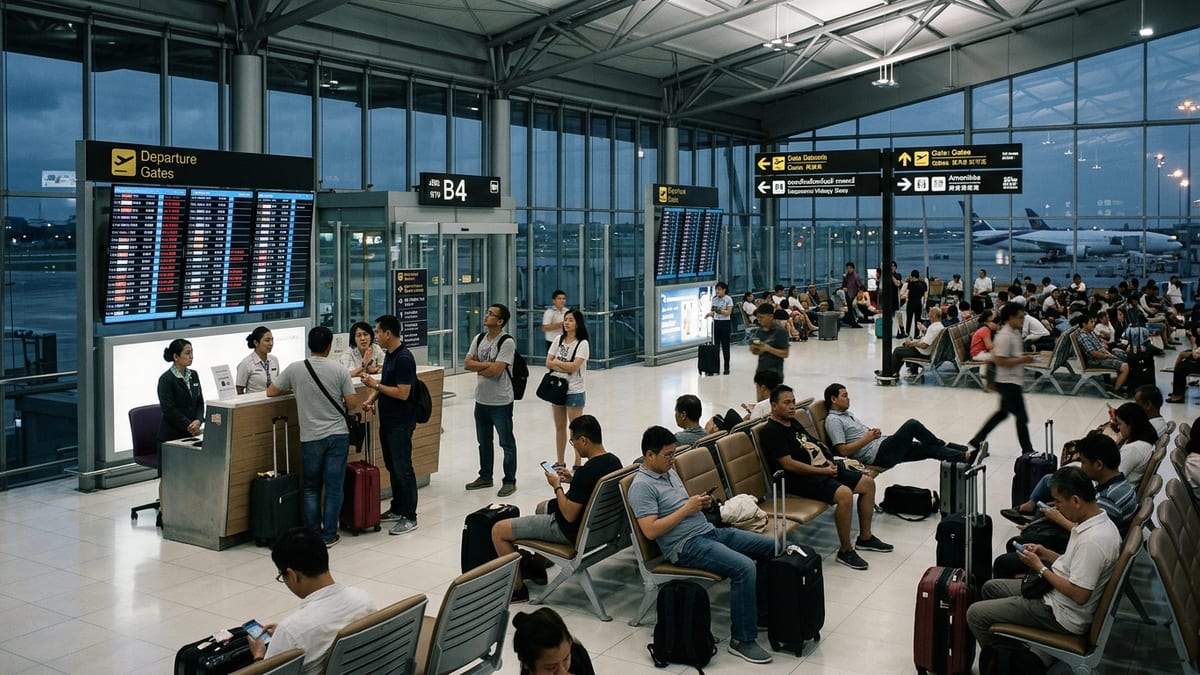
Reports from travel platforms and local media describe crowded terminals, long check in and security lines, and congested customer service counters at several major Chinese airports. With so many flights affected simultaneously, travelers have faced limited same day alternatives, especially on popular trunk routes where remaining seats have quickly sold out.
Many passengers are being shifted to later flights or alternate routings via less congested airports, but the sheer volume of delays and cancellations has meant that some rebookings extend into subsequent days. Hotel and ground transport demand around affected hubs has increased as stranded travelers seek last minute accommodation and alternative ways to reach nearby cities by high speed rail or long distance bus.
Publicly available guidance from airlines and airports emphasizes the importance of checking flight status frequently, using mobile apps and official information boards before traveling to the airport, and allowing additional time for check in and security procedures. Flexible ticket policies and fee waivers have been introduced by some carriers for flights touching the hardest hit airports, although conditions vary by airline and fare type.
Travel advisors suggest that passengers with critical time sensitive commitments build in additional buffers for trips involving southern China over the coming days, and consider early morning departures where possible, as these are sometimes less affected by knock on delays from the previous operating day.
Outlook: Recovery Tied to Weather Windows and Network Flexibility
Meteorological forecasts for southern China indicate periods of continued unsettled weather interspersed with calmer intervals, suggesting that recovery at major hubs may progress in stages rather than in a single, rapid normalization. Aviation analysts following the region note that large backlogs of delayed aircraft and crews can take several operating cycles to unwind even once weather conditions improve.
Chinese carriers have been steadily rebuilding capacity on domestic and international networks since pandemic restrictions eased, which has increased overall system utilization. While this growth has supported strong tourism and business travel, it has also reduced available spare aircraft and crew resources. In the current disruption, that tighter operating margin appears to be lengthening the time needed to restore full schedules.
For travelers planning near term journeys through Guangzhou, Shenzhen, Shanghai or Beijing, the most recent flight information from airlines and airport operators will be critical. Industry observers expect that once a sustained weather improvement window opens, airlines will prioritize restoring core domestic trunk routes and key international links before gradually re inserting lower frequency services.
Given the combination of volatile spring weather patterns and a busy travel calendar, travel planners and corporate buyers are watching how Chinese hubs manage the present disruption as an indicator of resilience for the broader East Asian aviation network in the months ahead.