

More news on this day
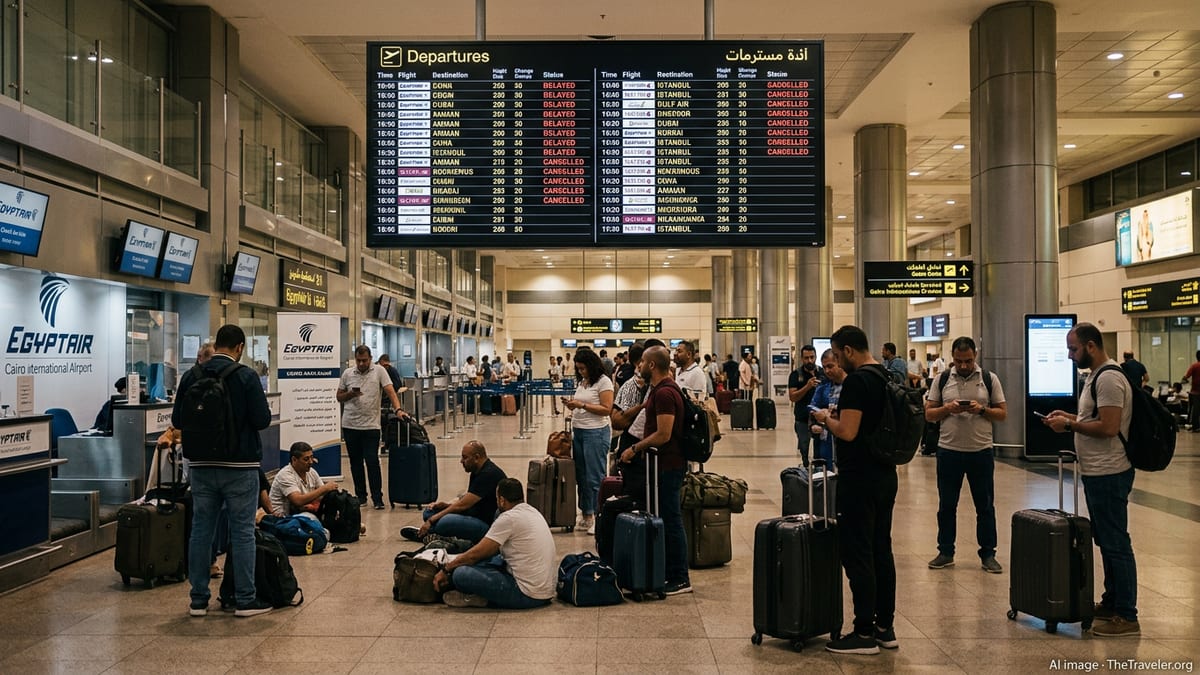
Passengers at Cairo International Airport have faced mounting disruption as dozens of flights to Doha, Dubai, Amman and Istanbul operated by EgyptAir, Gulf Air, Qatar Airways and other regional carriers were delayed or cancelled, straining already busy winter travel schedules across the Middle East.
Get the latest news straight to your inbox!
Wide-Ranging Disruptions Across Regional Routes
Publicly available flight-tracking data and local media reports indicate that Cairo International Airport has recorded 94 delayed departures and 32 cancellations on services bound for key regional hubs including Doha, Dubai, Amman and Istanbul. The disruption has affected both national carrier EgyptAir and a number of foreign airlines that operate heavily trafficked links between Egypt and the wider Middle East.
The affected routes connect Cairo with some of the region’s busiest transit airports, amplifying the knock-on impact for travelers with onward long-haul connections to Europe, Asia and North America. Delays of more than two hours have been reported on multiple departures, with some services rescheduled repeatedly before being cancelled altogether.
While the precise breakdown by airline continues to shift as schedules are adjusted, EgyptAir’s own network has been particularly exposed because of its extensive frequencies to Gulf gateways. Flights operated by Gulf Air, Qatar Airways and other carriers serving Doha and Dubai have also experienced rolling delays as turnarounds and crew rotations are disrupted at Cairo.
Published coverage suggests that the pattern of irregular operations is not limited to a single day’s schedule, with late-running flights and equipment changes cascading into subsequent rotations. This has left passengers facing extended waits in terminals and uncertainty over connection times at onward hubs.
Operational Strain and Airspace Constraints
A combination of operational challenges and regional airspace constraints appears to be driving the wave of disruption. Aviation analysis shared in recent days points to heightened congestion on certain Middle Eastern corridors, as carriers adjust routings and flight levels around sensitive areas, extending block times and squeezing already tight schedules.
These longer routings can have a disproportionate effect on airports such as Cairo that act as intermediate points on flows between Africa, the Gulf and South Asia. When aircraft arrive late from upstream sectors, departures to destinations like Doha, Dubai, Amman and Istanbul are more likely to miss their targeted slots, forcing ground holds and re-sequencing.
Operational strain at Cairo itself is also a factor. With winter demand and a growing volume of transfer traffic, turnaround buffers have thinned. Industry observers note that even minor technical issues or crew duty limits can quickly lead to compounding delays when multiple flights are scheduled within narrow time banks to the same regional hubs.
According to aviation data platforms, some of the longest disruptions have involved aircraft that had already been delayed on earlier segments, highlighting how small schedule shocks can ripple across networks spanning several countries and time zones.
Impact on Passengers and Downstream Connections
For travelers, the most immediate effect of the disruption has been extended waiting times at Cairo International Airport and at onward hubs. Passengers connecting through Doha, Dubai, Amman and Istanbul to long-haul destinations have reported missed connections and involuntary overnight stays as minimum connection times are breached by late-arriving feeder flights.
Reports from traveler forums describe disrupted itineraries where a delayed Cairo departure to Doha or Dubai results in a cascade of rebookings across multiple airlines, especially when tickets involve separate bookings or complex multi-stop journeys. In such cases, re-accommodating passengers can be more challenging and may require manual intervention at airport ticket desks.
Publicly available information from customer advisories stresses the importance of monitoring flight status in real time and arriving at the airport only once a departure is confirmed, particularly for evening and overnight services that are more vulnerable to rolling knock-on delays. Travelers with essential connections are being encouraged to allow for additional buffer time or to consider earlier departures where possible.
At the same time, consumer advocates point out that passengers may have varying levels of protection depending on their origin, ticket type and operating carrier. While some travelers can be rebooked on the next available flight at no extra cost, others may face more limited options if their journey involves separate tickets or non-refundable fares.
Responses from Airlines and Airport Stakeholders
Airlines with a strong presence at Cairo have begun adjusting schedules and aircraft assignments in an effort to stabilize operations. According to timetable data and airline notices, selected frequencies to Doha, Dubai, Amman and Istanbul have been consolidated or retimed to create more robust turnaround windows, reducing the risk of repeated late departures.
EgyptAir has restructured some of its wave patterns to key Gulf destinations, pairing aircraft rotations differently so that long-haul arrivals feed into slightly later departures. Gulf-based carriers operating to Cairo have also implemented tactical adjustments, such as swapping aircraft types or combining lightly booked services, to ease pressure on crewing and maintenance.
Airport stakeholders at Cairo are working within these revised schedules to manage gate assignments and ground handling resources. Operational updates circulated in aviation channels suggest efforts to prioritize flights with high volumes of connecting passengers or those feeding into limited-frequency long-haul services.
Ground-handling teams are under particular strain as they handle late-night and early-morning peaks that now include an elevated number of off-schedule aircraft. This can affect everything from baggage delivery times to coach transfers between remote stands and terminal buildings, adding further complexity to an already stressed operation.
Outlook for Travelers Planning Upcoming Trips
Looking ahead, available schedule information indicates that airlines are aiming to gradually restore greater punctuality on Cairo routes to Doha, Dubai, Amman and Istanbul by smoothing peak periods and allowing more generous buffers for potential airspace-related delays. However, analysts caution that conditions remain fluid across parts of the region’s airspace, meaning further irregular operations cannot be ruled out.
Travelers planning to transit through Cairo in the coming days are advised, based on published travel guidance, to build additional flexibility into their itineraries. This may include opting for longer connection times at onward hubs, avoiding tight back-to-back connections, and ensuring that contact details are up to date in airline bookings so that rebooking notifications can be received promptly.
For those yet to purchase tickets, publicly available consumer advice suggests favoring single-ticket itineraries on one or two allied carriers rather than stitching together separate bookings. Such arrangements typically give travelers stronger rebooking options when disruptions occur on one segment, particularly on complex routings that pass through multiple hubs.
While the current wave of delays and cancellations at Cairo International Airport highlights the vulnerability of regional air travel to both local operational factors and wider airspace dynamics, airlines and airport partners continue to adjust schedules and resource plans in an attempt to keep critical links to Doha, Dubai, Amman and Istanbul functioning for business and leisure travelers alike.